
The Acceleration of Space-Based Broadband: Implications for Investors in the Satellite and 5G Sectors


 Aime Summary
Starlink's Aviation Breakthrough: A Case Study in Strategic Expansion
According to Bloomberg, SpaceX has secured a pivotal agreement with Emirates to deploy Starlink-powered in-flight Wi-Fi across its widebody fleet, starting with BoeingBA-- 777s in November 2025 and extending to Airbus A380s by early 2026. This partnership, which will equip approximately 14 aircraft monthly, highlights Starlink's ability to penetrate niche markets where traditional telecom providers struggle. The aviation sector alone represents a $2.3 billion global market for in-flight connectivity, and Starlink's low-latency, high-bandwidth capabilities position it to capture a significant share.
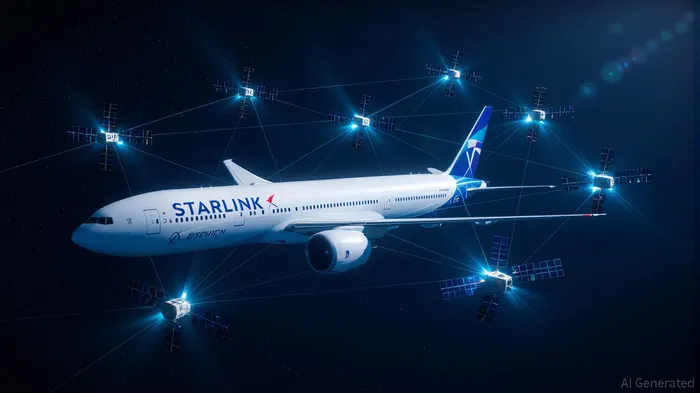
This move also signals a broader trend: the integration of satellite networks into hybrid 5G ecosystems. As terrestrial networks face challenges in rural and remote areas, space-based solutions like Starlink are filling gaps, creating a dual-layer infrastructure that enhances redundancy and scalability. For investors, this hybrid model suggests a shift in capital flows toward companies that can bridge the digital divide through orbital assets.
Strategic Implications for Telecom and 5G Sectors
The telecom industry is at a crossroads. While 5G rollout continues, its limitations in coverage and cost per user are becoming apparent. Starlink's recent satellite launches-part of its fifth-generation V2+ fleet-likely include advanced phased-array antennas and laser crosslinks, enabling faster data transfer and reduced reliance on ground stations. Though technical specifications for the November 2025 batch remain undisclosed, industry observers note that these satellites are critical for achieving Starlink's ambition of 8,000+ satellites in orbit by 2027.
The investment community is taking notice. Analysts at Morgan Stanley recently upgraded their outlook for satellite-as-a-service (SaaS) models, projecting a 15% CAGR in revenue for firms leveraging low-Earth-orbit (LEO) constellations between 2025 and 2030. This growth is driven by demand from not just aviation but also maritime, emergency response, and rural broadband markets. For traditional telecom providers, the challenge is clear: adapt by integrating satellite backhaul into their networks or risk obsolescence.
Long-Term Viability: Disruption or Coexistence?
Space-based broadband's long-term appeal lies in its potential to democratize access. With Starlink's user base surpassing 2.5 million in late 2025, the economics of scale are beginning to materialize. However, regulatory hurdles-such as spectrum allocation disputes and concerns over orbital debris-remain unresolved. Investors must weigh these risks against the transformative potential of a globally connected world.
For now, the Emirates deal and Starlink's satellite cadence suggest a company in hypergrowth mode. While technical details on the November 2025 launch are sparse, the strategic implications are unmistakable: space is no longer a frontier for science fiction but a critical infrastructure asset.
Conclusion
The acceleration of space-based broadband is redefining connectivity, with SpaceX leading the charge. For investors, the key takeaway is the need to diversify portfolios beyond traditional telecom stocks and consider exposure to satellite infrastructure, LEO constellations, and hybrid 5G ecosystems. As Starlink's global partnerships expand, so too does the investment case for next-gen infrastructure-provided stakeholders navigate regulatory and technical challenges effectively.

Delivering real-time insights and analysis on emerging financial trends and market movements.
Latest Articles
Stay ahead of the market.
Get curated U.S. market news, insights and key dates delivered to your inbox.




Comments
No comments yet