
The Acceleration of 5G SA and Its Impact on the Mobile Core Network Market
 Aime Summary
The telecommunications industry is undergoing a seismic shift as 5G Standalone (SA) deployments surge ahead of schedule. With the global 5G SA market valued at $3.67 billion in 2025 and projected to grow at a 55.6% CAGR through 2030, the transition from non-standalone (NSA) to SA architectures is no longer a theoretical exercise—it's a race for dominance in the next-gen telecoms landscape. For investors, this represents a pivotal inflection point: capital is flowing into infrastructure providers, cloud enablers, and edge computing ecosystems at an unprecedented rate. But what exactly is driving this acceleration, and where should capital be allocated to capture long-term value?
The Surge in 5G SA Deployments: A Catalyst for Capital Reallocation
The shift to 5G SA is being fueled by the need for ultra-low latency, high reliability, and scalable connectivity to support use cases like industrial automation, autonomous vehicles, and smart cities. Unlike NSA, which relies on 4G infrastructure, SA operates on a fully independent 5G core, enabling network slicing and edge computing integration. By 2025, 115 operators across 52 countries are investing in SA networks, with Europe, Asia-Pacific, and North America leading the charge.
For example, in the U.S., T-MobileTMUS-- and VerizonVZ-- are prioritizing SA for enterprise Fixed Wireless Access (FWA) and industrial IoT, while China's telecom giants are building SA networks to underpin AI-driven manufacturing and smart grid projects. The financial implications are clear: operators are raising tariffs (e.g., 10–27% hikes in India) to fund infrastructure, and the market for 5G SA equipment is expected to reach $43.5 billion by 2025.
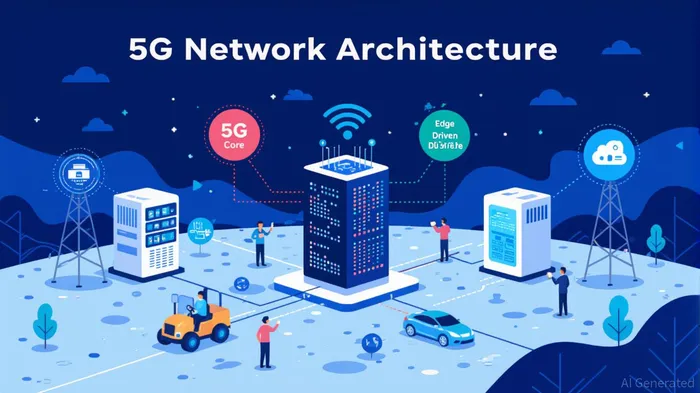
Network Slicing: The New Frontier of Monetization
Network slicing is the linchpin of 5G SA's value proposition. By creating virtual networks tailored to specific use cases, operators can charge premium rates for performance guarantees. For instance, a slice optimized for remote surgery might prioritize latency and reliability, while a slice for augmented reality gaming could focus on high throughput.
Recent case studies, such as the AR gaming application in central Europe, demonstrate how AI-driven slicing dynamically allocates resources based on real-time demand. These slices, combined with edge computing, reduce latency to under 16 milliseconds—a critical threshold for applications like autonomous vehicles. The market for network slicing is expected to grow at a 41.7% CAGR through 2034, reaching $675.9 billion.
AI-Driven Core Optimization: The Invisible Engine of Efficiency
Artificial intelligence is no longer a buzzword in telecoms—it's a necessity. AI algorithms optimize 5G SA cores by predicting traffic patterns, automating resource allocation, and identifying faults before they impact users. For example, Ericsson's AI-powered network management systems reduced operational costs by 30% for one European operator by minimizing manual interventions.
The financial impact is significant. AI-driven optimization cuts capital expenditures (CapEx) by up to 20% and boosts return on investment (ROI) through improved service reliability. As AI adoption in telecoms grows—projected to reach $12.5 billion by 2027—companies like QualcommQCOM-- and Huawei are positioning themselves as key players in AI-enabled 5G infrastructure.
Edge Computing: Bridging the Gap Between Cloud and Device
Edge computing is the final piece of the 5G SA puzzle. By decentralizing data processing, edge nodes reduce latency and enable real-time decision-making for applications like robotics and smart grids. In 2025, edge computing integration with 5G SA is expected to create a $20 billion market opportunity, with companies like AWS and MicrosoftMSFT-- Azure expanding their edge offerings.
The strategic value for investors lies in the symbiosis between telecom providers and cloud enablers. For example, T-Mobile's partnership with AWS to deploy edge nodes at cell towers is a blueprint for monetizing distributed computing. Similarly, Verizon's Edge Cloud solutions for enterprise clients highlight how telecoms can transition from connectivity providers to full-service infrastructure players.
Strategic Investment Opportunities and Risks
The acceleration of 5G SA is reshaping capital allocation for telecom providers and cloud enablers. Key opportunities include:
1. Infrastructure Providers: Companies like EricssonERIC--, NokiaNOK--, and Huawei are securing multi-billion-dollar contracts to supply 5G SA hardware. Their ability to deliver open RAN (O-RAN) solutions will be critical to mitigating vendor lock-in risks.
2. AI and Edge Computing Firms: Investments in AI-driven network optimization and edge computing platforms (e.g., NVIDIANVDA--, Intel) are poised to outperform as 5G SA adoption accelerates.
3. Private 5G Networks: The market for enterprise-grade 5G solutions is growing at 54.3% CAGR, with operators like VodafoneVOD-- and AT&T leading the charge.
However, challenges remain. Interoperability issues, security vulnerabilities, and the high cost of spectrum licenses could slow adoption. Investors must also watch for regulatory shifts, particularly in regions like the EU and China, where government policies heavily influence 5G deployment.
Conclusion: Positioning for Long-Term Returns
The 5G SA revolution is not just about faster internet—it's about redefining the role of telecoms in the digital economy. For investors, the key is to focus on companies that can bridge the gap between connectivity, compute, and AI. While short-term volatility is inevitable, the long-term trajectory is clear: 5G SA will drive a $33.43 billion mobile core network market by 2030, with edge computing and AI amplifying its value.
In this high-stakes race, early movers in infrastructure, AI, and edge computing will reap the rewards. The question isn't whether to invest—it's where to position for the next decade of growth.

Delivering real-time insights and analysis on emerging financial trends and market movements.
Latest Articles
Stay ahead of the market.
Get curated U.S. market news, insights and key dates delivered to your inbox.




Comments
No comments yet