
The Accelerating Space Economy and Its Implications for Investors


 Aime Summary
The Falcon 9 and Starlink: A Dual-Engine for Cost Reductions and Market Growth
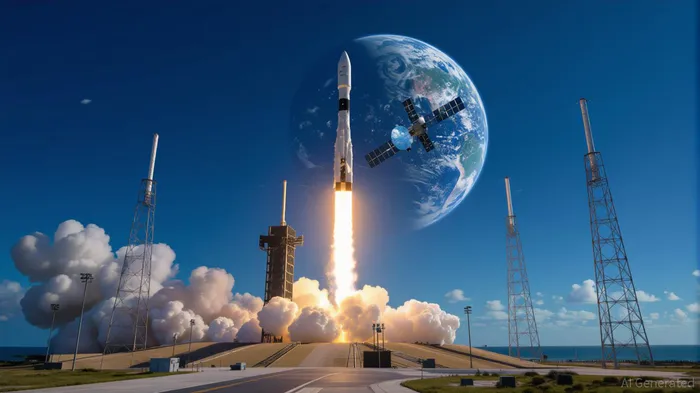
SpaceX's ability to execute frequent, cost-effective launches has been a game-changer. The Falcon 9's reusability has slashed per-launch expenses, enabling the company to deploy Starlink satellites at an unprecedented scale. In 2025, SpaceX plans to double down on this strategy with dual Falcon 9 Starlink missions, such as the pair of launches scheduled for the week following November 14, 2025 as reported by Morningstar. These missions are part of a broader effort to expand Starlink's global broadband network, which now serves remote regions in India, Africa, and beyond.
The economic implications are profound. , according to Barrons analysis. This scalability is critical for companies building large constellations, as it reduces capital expenditures and accelerates time-to-market. For instance, partnerships like the one between Starlink and Cambium Networks-enabling unified management of satellite and terrestrial networks-highlight how infrastructure advancements are making space-based services more accessible to operators according to market reports.
Strategic Partnerships and Market Expansion
The maturation of the space economy is also evident in the growing number of strategic alliances. In India, Maharashtra's partnership with Starlink aims to bridge the digital divide in rural areas, aligning with national broadband goals as reported by Economic Times. Similarly, South Africa's Vodacom has integrated Starlink into its mobile network to enhance rural connectivity in Africa as Bloomberg reports. These collaborations underscore how satellite broadband is no longer a niche offering but a critical infrastructure layer for global connectivity.
Emerging markets are not the only beneficiaries. In aviation, Emirates' pending adoption of Starlink for in-flight Wi-Fi on 250 widebody aircraft represents a major win for the company, positioning it as a leader in premium connectivity according to . Such partnerships not only validate Starlink's reliability but also open new revenue streams for SpaceX, further diversifying its business model.
Competition and the Path to Commercialization
While SpaceX dominates the launch market, competition is intensifying. Blue Origin's recent success in landing its New Glenn rocket's first-stage booster marks a critical step toward reusable technology, challenging SpaceX's cost leadership as Morningstar reports. Meanwhile, smaller players like Rocket Lab and Firefly Aerospace are innovating in niche markets, though their lower payload capacities (compared to the Falcon 9) highlight SpaceX's structural advantage according to Barrons analysis.
This competitive landscape is driving innovation and reducing barriers to entry. As launch costs decline, more companies can afford to deploy satellites for applications ranging from Earth observation to climate monitoring. For investors, this means a broader pipeline of opportunities in satellite manufacturing, ground infrastructure, and data analytics.
Investment Implications: Where to Allocate Capital
The accelerating space economy offers multiple avenues for investment:
1. Aerospace Technology: Companies developing reusable rockets, advanced propulsion systems, or satellite manufacturing automation.
2. Satellite Services: Firms integrating space-based connectivity into terrestrial networks, such as Cambium NetworksCMBM-- or Vodacom.
3. Launch Systems: Players optimizing launch cadence and cost, including SpaceX's competitors and suppliers.
However, risks remain. Regulatory hurdles, technical challenges in satellite longevity, and geopolitical tensions could slow growth. Investors must also consider the environmental impact of increased space debris and the sustainability of satellite constellations.
Conclusion
The maturation of the commercial space sector, exemplified by SpaceX's Falcon 9 and Starlink operations, is reshaping the economic landscape of space. With dual launches, strategic partnerships, and reusable technology driving down costs, the sector is transitioning from a niche frontier to a mainstream market. For investors, this represents a unique window to capitalize on infrastructure development and next-gen satellite services-provided they navigate the risks with a long-term, diversified approach.

Delivering real-time insights and analysis on emerging financial trends and market movements.
Latest Articles
Stay ahead of the market.
Get curated U.S. market news, insights and key dates delivered to your inbox.




Comments
No comments yet