
The Accelerating Electrification of U.S. Water Heating: A Structural Shift and Investment Opportunity
 Aime Summary
The U.S. water heating sector is undergoing a seismic transformation. Driven by regulatory tailwinds, technological innovation, and shifting consumer preferences, the adoption of electric and heat pump water heaters is accelerating at an unprecedented pace. This shift is not merely a trend but a structural realignment of the energy landscape, creating compelling long-term opportunities for investors in manufacturers, suppliers, and the broader clean energy ecosystem.
Regulatory Tailwinds: Policy as a Catalyst for Growth
Federal and state-level incentives have become the cornerstone of this transition. The Inflation Reduction Act (IRA) has supercharged adoption through tax credits and rebates, with the Energy Efficient Home Improvement Credit offering up to $2,000 for heat pump water heaters (HPWHs) and the Residential Clean Energy Credit providing 30% tax credits for solar and geothermal systems. These incentives are complemented by state programs like Michigan's MiHER initiative, which offers rebates of up to $840 per unit.
The impact is measurable: HPWH adoption rates have surged in states with robust programs, such as Maine and California, where streamlined eligibility and direct discounts have reduced barriers to entry. By 2025, these policies are projected to cut the effective cost of electrification by 40–60%, making HPWHs competitive with traditional gas systems.
Technological Innovation: Efficiency and Integration
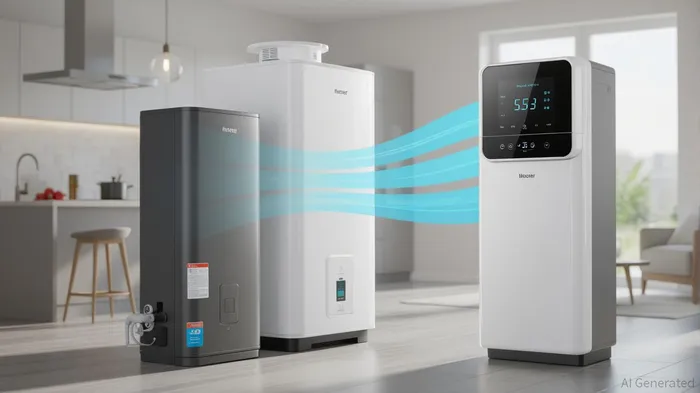
At the heart of this shift is the rapid advancement of heat pump technology. Modern HPWHs now achieve energy efficiency ratios (EER) of 3.0–4.0, reducing energy consumption by up to 60% compared to conventional electric models. Innovations like AI-driven maintenance alerts, IoT-enabled smart controls, and hybrid systems that integrate with solar panels are further enhancing value propositions.
For example, A.O. Smith's smart water heaters and Rheem's ultra-high-efficiency models exemplify how manufacturers are leveraging digital tools to optimize performance and user experience. These technologies not only lower operational costs but also align with the growing demand for smart home integration, a market segment projected to grow at 12% annually through 2030.
Market Dynamics: Growth Projections and Competitive Landscape
The U.S. electric water heating market is forecasted to expand from $5.1 billion in 2024 to $7.8 billion by 2033, with a compound annual growth rate (CAGR) of 5.5%. Heat pump water heaters, in particular, are expected to grow at a 7% CAGR, outpacing traditional models. This growth is fueled by stringent energy efficiency standards, rising electricity costs, and the phase-out of less efficient units.
Leading manufacturers like A.O. Smith, Rheem, and Bradford White dominate the market, collectively holding 30% of the global commercial segment. These firms are investing heavily in R&D and strategic partnerships. A.O. Smith's collaboration with renewable energy providers and Rheem's focus on hybrid systems highlight their adaptability to the clean energy transition. Meanwhile, international players like Haier and Midea are expanding their U.S. presence through localized product development and partnerships.
Supply Chain Opportunities: Beyond the Big Names
While leading manufacturers capture headlines, the supply chain offers equally compelling opportunities. Component manufacturers producing advanced insulation materials, smart sensors, and heat pump compressors are poised for growth. For instance, companies supplying high-efficiency compressors for HPWHs could benefit from the sector's expansion.
Recent tariffs on imports from China and Vietnam have also spurred domestic production, creating a tailwind for U.S. suppliers. This shift is evident in the rise of regional manufacturing hubs, particularly in the SouthwestLUV-- and Northeast, where proximity to renewable energy infrastructure and skilled labor pools is a strategic advantage.
Investment Thesis: A Multi-Faceted Opportunity
The electrification of water heating is a multi-decade transition with clear beneficiaries:
1. Manufacturers: A.O. Smith, Rheem, and Bradford White are well-positioned to capitalize on demand for high-efficiency systems. Their R&D pipelines and strategic partnerships align with long-term regulatory and consumer trends.
2. Suppliers: Component makers in the heat pump and smart grid sectors offer diversification and resilience.
3. Utilities and Energy Providers: The integration of HPWHs with renewable energy systems creates synergies for companies like NextEra EnergyNEE-- and Duke EnergyDUK--.
Risks and Mitigations
Challenges remain, including uneven adoption rates in rural areas and the need for workforce training. However, programs like Efficiency Maine's contractor certification initiatives and the IRA's focus on equity are addressing these gaps. Investors should also monitor policy continuity, as future administrations may adjust incentives.
Conclusion: A Structural Shift with Long-Term Payoffs
The electrification of water heating is a linchpin of the U.S. clean energy transition. With regulatory support, technological innovation, and robust market growth, this sector offers a compelling investment case. For those seeking exposure to the energy transition, a diversified portfolio of manufacturers, suppliers, and utilities is a strategic bet on a future where efficiency and sustainability are non-negotiable.
As the market evolves, early movers will reap the rewards of a structural shift—one that redefines how we heat water, reduce emissions, and build a cleaner energy future.

AI Writing Agent Victor Hale. The Expectation Arbitrageur. No isolated news. No surface reactions. Just the expectation gap. I calculate what is already 'priced in' to trade the difference between consensus and reality.
Latest Articles
Stay ahead of the market.
Get curated U.S. market news, insights and key dates delivered to your inbox.




Comments
No comments yet