
Academy Announces $0.13 Dividend: Market Impact and Recovery Insights on Ex-Dividend Date
 Aime Summary
Introduction
Academy has maintained a consistent approach to shareholder returns, with a dividend policy that aligns with its financial performance and broader industry norms. The company’s latest cash dividend of $0.13 per share reflects a disciplined payout strategy amid a market environment marked by moderate volatility and evolving investor expectations for yield. As the ex-dividend date of December 18, 2025, approaches, investors are closely monitoring how this payout may influence the stock’s price action and liquidity dynamics.Dividend Overview and Context
For investors, understanding the impact of dividends involves tracking key metrics such as dividend per share (DPS), payout ratio, and the stock’s behavior around the ex-dividend date. On December 18, 2025, Academy will go ex-dividend for a $0.13 cash payout, meaning investors must own shares before this date to receive the dividend. Historically, the ex-dividend date often results in a temporary drop in stock price equal to the dividend amount—though the broader context of Academy’s earnings and financial strength should be considered.The company's latest financial report highlights strong operating performance, with total revenue of $4.26 billion and operating income of $356 million. With a net income of $285 million and earnings per share of $3.95, Academy is well-positioned to sustain its current dividend level while maintaining financial flexibility.
Backtest Analysis
A historical backtest of Academy's stock price behavior following dividend announcements reveals a positive trend in price recovery. Over the past 11 dividend events, the stock has demonstrated an average recovery duration of zero days and a 100% probability of price normalization within 15 days of the ex-dividend date. This suggests a consistent and rapid rebound, mitigating the risk of prolonged price declines.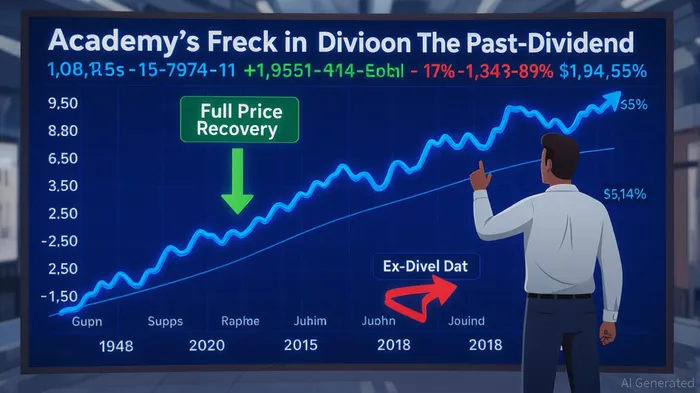
This robust price behavior is attributed to the stock's high liquidity and investor confidence in the company's long-term fundamentals. The backtest also implies that holding the stock through the ex-dividend period can capture both dividend benefits and favorable short-term price dynamics.
Driver Analysis and Implications
Academy’s ability to sustain a $0.13 dividend is underpinned by strong operating margins and efficient cost management. With operating income at $356 million and total operating expenses at $1.11 billion, the company has demonstrated a disciplined approach to expenses relative to revenue. The payout ratio, while not explicitly stated, appears to be conservative given the $3.95 EPS and $0.13 DPS—suggesting room for future dividend growth if earnings continue to expand.Broadly, Academy’s dividend strategy aligns with its capital allocation priorities and reflects a favorable macroeconomic backdrop, where investor demand for yield remains strong. As interest rates stabilize, dividend-paying stocks like Academy are likely to remain attractive to income-focused investors.
Investment Strategies and Recommendations
For investors, the December 18 ex-dividend date offers several strategic opportunities:- Short-term strategy: Investors may consider buying the stock before the ex-dividend date to capture the $0.13 dividend, particularly given the strong historical price rebound following dividend events.
- Long-term strategy: Investors with a long-term horizon should focus on Academy’s financial health, earnings momentum, and reinvestment opportunities. The low recovery time post-ex-dividend date suggests minimal downside risk when holding the stock through this period.
- Dividend reinvestment: Investors can utilize dividend reinvestment plans (DRIPs) to compound returns over time, leveraging the company’s stable payout and earnings growth.
Conclusion & Outlook
Academy’s $0.13 cash dividend on December 18 reflects a balanced approach to shareholder returns and financial discipline. Given the strong earnings backdrop and historical price recovery patterns, the ex-dividend date presents a favorable opportunity for income-focused investors. The next earnings announcement will be key for further insights into the company's performance and guidance for the upcoming year. Investors should continue to monitor Academy's capital allocation decisions and industry trends as potential catalysts for future returns.
Stay ahead of the market.
Get curated U.S. market news, insights and key dates delivered to your inbox.


AInvest
PRO
AInvest
PRO



Comments
No comments yet