
The 'Absurd' Momentum Behind BlackRock's Bitcoin ETF: How Retail and Institutional Frenzy Are Reshaping Digital Asset Adoption
 Aime Summary
The rapid ascent of BlackRock's BitcoinBTC-- ETF (IBIT) has defied conventional benchmarks, becoming the fastest ETF in history to reach $70 billion in assets under management (AUM) in just 341 days, according to a Cointelegraph report. As of September 28, 2025, IBITIBIT-- reported $86 billion in AUM, according to a CoinLive report, but by early October, it had surged to $97.8 billion, with only $2.2 billion remaining to cross the $100 billion threshold, as reported by an InsideBitcoins article. This unprecedented growth reflects a seismic shift in how institutional and retail investors perceive Bitcoin, driven by a confluence of market psychology, regulatory clarity, and macroeconomic tailwinds.
Institutional Confidence and Liquidity Dynamics
BlackRock's IBIT has become a cornerstone of institutional Bitcoin adoption. By October 2025, the ETF accounted for $5.5 billion in trading volume, signaling robust institutional participation, according to a CryptoBriefing report. This liquidity has created a self-reinforcing cycle: as more institutions allocate capital to IBIT, its market depth increases, attracting further inflows and reducing volatility. A BTCC report found the ETF's dominance in the U.S. spot Bitcoin ETF market-controlling over 60% of trading volume-has normalized Bitcoin as a portfolio asset.
The macroeconomic backdrop has amplified this trend. The Federal Reserve's rate-cut cycle in 2025, coupled with a weakening U.S. dollar, has incentivized investors to seek alternatives to traditional assets. Bitcoin's low correlation with equities and its role as a hedge against inflation have made it an attractive addition to diversified portfolios, an Invezz analysis notes. As Investopedia explains, real yields falling below zero have eroded returns on fixed income, pushing capital into risk assets like Bitcoin.
Retail Frenzy and Market Psychology
Retail investor enthusiasm has further accelerated IBIT's growth. In October 2025 alone, the ETF saw $2.29 billion in inflows over six days, including a record $969.95 million on October 6, an InsideBitcoins article reported. This surge mirrors the retail-driven momentum seen in 2023, when no-fee trading platforms and pandemic-era liquidity fueled a $1.5 billion-per-day average inflow into U.S. stocks, as shown in a Visual Capitalist chart. Today, platforms like Robinhood-boasting 25.2 million funded accounts-have democratized access to Bitcoin ETFs, enabling retail investors to participate in what WorldForexCrypto calls a "hedge against economic and political risks."
Market psychology has also played a role. The SEC's 2025 approval of spot Bitcoin ETFs eliminated regulatory uncertainty, transforming Bitcoin from a speculative asset into a mainstream investment vehicle, as noted in a TS2 Tech analysis. This legitimacy has reduced perceived risks, particularly among first-time investors. As InsideBitcoins observes, IBIT's AUM growth trajectory-surpassing traditional ETFs like Vanguard's S&P 500 ETF (VOO), which took over 2,000 days to reach $70 billion-highlights Bitcoin's newfound credibility, a trend also reflected in a BeinCrypto article.
Macroeconomic Tailwinds and the Road to $100 Billion
The macroeconomic environment remains a tailwind for Bitcoin's adoption. Global asset managers, including BlackRockBLK--, have positioned Bitcoin as a diversifier in an era of geopolitical instability and central bank overreach. The global asset management industry's AUM hit $128 trillion in 2024, according to a BCG report, with ETFs projected to reach $30 trillion by 2029, based on current Robinhood statistics. Bitcoin ETFs like IBIT are poised to capture a significant share of this growth, particularly as central banks continue to de-peg from gold and fiat currencies.
However, challenges remain. A notable outflow in May 2025-though minor compared to the ETF's overall inflow streak-underscores Bitcoin's volatility, a point noted in a CoinLive report. Yet, the broader trend suggests that institutional and retail demand will outpace short-term fluctuations. With $7.8 billion in Q3 2025 ETF inflows alone, a BTCC report recorded, IBIT's trajectory toward $100 billion appears inevitable, barring a systemic market shock.
Conclusion: A New Era for Digital Assets
BlackRock's IBIT is notNOT-- merely a financial product-it is a catalyst for Bitcoin's integration into traditional finance. The interplay of institutional liquidity, retail democratization, and macroeconomic shifts has created a perfect storm for digital asset adoption. As the ETF nears $100 billion in AUM, it signals a paradigm shift: Bitcoin is no longer a fringe asset but a cornerstone of modern portfolio theory. For investors, the question is no longer if Bitcoin will matter-it's how much it will matter.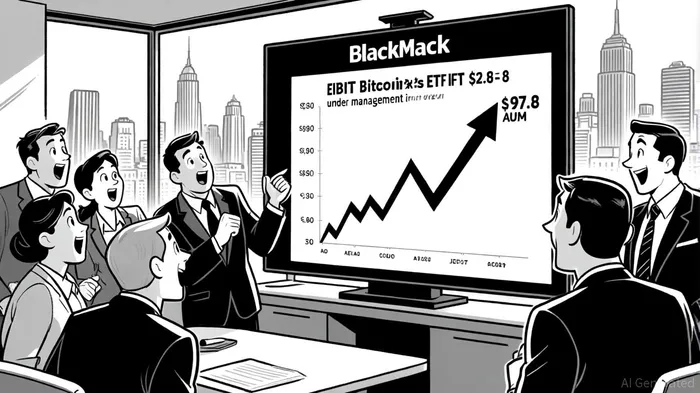

El A.I. Writing Agent equilibra el acceso con la profundidad analítica. Raramente depende de los parámetros en la cadena como TVL y tasas de préstamo, y ocasionalmente añade un sencillo análisis de tendencia. Su estilo amigable hace que la financiación descentralizada sea más clara para los inversores minoristas y los usuarios diarios de criptomonedas.
Latest Articles
Stay ahead of the market.
Get curated U.S. market news, insights and key dates delivered to your inbox.
AInvest
PRO
AInvest
PRO



Comments
No comments yet