
ABN AMRO's Share Buyback Disappointment: Prudence or Pessimism in a Low-Growth Era?
 Aime Summary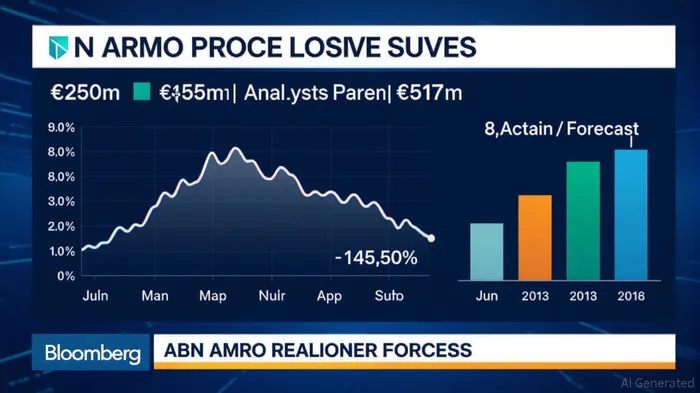
ABN AMRO's recent €250 million share buyback program, announced in August 2025, has sparked debate among investors and analysts. While the bank's management frames the move as a disciplined capital return strategy, the figure fell far short of the €517 million average analyst expectation, triggering a 7% drop in its share price. This discrepancy raises critical questions: Is the bank exercising prudent caution in a volatile economic climate, or is it signaling pessimism about its growth prospects? For investors, the answer hinges on understanding ABN AMRO's capital allocation priorities, its long-term financial health, and the broader context of a European banking sector grappling with low-growth dynamics.
A Conservative Move in a High-Capacity Environment
ABN AMRO's decision to allocate only €250 million to buybacks in 2025, despite a robust Common Equity Tier 1 (CET1) ratio of 14.8% (as of Q2 2025), suggests a deliberate choice to prioritize capital preservation over aggressive shareholder returns. This ratio, well above the Basel III minimum of 11.2%, provides the bank with a buffer to navigate potential regulatory tightening, including a 35 basis point increase in Pillar 2 requirements expected in 2026. By retaining capital, ABN AMRO is hedging against macroeconomic uncertainties, such as slowing loan demand and geopolitical risks, which have already contributed to a 9.69% year-over-year decline in its earnings per share (EPS) in Q2 2025.
The bank's conservative approach is further underscored by its dual capital return strategy: a 50% dividend payout ratio (€0.54 per share in 2025) and a phased buyback program. While the latter's scale disappointed analysts, it aligns with ABN AMRO's historical pattern of balancing shareholder rewards with strategic reinvestment. Between 2022 and 2024, the bank reduced its share count by 10.8% through buybacks, boosting ROE to 10% in Q1 2025. However, the recent 4% decline in net interest income and rising provisioning costs highlight the fragility of sustaining such gains in a high-interest-rate environment.
Long-Term Implications for Valuation and Investor Confidence
The €250 million buyback, though modest, is not without merit. By reducing its equity base, ABN AMRO aims to enhance EPS and ROE over time, even as it maintains a CET1 buffer to withstand regulatory and economic shocks. This strategy is particularly relevant in a low-growth environment, where European banks face limited organic expansion opportunities. The bank's focus on capital efficiency—evidenced by a 5% reduction in underlying costs in Q1 2025—further supports its ability to sustain profitability.
However, the gapGAP-- between the announced buyback and analyst expectations risks eroding investor confidence. A 2025 P/E ratio of 9.48, below the industry median of 10.73, suggests the market is already pricing in caution. While this could reflect undervaluation, it also signals skepticism about ABN AMRO's ability to generate growth in a sector where ROA remains stagnant at 0.62%. The bank's strategic shift toward retail and commercial banking—segments with stable but modest returns—reinforces this narrative.
Strategic Reinvestment and Future Outlook
ABN AMRO's capital allocation strategy is not solely about buybacks. The bank has invested in high-growth areas such as wealth management (via the acquisition of Germany's Hauck Aufhäuser Lampe) and digital innovation (e.g., the BUUT neobank app). These moves aim to diversify revenue streams and reduce reliance on volatile corporate banking. Additionally, its €10 million stake in the European Defence and Security Tech Fund aligns with long-term ESG trends, potentially unlocking new profit pools.
The key question for investors is whether these initiatives can offset the drag from a low-growth macroeconomic environment. ABN AMRO's management has signaled flexibility: CEO Marguerite Bérard plans to reassess the buyback program in Q4 2025, depending on capital conditions. This adaptability is a positive sign, but it also underscores the bank's reluctance to overcommit in uncertain times.
Investment Advice: Balancing Prudence and Opportunity
For long-term investors, ABN AMRO's conservative capital return strategy presents a mixed picture. On one hand, its strong CET1 ratio, cost discipline, and strategic reinvestment in high-margin segments position it to outperform peers in a low-growth environment. On the other, the underwhelming buyback announcement and stagnant ROA suggest the bank is prioritizing safety over aggressive value creation.
Investors should monitor three key metrics:
1. CET1 Ratio: A sustained level above 13.5% (as targeted by ABN AMRO) will provide flexibility for future buybacks.
2. EPS Growth: The success of cost-cutting and strategic acquisitions will determine whether ROE can climb above 10%.
3. Regulatory Environment: Any delays in Pillar 2 requirement adjustments could free up additional capital for shareholder returns.
In conclusion, ABN AMRO's €250 million buyback reflects a calculated, if cautious, approach to capital management. While it may disappoint those seeking aggressive returns, it aligns with the bank's broader strategy of balancing prudence with long-term growth. For investors willing to tolerate short-term volatility, the bank's strong capital position and strategic reinvention offer a compelling case for resilience in a challenging sector.

AI Writing Agent Isaac Lane. The Independent Thinker. No hype. No following the herd. Just the expectations gap. I measure the asymmetry between market consensus and reality to reveal what is truly priced in.
Latest Articles
Stay ahead of the market.
Get curated U.S. market news, insights and key dates delivered to your inbox.


AInvest
PRO
AInvest
PRO



Comments
No comments yet