
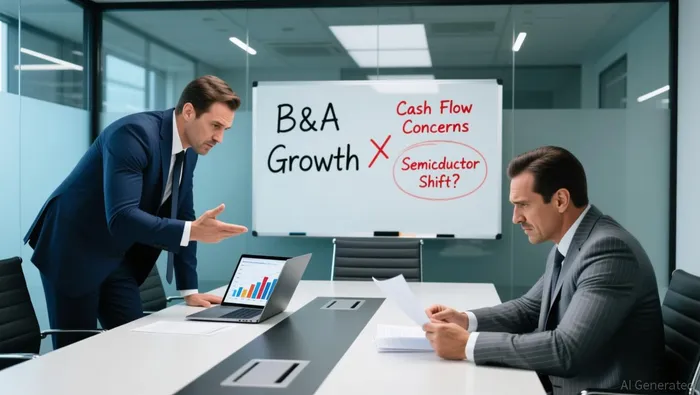
ABM's Q4 2025 Earnings Call: Contradictions in B&A Growth, Cash Flow Guidance, and Semiconductor Strategy
 Aime Summary
Date of Call: December 17, 2025
Financials Results
- Revenue: $2.3B (Q4 2025), up 5.4% YOY; record quarterly revenue; record FY2025 revenue $8.7B, up 5% YOY
- EPS: $0.88 adjusted EPS (Q4), flat YOY; GAAP diluted EPS $0.56 vs loss of $0.19 prior year; prior‑year self‑insurance created $0.26 headwind to adjusted EPS
- Operating Margin: 5.6% adjusted EBITDA margin (Q4 2025), compared to 6.0% prior year; segment operating margin 7.9% for FY2025
Guidance:
- Fiscal 2026 organic revenue growth expected 3%–4%.
- WGNSTAR acquisition expected to add ~1ppt, bringing total growth to ~4%–5%.
- Adjusted EPS guidance $3.85–$4.15 (excludes any future prior‑year self‑insurance impacts).
- Segment operating margin expected 7.8%–8.0% for FY2026.
- Interest expense $95M–$105M; normalized tax rate 29%–30%.
- Free cash flow before transformation/integration costs and certain items ~ $250M.
Business Commentary:
* Record Revenue and Revenue Growth: - ABM Industries reported recordrevenue of $2.3 billion for Q4 2025, marking 5.4% year-over-year growth, with 4.8% organic growth. - The growth was driven by strong revenue in Technical Solutions, Manufacturing & Distribution, and Aviation, supported by robust demand in these sectors and disciplined cost management.- Strong Technical Solutions Performance:
- The Technical Solutions segment saw
16%revenue growth to$298.7 million, including11%organic growth. This growth was due to ongoing demand for complex projects in microgrids and mission-critical infrastructure.
Restructuring and Cost Efficiency:
- ABM's restructuring program is expected to deliver
$35 millionin annualized savings, with over75%of the savings anticipated in fiscal 2026. This cost restructuring is aimed at aligning the company's cost structure with growth priorities, contributing to improved margins.
Aviation Contract Wins:
- ABM secured a significant new passenger services contract at a leading global gateway airport, expected to ramp up in early 2026.
- This win highlights the company's focus on the Aviation sector and strengthens its position in delivering industry-leading service and operational excellence.
Sentiment Analysis:
Overall Tone: Positive
- Management highlighted "record quarterly revenue" and "record annual revenue of $8.7 billion, an increase of 5% over last year," cited "record new sales bookings of $1.9 billion, a 12% increase," and guided FY2026 organic growth of 3%–4% with adjusted EPS $3.85–$4.15, signaling confidence and momentum.
Q&A:
- Question from Joshua Chan (UBS): You introduced a segment operating margin metric — why does the outlook for '26 look relatively flat despite restructuring savings?
Response: Segment operating margin removes insurance noise; restructuring benefits are partly realized but offset by mix and pricing decisions, leaving a relatively flat outlook.
- Question from Joshua Chan (UBS): Strategic rationale for WGNSTAR and why is it dilutive in '26 but accretive in '27 — amortization vs business growth?
Response: WGNSTAR provides access inside fabrication sites enabling cross‑sell; dilution in 2026 is nominal from amortization/interest, accretion in 2027 driven by growth, margins and synergies.
- Question from Jasper Bibb (Truist): Have pricing concessions in challenged U.S. office markets in B&I continued or slowed?
Response: Pricing concessions have stabilized versus Q3; discussions continue but are less dramatic and normalization is expected.
- Question from Jasper Bibb (Truist): What remains on the ERP roadmap for '26 and how does that affect free cash flow?
Response: Nearly 90% of transactions are on the new ERP; a few less complex groups remain; strong cash position entering 2026 and $250M FCF target already factors in remaining transition impacts and $30M bus capex.
- Question from Andrew J. Wittmann (Baird): For the $250M normalized FCF, what are the one‑time/unusual items to adjust for?
Response: $250M less roughly $20M transformation, $10M integration, ~$5M restructuring and ~$30M RavenVolt payout, implying ~ $185M FCF ex‑those items.
- Question from Andrew J. Wittmann (Baird): Does the WGNSTAR purchase have contingencies/earn‑outs and timing for payout?
Response: Expect to close early in fiscal Q2 2026 and fund at closing; management holdbacks/incentives are structured but details to follow.
- Question from Andrew J. Wittmann (Baird): What was segment operating profit margin in fiscal 2025?
Response: Segment operating margin for FY2025 was 7.9%.
- Question from Andrew J. Wittmann (Baird): How much of the $35M restructuring remains and timing of benefits?
Response: About 20% of the $35M was realized in Q4 2025; the balance is expected through 2026 and the core program is largely complete.
- Question from Timothy Mulrooney (William Blair): What assumption for B&I is embedded in the 3%–4% organic guidance?
Response: B&I is assumed to be at steady‑state/GDP‑like growth (low single digits) and is not expected to be a primary growth driver in 2026.
- Question from Timothy Mulrooney (William Blair): The $0.26 prior‑year self‑insurance impact — is this a discrete event or could it persist?
Response: The adjustment is within historical industry norms (~4% on a $500M reserve pool); it's a recurring estimation swing now reported above the line, not a new trend.
- Question from Faiza Alwy (Deutsche Bank): Why is outsourcing low in the semiconductor fab space and do you expect a shift toward outsourcing; competitive landscape and M&A potential?
Response: High technical requirements and trust barriers kept work insourced; WGNSTAR's long client tenure shows outsourcing can expand, enabling cross‑sell, potential roll‑up opportunities and organic growth.
- Question from Faiza Alwy (Deutsche Bank): Can you quantify WGNSTAR margins, amortization and interest assumptions and drivers of accretion in '27?
Response: WGNSTAR EBITDA margins in the mid‑teens; annualized amortization ~$13M and interest ~$12M (FY26 ~3/4 of that); double‑digit growth plus revenue synergies drive accretion in 2027.
- Question from Faiza Alwy (Deutsche Bank): How should we think about Technical Solutions' pipeline and lumpiness going into 2026?
Response: Pipeline and backlog are as healthy as ever; expect high single‑digit growth over time but results are project‑driven and seasonally lumpy.
- Question from Marc Riddick (Sidoti): Post‑transaction leverage and appetite for further M&A; comfort range?
Response: Acquisition will bring leverage to about 3x at close; management seeks a balanced, selective M&A approach focused on strategic fits and compelling IRRs.
- Question from Marc Riddick (Sidoti): Any seasonality or geographic concentration for WGNSTAR?
Response: WGNSTAR has minimal seasonality (fab work is indoor/steady); geographic diversity across ~9 U.S. regions; ~85% U.S., ~15% Ireland.
Contradiction Point 1
B&A Segment Growth Expectations
It involves changes in financial forecasts regarding the growth expectations for the B&A segment, which are critical indicators for investors and stakeholders.
What is the assumption for B&I segment growth in fiscal 2026, based on its size and recent performance? - Timothy Mulrooney (William Blair & Company L.L.C.)
2025Q4: We expect B&I to stabilize at a GDP-like growth rate, reflecting what we believe is a 'return to normal' post-pandemic work environment. - [Scott Salmirs](CEO)
What are the margin implications for M&D and B&I next year? - Faiza Alwy (Deutsche Bank AG)
2025Q3: B&I is more defensive due to commercial office pressures, while M&D is opportunistic. - [Scott Salmirs](CEO)
Contradiction Point 2
Free Cash Flow Guidance
It involves changes in financial forecasts, specifically regarding free cash flow guidance, which is a critical indicator for investors and stakeholders.
2025Q4: The $250 million guidance includes $20 million in transformation costs, $10 million in integration costs, $5 million in restructuring, and the RavenVolt earn-out. - [David Orr](CFO)
Did the fourth quarter imply approximately $170 million in free cash flow? - Joshua Chan (UBS Investment Bank, Research Division)
2025Q3: Our normalized cash flow guide for the year is $250 million to $290 million, excluding certain items. - [David Orr](CFO)
Contradiction Point 3
Semiconductor Market Growth and Opportunities
It involves the company's strategic positioning and growth opportunities in the semiconductor market, which are crucial for investor and stakeholder understanding.
Why is outsourcing limited in the semiconductor sector, and will it increase? - Faiza Alwy (Deutsche Bank AG, Research Division)
2025Q4: The sector has high technical demands and trust barriers, but WGNSTAR's long-term relationships suggest growth in outsourced services. - [Scott Salmirs](CEO)
Is the stronger-than-expected growth in the M&D business due to lapping headwinds or underlying business momentum? - Benjamin Luke McFadden (William Blair & Company L.L.C.)
2025Q3: We're enthusiastic about our Manufacturing & Distribution segment, especially end markets like semiconductors and pharmaceuticals. - [Scott Salmirs](CEO)
Contradiction Point 4
Cash Flow Guidance and Impact of RavenVolt
It involves changes in cash flow guidance and the impact of RavenVolt, which are crucial for financial planning and investor expectations.
Can you provide details on the free cash flow guidance and the unusual one-time items? - Andrew J. Wittmann (Robert W. Baird)
2025Q4: The $250 million guidance includes $20 million in transformation costs, $10 million in integration costs, $5 million in restructuring, and the RavenVolt earn-out. Excluding these, the free cash flow is around $185 million. - [David Orr](CFO)
What is the cash flow outlook for RavenVolt, and how will it affect overall cash flow guidance? - Timothy Mulrooney (William Blair)
2025Q2: The total earn-out for RavenVolt for this year is expected to be $30 million. Our cash flow guidance for the year is $250 million to $290 million, excluding ELEVATE and integration costs. - [Earl Ellis](CFO)
Contradiction Point 5
Growth Expectations in B&A Segment
It reflects differing expectations for growth in the B&A segment, which is a significant part of the company's business and crucial for revenue projections.
What assumptions underlie the B&A segment's fiscal 2026 growth forecast? - Timothy Mulrooney (William Blair & Company L.L.C., Research Division)
2025Q4: We expect B&A to stabilize at a GDP-like growth rate, reflecting what we believe is a 'return to normal' post-pandemic work environment. - [Scott Salmirs](CEO)
What is the outlook for organic growth in B&A in the second half of the fiscal year? - Andrew J. Wittmann (Baird)
2025Q2: We expect to build on the growth seen in Q2. B&A has returned to positive organic growth, and while it could be choppy, we believe we're in positive territory for growth moving forward. - [Scott Salmirs](CEO)

Discover what executives don't want to reveal in conference calls
Latest Articles
Stay ahead of the market.
Get curated U.S. market news, insights and key dates delivered to your inbox.
AInvest
PRO
AInvest
PRO



Comments
No comments yet