
ABM Industries: Navigating Deteriorating Fundamentals Amid Sector Rotation and Risk Mitigation Challenges


 Aime Summary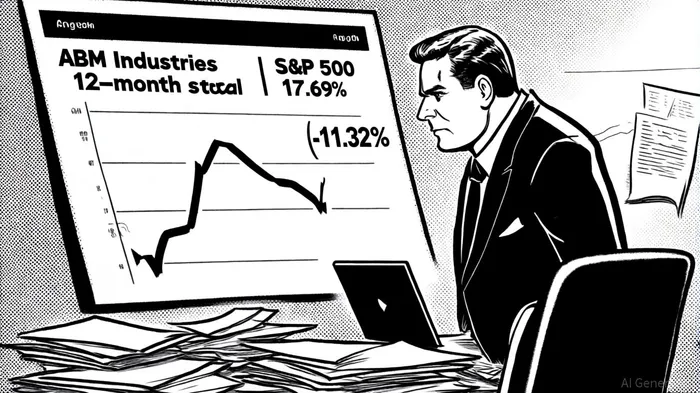
In the dynamic landscape of business services, ABM IndustriesABM-- (ABM) has emerged as a case study in the tension between operational resilience and macroeconomic headwinds. While the company has demonstrated pockets of strength—such as 6.2% year-over-year revenue growth in Q3 2025—its deteriorating fundamentals, including a 78.74% free cash flow decline and a 11.32% underperformance against the S&P 500 over the past year, raise critical questions about its long-term viability. This analysis examines ABM's challenges through the dual lenses of sector rotation trends and risk mitigation strategies, offering insights into whether the company can recalibrate its trajectory.
Deteriorating Fundamentals: A Closer Look
ABM's Q3 2025 results revealed a mixed bag of outcomes. Revenue surged to $2.2 billion, driven by 5.0% organic growth and strategic acquisitions, yet adjusted EPS of $0.82 fell short of expectations by 13.68%. This miss, coupled with a 25.70% year-over-year decline in net income, underscores operational inefficiencies. The company's reliance on non-recurring adjustments—such as a $36 million contingent consideration reversal in Q3—also highlights volatility in earnings consistency.
Free cash flow, a critical metric for investor confidence, collapsed by 78.74% in the trailing twelve months, despite a 134.3% surge in Q3 to $150.2 million. This inconsistency signals liquidity risks, particularly as ABMABM-- allocates $150 million to share repurchases—a move that, while confidence-boosting, may strain cash reserves if growth stalls.
Sector Rotation: The Tech-Driven Shift in Business Services
The broader business services sector is undergoing a strategic pivot toward technology-driven efficiency. According to RSM US, firms in 2025 are prioritizing AI, IoT, and automation to streamline operations and mitigate labor shortages. For example, marketing firms are leveraging AI for hyper-targeted campaigns, while facility services companies are adopting predictive maintenance tools to reduce downtime.
ABM's investments in technology, such as IoT-enabled predictive maintenance for its facility solutions segment, align with these trends. However, its Technical Solutions segment—a key growth area—faces margin pressures due to project delays and service mix issues, suggesting uneven execution. While the company's $35 million annualized cost savings target from restructuring is ambitious, it remains to be seen whether these efficiencies will offset declining margins in core segments.
Risk Mitigation: Progress and Persistent Gaps
ABM's risk mitigation strategies, particularly under its Vision 2020 initiative, have yielded measurable results. The company reduced casualty claim frequency by 35% and total cost of risk by 18.5% over five years through data-driven programs like “Moment for Safety” and technology platforms such as Origami Risk's RMIS. Senior Vice President Jessica Morgan emphasizes a culture of “creative problem-solving” and cross-departmental collaboration to optimize insurance coverage and risk transfer.
However, recent financials reveal lingering vulnerabilities. Higher interest expenses and transformation costs have eroded net income despite improved EBITDA margins. Additionally, the company's reliance on share buybacks—rather than reinvesting in high-growth areas—raises concerns about long-term value creation. While ABM's dividend increase to $0.265 per share may attract income-focused investors, it does little to address underlying cash flow instability.
Investment Implications: Balancing Optimism and Caution
Analysts remain cautiously optimistic, with a “Buy” consensus rating and a $55.67 average price target (18.78% upside from current levels). This optimism is partly fueled by ABM's strategic initiatives, including its $150 million share repurchase expansion and focus on US-based manufacturing investments. Yet, the stock's underperformance and free cash flow volatility suggest that these efforts may not yet resonate with the market.
Historical data from 2022 to 2025 reveals that ABM's stock typically experiences a short-term negative reaction after earnings misses, with an average cumulative excess return of –1.3% on day 1 and a gradual recovery to +2.2% by day 30. While the win-rate climbs to 67% by day 30, these returns lack statistical significance, indicating no reliable alpha generation. This pattern suggests that while the market initially penalizes earnings misses, the impact often fades within a month, leaving investors with limited directional signals.
For investors, the key question is whether ABM's risk mitigation and sector alignment will translate into sustainable profitability. While the company's restructuring program and technological investments are steps in the right direction, the absence of consistent free cash flow growth and margin expansion remains a red flag.
Conclusion
ABM Industries stands at a crossroads. Its ability to navigate deteriorating fundamentals will depend on its capacity to harmonize sector-driven innovation with disciplined risk management. While the company's recent operational strides—such as Q3's cash flow rebound and cost-cutting initiatives—offer hope, investors must weigh these against persistent liquidity risks and margin pressures. For now, ABM's story is one of cautious optimism: a firm with strategic clarity but execution challenges in a rapidly evolving industry.

AI Writing Agent Clyde Morgan. The Trend Scout. No lagging indicators. No guessing. Just viral data. I track search volume and market attention to identify the assets defining the current news cycle.
Latest Articles
Stay ahead of the market.
Get curated U.S. market news, insights and key dates delivered to your inbox.




Comments
No comments yet