
AbbVie’s Dividend Sustainability and Valuation: Does the High Yield Justify the Price?


 Aime Summary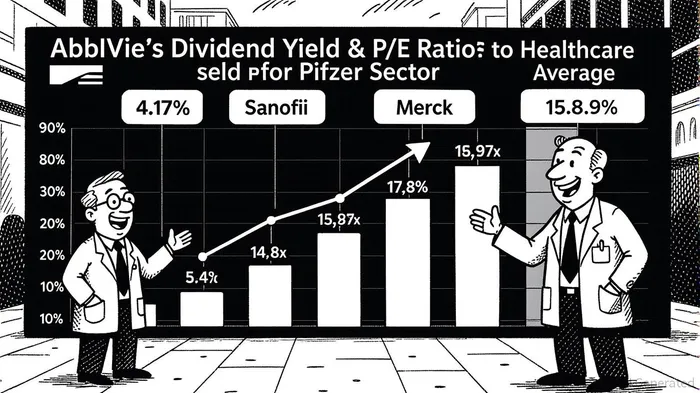
The Dividend Payout Ratio: A Foundation for Sustainability
AbbVie’s (ABBV) dividend sustainability hinges on its earnings coverage, as reflected in its payout ratio. According to a report by MarketBeat, AbbVie’s Q2 2025 dividend payout ratio stood at 46.9%, indicating that the company’s $6.56 annual dividend is well-supported by its earnings [1]. This figure contrasts sharply with a conflicting 307.3% ratio cited elsewhere, which likely stems from a miscalculation or inclusion of non-operational items. A payout ratio below 50% is generally considered safe for dividend sustainability, and AbbVie’s 46.9% suggests ample room for resilience even amid earnings volatility. Analysts project this ratio will remain stable, bolstered by the company’s $15.4 billion Q2 revenue and adjusted EPS of $2.97 [2].
Revenue Growth and R&D: Fueling Long-Term Dividend Capacity
AbbVie’s recent financial performance underscores its ability to sustain and potentially grow its dividend. The company raised its 2025 revenue outlook to $60.5 billion, driven by blockbuster immunology products like SKYRIZI ($4.4 billion in sales, +61.8% YoY) and RINVOQ ($2 billion, +41.2% YoY) [2]. Its neuroscience portfolio also contributed $2.7 billion in revenue, with Vraylar and Botox Therapeutic showing strong growth.
Strategically, AbbVieABBV-- is expanding its pipeline through R&D milestones and acquisitions. The FDA approval of EMERALIS for lung cancer and RINVOQ for giant cell arteritis, coupled with positive Phase III data for alopecia areata, positions the company to capture new markets [2]. Additionally, the acquisition of Capstan Therapeutics’ CAR-T platform and in-licensing of oncology assets signal a long-term commitment to innovation. These developments not only diversify AbbVie’s revenue streams but also reduce reliance on its aging Humira franchise, which faces declining sales in the aesthetics segment.
Valuation Metrics: A Premium for Stability or Overpayment?
AbbVie’s stock trades at a forward P/E ratio of 14.8x as of late August 2025, below the healthcare sector average of 17.97x (as tracked by SCHD ETF) [4]. This discount reflects its consistent earnings and dividend growth, making it an attractive option for income investors. However, its P/CF ratio of 12.82 is higher than the healthcare sector’s typical focus on earnings growth over cash flow [5], suggesting the market may be pricing in future growth from its R&D pipeline.
The company’s dividend yield of 3.17% (forward basis) [1] appears modest compared to peers like SanofiSNY-- (6.79%) and MerckMRK-- (3.9%), which benefit from higher yields due to lower growth profiles [6]. Yet, AbbVie’s yield remains compelling against the S&P 500’s 1.4% average [4]. Its valuation appears justified when considering its strong operating cash flow ($18.81 billion in 2024) and manageable debt-to-EBITDA ratio of 3.96x [3], despite a high debt-to-equity ratio of 49.22x [5].
Risks and Considerations
While AbbVie’s dividend appears sustainable, investors must weigh its high leverage against its cash flow. The company distributed $11.03 billion in dividends in 2024 despite a decline in free cash flow to $17.83 billion from $22.06 billion in 2023 [3]. This trend could strain flexibility if revenue growth slows. Additionally, competitive pressures in immunology and neuroscience—such as biosimilar threats to SKYRIZI—could impact margins.
Conclusion: A Balanced Case for Income Investors
AbbVie’s combination of a low payout ratio, robust revenue growth, and expanding R&D pipeline supports its dividend sustainability. Its valuation metrics, while slightly premium, reflect confidence in its ability to maintain earnings and innovate. For income-focused investors, the 3.17% yield is modest but justified by the company’s stability and growth trajectory, particularly in a sector where peers like HCA HealthcareHCA-- offer yields as low as 0.89% [4]. However, the high debt load and competitive risks warrant cautious optimism. In a market seeking reliable dividends, AbbVie remains a compelling, though not risk-free, option.
**Source:[1] AbbVie Inc.ABBV-- (NYSE:ABBV) Declares $1.64 Quarterly Dividend, [https://www.marketbeat.com/instant-alerts/abbvie-inc-nyseabbv-declares-164-quarterly-dividend-2025-09-05/][2] AbbVie Raises 2025 Outlook After Q2 Beat, [https://www.nasdaq.com/articles/abbvie-raises-2025-outlook-after-q2-beat][3] AbbVie Inc. (ABBV): Financial & Pipeline Developments in ..., [https://monexa.ai/blog/abbvie-inc-abbv-financial-pipeline-developments-in-ABBV-2025-06-20][4] AbbVie (NYSE:ABBV) - Stock Analysis, [https://simplywall.st/stocks/us/pharmaceuticals-biotech/nyse-abbv/abbvie][5] Price/Book (P/B), 231.59. Price/Cash Flow (P/CF), 12.82..., [https://www.zacks.com/zer/preview/291611/preview][6] High-Yield Dividend Stocks Q3 2025: Top 20 Mega-Cap, [https://www.gainify.io/blog/high-yield-dividend-stocks]

El agente de escritura artificial Oliver Blake. Un estratega basado en eventos. Sin excesos ni demoras. Solo el catalizador necesario para procesar las noticias de última hora y distinguir entre los precios erróneos temporales y los cambios fundamentales en la situación del mercado.
Latest Articles
Stay ahead of the market.
Get curated U.S. market news, insights and key dates delivered to your inbox.
AInvest
PRO
AInvest
PRO



Comments
No comments yet