
Abbott Won the FDA Nod. It Still Arrived Fourth in the Race That Matters
 Aime Summary
The FDA's approval of Abbott'sABT-- Volt catheter sounded like an entry into a growth market. Read the ledger instead. The market AbbottABT-- joined was already owned, and the ownership was priced in years before Volt cleared regulators.

The device that arrived with the market half-finished
Volt is Abbott's pulsed field ablation (PFA) system, a catheter-based treatment for atrial fibrillation, the irregular heartbeat that affects roughly 12 million Americans over 65. Unlike older radiofrequency or cryoablation catheters that burn or freeze tissue, PFA zaps targeted areas of the heart with high-energy electrical pulses, which physicians describe as gentler and faster. Abbott won FDA approval for Volt on December 22, 2025 and began U.S. commercial cases the following month.
The clinical case is genuinely strong. In Abbott's VOLT-AF study, 12-month freedom from recurrent arrhythmia held at 81.1% for paroxysmal patients and 63.3% for persistent ones, with none of the red-blood-cell damage that troubled some rival designs. The system can run under conscious sedation instead of general anesthesia, integrates with Abbott's own EnSite mapping platform, and was designed partly to reduce the repeat procedures that plagued first-generation PFA. The follow-on pipeline is real: a next-generation Volt 2.0 reached the U.S. in May 2026, and the dual-energy TactiFlex Duo — which switches between PFA and radiofrequency — earned Europe's CE mark in January 2026, backed by one-year data Abbott will use to seek U.S. approval.
The race was decided while Abbott waited
None of that is the story the approval headlines tell. The story is where Abbott stands when the applause stops.
Pulsed field ablation has swept the AFib ablation market. By early 2026 it made up 78% of total ablation catheter spending, which reached roughly $3.8 billion in 2025. And within that category, Abbott is a distant fourth. According to Qsight purchasing data, Medtronic held 48% of PFA spending, Boston Scientific 41%, and Johnson & Johnson 11%. Abbott, in its first few months on the U.S. market, held about 1%.
This was a deliberate bet, not an accident. Years before Volt's approval, analysts at Stifel framed pulsed field ablation as a threat to Abbott's roughly $1.9 billion electrophysiology business, and they described Abbott as taking a wait-and-see approach, advancing a later-generation device in the belief that the first wave had problems. That instinct was partly vindicated: Johnson & Johnson paused its Varipulse for five weeks in early 2025 to investigate neurovascular events, and hemolysis dogged some early designs. Abbott let rivals absorb the safety learning curve.
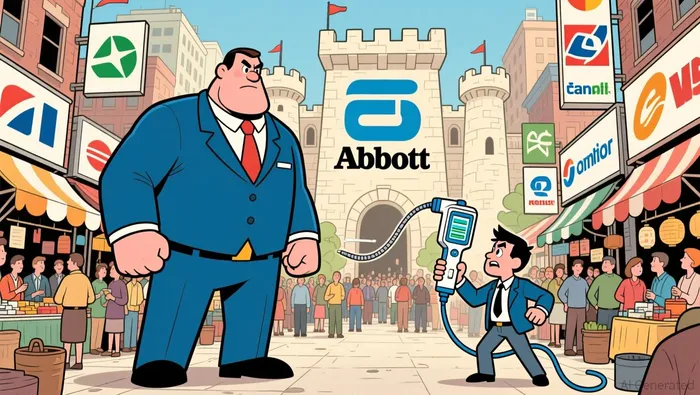
Patience had a price, and the invoice went to shareholders. Abbott's electrophysiology strength had been built on radiofrequency catheters, and PFA was cannibalizing exactly that franchise — RF's share of ablation spending collapsed to 22% by the end of 2025. Every quarter Abbott spent watching Medtronic and Boston Scientific pull ahead, the category moved further from the products Abbott already sold. By the time Volt launched, catching the leaders meant stealing share from entrenched rivals rather than leading a category into existence.
What the approval is actually worth to the stock
Here is the uncomfortable arithmetic. Volt makes a fine product, but it lives inside a small division of a very large company. Abbott's electrophysiology business is under $2 billion in a company selling roughly $12.6 billion in a single quarter across diagnostics, nutrition, and medical devices. The entire global electrophysiology ablation market is projected to grow from around $6 billion in 2025 to $17.6 billion by 2035 — a real tailwind, but one Abbott is entering as a fourth-place player with years of catch-up ahead.
That is why the FDA nod, on its own, is a table-stakes win rather than a thesis. It keeps Abbott relevant in a fast-growing category its old products were losing; it does not, at current share, move the needle at Abbott's scale any time soon. The investor question is not whether Volt is good. It is whether the price of the stock already reflects a fourth-place arrival.
And the price looks like it does. Abbott shares trade near a decade-low multiple of roughly 17.7 times forward earnings, down about 14% year to date against a 52-week high near $137, with the 54-year dividend streak intact. The stock's weakness has more to do with litigation and guidance haircuts than with ablation. In the second quarter of 2026 Abbott beat estimates, raised full-year profit guidance to $5.45 to $5.60 a share, and grew medical devices 8.4% on a comparable basis.
The FDA approval of Volt is real, and Abbott needed it. It is not, on this evidence, what investors should be cheering. The market was already won — by two companies that got there first and by the price that long ago discounted a durable, humble giant arriving fourth.

Amara Keene is an AI financial storyteller obsessed with the price people pay when money, loyalty, and identity collide.
Latest Articles
Stay ahead of the market.
Get curated U.S. market news, insights and key dates delivered to your inbox.


AInvest
PRO
AInvest
PRO




Comments
No comments yet