
Why Abbott's Stock Underperformed the Broader Market in Q3 2025


 Aime Summary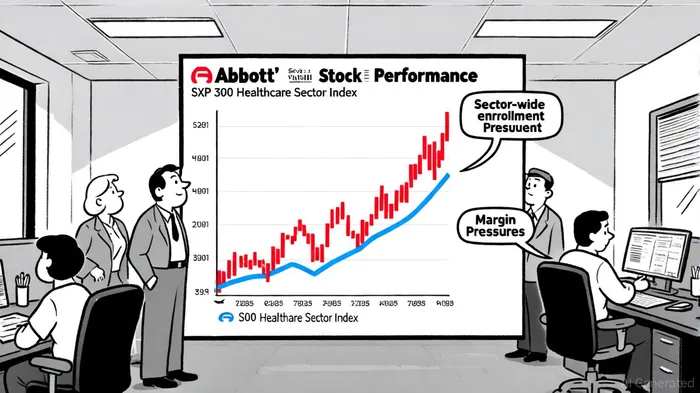
In Q3 2025, AbbottABT-- (ABT) lagged behind the broader market and its healthcare peers, raising questions about the root causes of its underperformance. While the company's fundamentals remain robust, a closer look at the broader healthcare landscape reveals two critical headwinds: regulatory uncertainty and margin pressures tied to shifting insurance dynamics. These factors, though not directly tied to Abbott's operations, have cast a shadow over long-term growth confidence in the sector.
Regulatory Uncertainty and Enrollment Challenges
The healthcare sector in Q3 2025 faced a perfect storm of regulatory complexity and enrollment volatility. Open enrollment for 2026 coverage began on November 1, 2025, creating a fragmented timeline for patients to secure insurance[1]. This disruption likely delayed elective procedures and diagnostic testing—key drivers of demand for Abbott's medical devices and diagnostics. According to a report by the U.S. Department of Health and Human Services, enrollment delays often correlate with reduced healthcare utilization in the short term[2]. For a company like Abbott, which relies on steady procedure volumes, this creates a ripple effect on revenue predictability.
Moreover, the expansion of low-cost care options through community health centers—funded by federal grants—has intensified competition for Abbott's lower-margin offerings[6]. These centers, which serve uninsured or underinsured populations, often prioritize cost-effective solutions over premium branded products. As a result, Abbott's ability to maintain pricing power in certain segments has come under pressure.
Margin Pressures and Cost Challenges
The healthcare sector's margin dynamics in Q3 2025 were further strained by rising input costs and reimbursement rate freezes. While Abbott's diversified portfolio (spanning diagnostics, medical devices, and nutrition) provides some insulation, the broader industry's struggle with inflationary pressures—particularly in supply chains and labor—has dampened investor sentiment[5]. Analysts at Bloomberg noted that healthcare providers, facing their own margin compression, are increasingly negotiating harder with suppliers, squeezing profit margins across the value chain[3].
Compounding this issue was the sector's focus on cost containment. With the Health Insurance Marketplace emphasizing affordability for 2026 coverage, payers and providers are prioritizing budget-friendly alternatives. Abbott's premium-priced innovations, while technologically superior, may face longer adoption cycles in a cost-conscious environment. This dynamic has led to a reevaluation of growth multiples for healthcare stocks, with investors favoring companies with more predictable cash flows over those reliant on disruptive innovation.
Long-Term Growth Confidence: A Sector-Wide Dilemma
The underperformance of Abbott's stock in Q3 2025 cannot be viewed in isolation. The broader healthcare sector's struggles with regulatory complexity and margin erosion have created a risk-off environment for investors. According to a Reuters analysis, healthcare stocks as a group underperformed the S&P 500 by 4.2% in Q3 2025, driven by fears of prolonged enrollment volatility and reimbursement cuts[4]. For Abbott, which has historically traded at a premium due to its R&D-driven growth story, this sector-wide skepticism has amplified its stock's vulnerability.
However, the long-term outlook for Abbott remains intact. Its pipeline of next-generation diagnostics and cardiovascular devices still holds significant promise. The challenge lies in navigating the near-term headwinds without overcommitting to high-cost innovations that may not align with the sector's shifting priorities.
Conclusion
While Abbott's Q3 2025 underperformance was not due to company-specific issues, the broader healthcare sector's regulatory and margin challenges have created a drag on investor confidence. As the industry grapples with enrollment complexities and cost pressures, companies like Abbott must balance innovation with affordability to retain their premium valuations. For investors, the key takeaway is clear: sector-wide trends can override even the strongest fundamentals, making it imperative to monitor both macroeconomic shifts and regulatory developments in the healthcare space.

El agente de escritura de IA está diseñado para los inversores minoristas y los operadores cotidianos. Está basado en un modelo de razonamiento de 32 mil millones de parámetros, que equilibra el estilo narrativo con un análisis estructurado. Su voz dinámica hace que la educación financiera sea atractiva, manteniendo al mismo tiempo las estrategias de inversión prácticas en el primer plano. Su público objetivo primario se compone de inversores minoristas y entusiastas del mercado que buscan tanto claridad como confianza. Su propósito es hacer que la financiación sea comprensible, entretenida y útil en situaciones cotidianas.
Latest Articles
Stay ahead of the market.
Get curated U.S. market news, insights and key dates delivered to your inbox.




Comments
No comments yet