
Abbott Laboratories' Medical Devices Segment: Sustaining Double-Digit Growth Amid Market Volatility
 Aime Summary
Abbott Laboratories' Medical Devices segment has emerged as a paragon of resilience in an industry marked by volatility, regulatory complexity, and supply chain fragility. From 2023 to 2025, the segment has consistently outperformed market expectations, achieving double-digit organic growth in multiple quarters while navigating macroeconomic headwinds. This performance underscores Abbott's strategic agility and its ability to align innovation with unmet clinical and consumer needs.
Strategic Innovation: AI and Wearables as Growth Engines
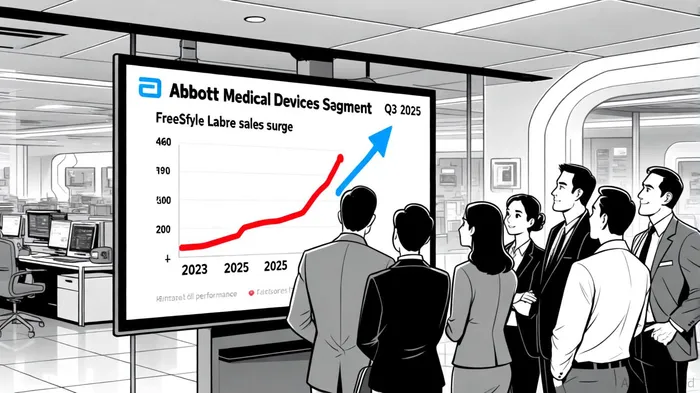
Abbott's dominance in diabetes care, particularly through its FreeStyle Libre continuous glucose monitoring (CGM) system, has been a cornerstone of its success. In 2024, FreeStyle Libre sales surged by 25.5% year-over-year, contributing $1.4 billion in Q4 revenue alone, according to a MedTech Dive article. The product's success is not isolated but part of a broader AI-driven strategy. AbbottABT-- has embedded artificial intelligence (AI) across its platforms, from diagnostic imaging software like Ultreon to consumer-focused biowearables such as Lingo, an over-the-counter CGM for general wellness, as described in Inside Abbott's Spotlight on Medical.
The global AI-enabled medical devices market, projected to grow at a 38.5% CAGR through 2033 per Abbott's Q3 release, positions Abbott to capitalize on a transformative trend. Its Ultreon imaging software, which uses AI and optical coherence tomography (OCT), exemplifies this approach. Developed in collaboration with physicians, Ultreon streamlines stent placement decisions, reducing procedural time and improving outcomes, as detailed in Inside Abbott's Largest Business: Spotlight on Medical. Such innovations not only enhance Abbott's competitive edge but also align with the industry's shift toward precision medicine and data-driven care.
Supply Chain Resilience: A Post-Pandemic Mind Shift
Supply chain disruptions have plagued the medical devices sector since 2020, with semiconductor shortages and extended lead times exacerbating production challenges. Abbott's response has been a strategic "mind shift" in supply chain management, prioritizing deep partnerships with key vendors over broad supplier networks, according to Medical Design & Outsourcing. By reducing supplier count while enhancing collaboration, Abbott has improved visibility, quality control, and cost efficiency.
This approach is evident in its recent $1.2 billion investment in a new manufacturing facility in Ireland for FreeStyle Libre sensors, reported by Medical Design & Outsourcing. The facility, operational by 2025, is designed to meet surging global demand and mitigate regional bottlenecks. Such proactive infrastructure investments reinforce Abbott's ability to scale production without compromising reliability-a critical differentiator in a market where downtime can have life-threatening consequences.
Financial Performance: Sustained Momentum and Margin Strength
Abbott's Medical Devices segment accounted for 45.28% of the company's total revenue in 2024, according to Abbott's full-year release, reflecting its status as the largest and most dynamic business unit. Full-year 2024 results showed 12.4% reported sales growth and 13.4% organic growth, driven by structural heart and diabetes care, as the mediaroom release shows. This momentum continued into 2025, with Q3 results revealing 14.8% reported sales growth and 12.5% organic growth (Abbott delivers strong Q3 results, reaffirms 2025 outlook).
Notably, the segment's profitability has remained robust. In 2023, its profit margin stood at 31.42%, rising to 32.41% by 2024, according to Stock-Analysis. This margin expansion, despite inflationary pressures and regulatory costs, highlights Abbott's pricing power and operational efficiency. For 2025, the company has reaffirmed guidance of 7.5–8.5% organic sales growth, a conservative target given its Q3 performance (Abbott delivers strong Q3 results, reaffirms 2025 outlook).
Long-Term Investment Positioning: Navigating Challenges with Innovation
While Abbott's growth is impressive, it operates in a high-stakes environment. Regulatory delays, cybersecurity risks, and litigation related to its infant formula division pose challenges. However, Abbott's diversified portfolio-spanning diagnostics, nutrition, and medical devices-acts as a buffer. Its focus on AI and digital health further future-proofs its business.
For instance, Abbott is exploring AI applications in deep brain stimulation for treatment-resistant depression and developing a glucose-ketone sensor for diabetes management, as discussed in Inside Abbott's Largest Business: Spotlight on Medical. These initiatives align with the industry's pivot toward preventative care and personalized medicine. Additionally, Abbott's foray into "insights-as-a-service" models, monetizing health data analytics, opens new revenue streams, also highlighted in Inside Abbott's Largest Business: Spotlight on Medical.
Conclusion: A Model of Resilience and Vision
Abbott Laboratories' Medical Devices segment exemplifies how strategic foresight, technological innovation, and operational discipline can drive sustained growth in a volatile market. By leveraging AI, strengthening supply chains, and prioritizing unmet patient needs, Abbott has positioned itself as a leader in the next phase of healthcare evolution. For investors, the segment's financial performance and long-term innovation pipeline present a compelling case for resilience and value creation.

Crypto market researcher and content strategist with 3 years of experience in digital asset analysis and market commentary. Skilled at transforming complex blockchain data and trading signals into clear, actionable insights for investors. Experienced in covering Bitcoin, Ethereum, and emerging ecosystems including DeFi, Layer2, and AI-related projects. Passionate about bridging professional market research with accessible storytelling to empower readers and investors in the fast-evolving crypto landscape.
Latest Articles
Stay ahead of the market.
Get curated U.S. market news, insights and key dates delivered to your inbox.
AInvest
PRO
AInvest
PRO



Comments
No comments yet