
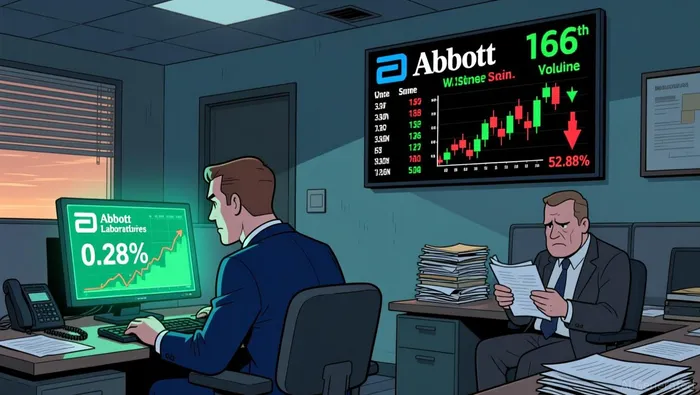
Abbott Laboratories Gains 0.28% Amid 52.88% Volume Drop to Rank 166th in U.S. Daily Trading Activity as Insider Sales Continue
 Aime Summary
Market Snapshot
On November 28, 2025, , , . This volume placed ABTABT-- at rank 166 among U.S. equities for daily trading activity. While the stock’s price movement was modest, the sharp drop in volume suggests reduced investor engagement, potentially linked to recent corporate activity such as insider transactions disclosed earlier in the week. , , .
Key Drivers
Eric Shroff, Senior Vice President of Abbott LaboratoriesABT--, , 2025, , . This transaction, disclosed via SEC Form 4, marked another instance of insider selling for the company, . Shroff’s sale follows a pattern of prior divestitures, with no insider purchases recorded in the same period. The timing of the sale—occurring three days before ABT’s modest 0.28% price gain—suggests that while insider activity may signal mixed signals, it did not directly correlate with the stock’s recent performance.
The sale was preceded by a Form 144 filing on November 25, notifying the SEC of Shroff’s intent to sell restricted securities through broker UBS Financial Services Inc. Such filings are standard for insiders looking to liquidate shares within a 90-day window. While the transaction itself is routine, the cumulative effect of repeated insider sales—particularly in the absence of offsetting purchases—could raise questions about management’s confidence in the stock’s near-term prospects. However, , which factors in historical multiples, growth adjustments, and analyst forecasts, .
, , . This valuation discrepancy may reflect investor skepticism toward broader healthcare sector fundamentals or specific concerns about Abbott’s growth trajectory. Yet, the company’s diversified business segments—Established Pharmaceuticals, Diagnostics, Nutritional Products, and Medical Devices—suggest resilience in a volatile market. The recent insider sales, while noteworthy, do not appear to have triggered a broader sell-off, as ABT’s price remained largely stable in the following days.
The lack of insider buying over the past year contrasts with the frequency of selling, potentially signaling a cautious stance among executives. However, it is important to contextualize these transactions within personal financial planning or portfolio diversification strategies, rather than interpreting them as direct commentary on the company’s intrinsic value. With ABT’s market cap and valuation metrics pointing to a stable, if unexciting, outlook, the stock’s performance appears more influenced by macroeconomic factors and sector dynamics than by recent insider activity.
In summary, while Eric Shroff’s sale and the broader pattern of insider divestitures warrant attention, they do not detract from Abbott’s fundamentally sound valuation or its position as a diversified healthcare player. Investors may view the current P/E ratio and GF Value as indicators of a stock trading near its intrinsic worth, with the recent price gain potentially reflecting broader market rotation rather than company-specific catalysts. The interplay between insider sentiment and valuation metrics underscores the need for a nuanced assessment of Abbott’s prospects, balancing short-term transactional data with long-term operational strengths.

Stay ahead of the market.
Get curated U.S. market news, insights and key dates delivered to your inbox.
AInvest
PRO
AInvest
PRO



Comments
No comments yet