
Aave Shifts Governance Strategy Amid Developer Dispute
 Aime Summary
- Aave’s development community is experiencing internal discord as key contractor Bored Ghosts Developing (BGD) decides not to renew its contract for AaveAAVE-- V3 development, citing misalignment with Aave Labs’ focus on Aave v4.
- The departure of BGD raises concerns over the maintenance and evolution of Aave V3, the protocol’s primary revenue-generating engine, as stakeholders debate the merits of maintaining the current system versus redirecting resources to the next iteration according to analysis.
- Aave Labs CEO Stani Kulechov has acknowledged BGD’s contributions but emphasized that v4 development is not being rushed and will be optional for users to adopt as stated.
Aave Labs is transitioning its economic model to prioritize token-centric value capture, aiming to consolidate its position in the DeFi space while aligning incentives for token holders. The proposed model will direct 100% of revenue from for-profit applications to the Aave DAO, reinforcing transparency and community governance.
The broader Aave ecosystem includes a range of products like the GHO stablecoin, the Lens Protocol, and the Family wallet, illustrating the platform’s ambitions to become a comprehensive DeFi platform.
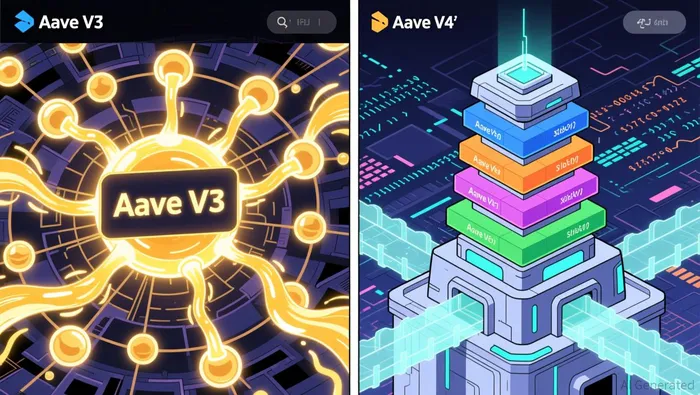
Aave V4 is designed to introduce a modular architecture featuring a hub and spoke model, enabling the protocol to scale into diverse risk categories while maintaining liquidity concentration. The new version aims to enhance capital efficiency and introduce more advanced features without compromising the stability of V3 according to reports.
Stani Kulechov has underscored the importance of token-centric governance as a means to foster long-term sustainability and reduce uncertainty for investors. The shift in focus reflects a broader trend in DeFi towards more decentralized and transparent governance models.
The internal debate over Aave’s governance and development strategy highlights the challenges of managing a decentralized protocol while maintaining innovation and community trust as noted. Aave’s ability to balance these competing priorities will likely determine its long-term success in the rapidly evolving DeFi landscape.
The ongoing disputes and strategic shifts underscore the complexity of aligning the interests of protocol developers, token holders, and users in a decentralized environment according to analysis. Aave’s future direction remains a focal point for the DeFi community as it navigates these challenges.
What are the implications of BGD’s departure for Aave V3?
Bored Ghosts has been a central contributor to Aave V3’s development, and its departure could slow progress on key improvements. This may delay the protocol’s ability to respond to market demands and competitive threats.
The departure also raises governance concerns, with some stakeholders calling the decision “devastating” for Aave V3’s continued development according to reports. BGD’s role in maintaining the protocol’s stability and innovation has been widely recognized, and its absence may require other contributors to step in.
Despite the concerns, Aave Labs has stated it is committed to maintaining V3’s functionality and will continue to offer support until users choose to migrate to v4 as confirmed. This approach aims to ensure a smooth transition without disrupting current users.
What is Aave’s token-centric model, and how does it impact investors?
Aave’s token-centric model is designed to centralize value capture around the Aave token, aligning the interests of token holders with the protocol’s growth. This model enhances transparency and provides a clear framework for revenue distribution.
Under the proposed model, 100% of revenue from for-profit applications will be directed to the Aave DAO, ensuring that token holders benefit directly from the protocol’s success. This aligns with the broader DeFi trend of emphasizing decentralized governance and community-driven development.
The token-centric approach also reduces uncertainty for investors by eliminating the dual model, where value capture was distributed between for-profit applications and the DAO. This clarity is expected to foster greater trust and long-term sustainability.
Investors should consider how the token-centric model affects their exposure to Aave’s growth and governance. A more centralized value capture strategy could influence token price dynamics and investor sentiment.
The model also supports Aave’s broader goal of creating a sustainable and scalable DeFi platform. By focusing on token-centric governance, Aave aims to strengthen its position in the competitive DeFi market.
How does Aave V4 fit into the broader DeFi ecosystem?
Aave V4 is designed to introduce a modular architecture that allows the protocol to scale into different risk categories while maintaining liquidity concentration. This flexibility is intended to support a wide range of DeFi applications and user needs.
The new version will feature a hub and spoke model, enabling broader revenue models and enhancing capital efficiency. This innovation is expected to attract new users and developers to the Aave ecosystem.
Aave V4 aims to maintain the stability and reliability of V3 while introducing advanced features according to analysis. This dual focus on innovation and stability is crucial for maintaining Aave’s position as a leading DeFi protocol.
The modular architecture of Aave V4 also supports the tokenization of traditional assets, enhancing transparency and efficiency in financial systems. This expansion into new asset classes reflects Aave’s broader vision for the future of DeFi.
By introducing Aave V4, the protocol seeks to address market volatility and risk absorption issues. The new version’s design allows for more dynamic risk management, which is essential for maintaining user trust and adoption.
Overall, Aave V4 is a strategic move that positions the protocol for long-term growth and adaptability in the evolving DeFi landscape. The success of this transition will depend on the community’s adoption and continued innovation.

Blending traditional trading wisdom with cutting-edge cryptocurrency insights.
Latest Articles
Stay ahead of the market.
Get curated U.S. market news, insights and key dates delivered to your inbox.


AInvest
PRO
AInvest
PRO



Comments
No comments yet