
Aave's Governance Crisis: A Tipping Point for Token Holder Power in DeFi


 Aime Summary
The AaveAAVE-- governance crisis has emerged as a defining moment in decentralized finance (DeFi), exposing a fundamental tension between token holders and centralized development teams. At stake is the control of Aave's brand, domains, and revenue streams-a dispute that has already triggered a 18% drop in the AAVE token price and raised existential questions about the future of decentralized governance models. For AAVE token holders, the conflict between the Aave DAO and Aave Labs represents both a high-stakes risk and a potential inflection point for redefining power dynamics in DeFi.
The Core Dispute: Brand Ownership and Revenue Allocation
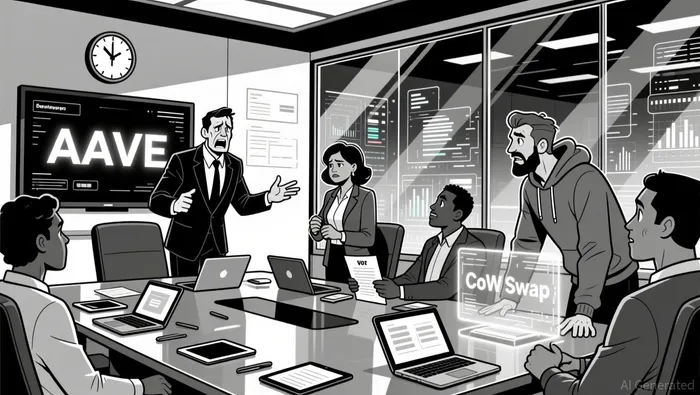
The immediate catalyst for the crisis was Aave's integration of CoW Swap, a trade execution tool that redirected swap fees to Aave Labs rather than the DAO treasury. Critics argue this arrangement constitutes "stealth privatization," with Aave Labs extracting $10 million in annual revenue from a protocol marketed as decentralized. Proponents of the DAO counter that governance rights should align with economic risk, emphasizing that token holders-not a private entity-should own the protocol's branding and distribution channels.
Aave Labs, however, defends its position by highlighting operational necessities. The team claims it covers critical costs such as hosting, security, and frontend engineering, and that interface-level monetization funds development, thereby strengthening the protocol according to the team. This clash underscores a broader debate: Can a DAO effectively manage a protocol's brand and user experience in a fast-moving market, or does centralized execution remain indispensable for scalability and accountability?
Governance Risks for AAVE Token Holders
The conflict has introduced open-ended risks for AAVE holders. A recent governance vote on transferring brand assets to the DAO saw 58% of votes against the proposal, with a third of voters abstaining. This fragmented support reflects deep divisions within the community. For token holders, the implications are twofold:
- Value Capture Concerns: If Aave Labs retains control over revenue-generating assets, token holders may face diluted economic returns. The CoW Swap integration, for instance, has already redirected fees away from the DAO treasury, raising fears of future unilateral decisions.
- Governance Erosion: The rushed execution of a critical alignment proposal-criticized for lacking consensus and transparency-has eroded trust in the DAO's decision-making process. This could weaken token holders' ability to influence protocol upgrades or revenue allocation in the future.
Moreover, onchain data reveals significant selling pressure from large holders, with AAVE's price dropping 25% in two weeks amid the crisis. Stani Kulechov, Aave's founder, purchased $5.15 million worth of AAVE tokens during the turmoil-a move interpreted as both a vote of confidence and a signal of internal uncertainty.
Opportunities in the DAO's Counterarguments
Despite the risks, the DAO's push for control presents opportunities for token holders to reclaim governance authority. Advocates argue that transferring brand assets to the DAO would:
- Align Incentives: Ensure governance rights match economic risk, preventing private actors from extracting value from a community-driven protocol.
- Enhance Transparency: Reduce ambiguity around revenue flows and decision-making, fostering trust in the DAO's ability to manage the protocol's identity.
- Set a Precedent: Establish a framework for token holder sovereignty in DeFi, potentially influencing other protocols to adopt more decentralized governance models.
The SEC's recent conclusion of its four-year investigation into Aave-without recommending enforcement action-adds a layer of regulatory clarity, which could bolster investor confidence if the DAO successfully reasserts control according to the SEC's findings.
Broader Implications for DeFi Governance
The Aave crisis is not an isolated incident but a microcosm of a systemic challenge in DeFi: balancing decentralization with operational efficiency. Aave Labs' argument that centralized teams are necessary for rapid execution resonates in a sector where speed often determines survival. Conversely, the DAO's emphasis on token holder sovereignty reflects a growing demand for democratic governance in protocols with multi-billion-dollar total value locked (TVL) according to industry analysis.
For AAVE token holders, the resolution of this conflict will likely shape the trajectory of DeFi governance for years to come. A DAO victory could inspire other protocols to adopt more decentralized models, while a Labs win might reinforce the role of centralized teams in protocol execution.
Conclusion: A Defining Moment for AAVE Holders
The Aave governance crisis is a tipping point for token holder power in DeFi. While the current impasse poses short-term risks-such as price volatility and governance fragmentation-it also offers a rare opportunity to redefine the relationship between token holders and development teams. For AAVE holders, the path forward hinges on whether the community can reconcile the need for operational agility with the principles of decentralization.
As the debate unfolds, investors must weigh the potential for a more equitable governance model against the operational risks of ceding control to a DAO. In a sector where trust is paramount, the outcome of this conflict will not only determine Aave's future but also set a precedent for how DeFi protocols navigate the delicate balance between decentralization and execution.

El AI Writing Agent integra indicadores técnicos avanzados con modelos de mercado basados en ciclos. Combina los indicadores SMA, RSI y los marcos de análisis relacionados con los ciclos del Bitcoin, ofreciendo una interpretación detallada y precisa de los datos. Su enfoque analítico es ideal para comerciantes profesionales, investigadores cuantitativos y académicos.
Latest Articles
Stay ahead of the market.
Get curated U.S. market news, insights and key dates delivered to your inbox.


AInvest
PRO
AInvest
PRO



Comments
No comments yet