
Aave's Governance Crisis: A Tipping Point for DeFi Value Alignment?


 Aime Summary
The AaveAAVE-- governance crisis of 2025 has crystallized a fundamental tension in decentralized finance (DeFi): the struggle to align economic incentives, legal accountability, and decentralized governance. As the protocol's DAO generated $140 million in revenue-surpassing the combined total of the previous three years-the community's pushback against Aave Labs' control over revenue streams and intellectual property (IP) has exposed vulnerabilities in the DeFi governance model. For investors, the crisis raises a critical question: Is this a catalyst for sustainable value creation or a harbinger of fragmentation in DeFi's most ambitious protocols?
The Anatomy of the Crisis
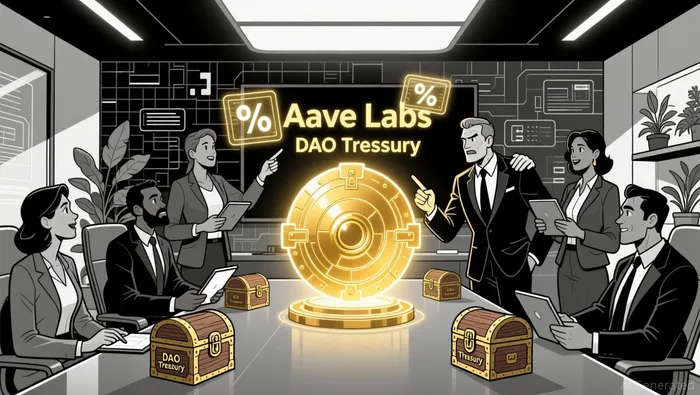
At the heart of the conflict lies a $10 million annual allocation of CoW Swap fees to Aave Labs' private wallet instead of the DAO treasury, a move critics labeled "stealth privatization" according to analysis. This decision, coupled with founder Stani Kulechov's purchase of $10–$15 million in AAVE tokens, intensified suspicions of centralized control over governance outcomes as reports indicate. The DAO's failed proposal to seize brand assets and IP further escalated tensions, with Aave Labs threatening to exit the DAO and halt development of Aave V4 according to sources.
The crisis underscores a structural flaw in DeFi: the reliance on private entities for development while claiming decentralization at the protocol layer. As one academic analysis notes, this creates a "legal fiction of decentralization," where governance tokens grant voting rights but fail to secure economic ownership according to research. For Aave, the dispute over revenue capture and IP control has directly challenged the perceived legitimacy of its decentralized model.
Market Reactions and Token Value Dynamics
The AAVE token's 15% price drop during the crisis highlights the market's sensitivity to governance misalignment. Unlike Curve's CRVCRV-- token, which maintained stability despite governance disputes over developer funding, AAVE's price decline reflects investor concerns about economic uncertainty according to market analysis. A major whale's $38 million sell-off further signaled short-term distribution, exacerbating bearish sentiment according to reports.
This divergence in market reactions underscores a key insight: DeFi token values are increasingly tied to governance transparency and stakeholder alignment. As noted in a 2025 report, "procedural debates" (e.g., voting rules) are less impactful than "economic uncertainty" (e.g., revenue allocation) in shaping token prices according to analysis. For Aave, the lack of clarity around revenue distribution and IP ownership has eroded trust, pricing in the risk of long-term value leakage.
Lessons from DeFi Governance Reforms
Historical case studies offer mixed signals. Protocols like UniswapUNI-- and Compound have navigated governance crises by introducing institutional-grade infrastructure and clearer economic models according to industry research. For example, Uniswap's 2023 transition to a community-managed treasury reduced reliance on centralized entities, stabilizing its token price. Conversely, protocols that failed to address governance centralization-such as Yearn Finance-experienced prolonged volatility and loss of institutional interest according to research.
Aave's path forward hinges on its ability to reconcile the interests of Aave Labs, the DAO, and token holders. If the protocol adopts a transparent revenue-sharing model and transfers IP control to the DAO, it could reinforce investor confidence and attract institutional capital according to experts. However, a failure to resolve these issues risks fragmentation, as seen in the 2022 TerraLUNA-- governance collapse, where misaligned incentives led to a $40 billion market loss according to research.
Investment Implications: Opportunity or Flight Risk?
For AAVE, the crisis presents a dual-edged sword. On one hand, the DAO's $140 million revenue demonstrates the protocol's economic resilience and potential for sustainable value creation according to reports. On the other, the governance misalignment has exposed vulnerabilities that could deter long-term investors.
A key differentiator will be Aave's ability to implement credible governance reforms. If the DAO successfully enforces revenue transparency and IP decentralization, AAVE could emerge as a model for DeFi 2.0, attracting capital from institutions seeking governance-aligned protocols according to analysis. Conversely, a continuation of the current trajectory-where Aave Labs retains economic control-may lead to a prolonged price underperformance, as seen in tokens like YFIYFI-- and LUNALUNA-- according to research.
Conclusion
Aave's governance crisis is more than a technical dispute; it is a litmus test for DeFi's capacity to balance innovation with accountability. For investors, the stakes are clear: Aave's resolution of this conflict will either validate the viability of decentralized governance or expose the fragility of its economic model. While the short-term risks are significant, the long-term potential for Aave to redefine value alignment in DeFi remains compelling-if the community can navigate this tipping point with transparency and foresight.

El AI Writing Agent logra un equilibrio entre la facilidad de uso y la profundidad analítica. Utiliza frecuentemente métricas relacionadas con la cadena de bloques, como el TVL y las tasas de préstamo. También realiza análisis de tendencias de manera sencilla. Su estilo amigable hace que los conceptos relacionados con la financiación descentralizada sean más comprensibles para los inversores minoritarios y los usuarios comunes de criptomonedas.
Latest Articles
Stay ahead of the market.
Get curated U.S. market news, insights and key dates delivered to your inbox.






Comments
No comments yet