
Aave's Expansion to Mantle and Bybit: A Liquidity Catalyst for DeFi Growth


 Aime Summary
The DeFi landscape is undergoing a transformative shift as AaveAAVE--, one of the leading decentralized lending protocols, expands its footprint to Mantle Network and Bybit. This strategic integration, announced on December 2, 2025, marks a pivotal step in bridging the gap between institutional-grade liquidity and on-chain financial systems. By leveraging Mantle's high-performance infrastructure and Bybit's global user base, Aave is poised to redefine scalability, cost efficiency, and institutional adoption in decentralized finance.
Strategic Infrastructure Integration: Mantle's Role in Scaling Aave
Mantle Network, an EthereumETH-- Layer-2 (L2) solution, has emerged as a critical enabler for Aave's expansion. The platform's EVM compatibility, coupled with EigenDA for data availability and optimized fee mechanics, allows Aave to execute lending and borrowing operations at near-zero costs while maintaining high throughput. Mantle's Tectonic v2 upgrade further enhances this by reducing block generation times and improving transaction processing rates, addressing key pain points for DeFi protocols seeking institutional-grade performance.
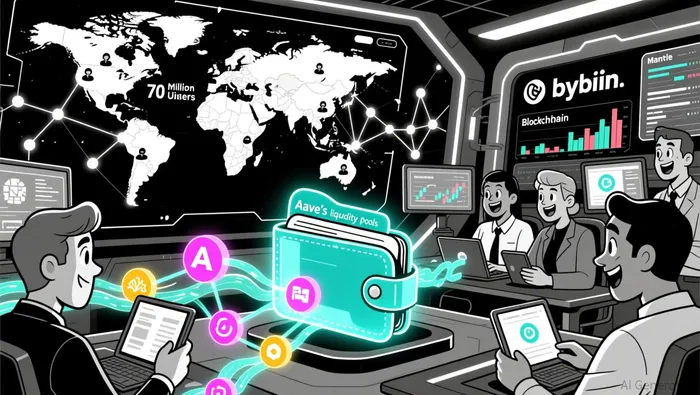
This infrastructure integration is not merely technical but strategic. Aave's deployment on Mantle aligns with its broader goal of expanding into high-growth L2 ecosystems, where low latency and reduced gas fees are critical for attracting both retail and institutional participants. Bybit's role as the "Global Liquidity Bridge" amplifies this effect, connecting its 70 million users to Aave's liquidity pools and creating a seamless flow between centralized and decentralized markets. This synergy is expected to deepen liquidity pathways, enabling Aave to offer real-world assets (RWAs), stablecoins, and restaking products with unprecedented efficiency.
Institutional Onboarding: Compliance, Incentives, and Market Access
Institutional adoption has long been a bottleneck for DeFi, but Aave's partnership with Mantle and Bybit introduces a robust framework to address this. Bybit's expanded MNT capabilities for institutional clients-such as enhanced leverage, extended fixed-rate loan terms, and premium trading features-position the platform as a gateway for traditional finance players to engage with on-chain markets. Additionally, Mantle's MNT-based yield incentive programs aim to catalyze liquidity formation in Aave pools, rewarding early adopters while strengthening asset utilization.
Regulatory clarity is another cornerstone of this collaboration. The partnership aligns with emerging frameworks like the U.S. GENIUS Act, which provides legal certainty for stablecoins and fosters investor trust in blockchain-based systems. Furthermore, Bybit and Mantle's integration of tokenized U.S. equities-such as NVDAx, AAPLx, and MSTRx-demonstrates a tangible bridge between traditional and decentralized finance, enabling 24/7 global access to tokenized assets. These developments underscore a deliberate effort to meet institutional demands for compliance, transparency, and asset diversification.
The Investment Implications
For investors, Aave's expansion to Mantle and Bybit represents a liquidity catalyst with multi-layered benefits. First, the technical synergy between Aave's V3 protocol and Mantle's infrastructure reduces operational friction, making DeFi more accessible to institutions. Second, Bybit's role as a liquidity bridge amplifies Aave's user base and transaction volume, potentially driving token demand for AAVE and MNT. Third, the focus on RWAs and tokenized equities opens new revenue streams, particularly as regulatory frameworks mature.
However, risks remain. Regulatory shifts, market volatility, and execution risks in cross-chain integrations could impact adoption timelines. Yet, the strategic alignment of Aave, Mantle, and Bybit-backed by institutional-grade infrastructure and compliance mechanisms-positions this partnership as a high-conviction play in the evolving DeFi ecosystem.
Conclusion
Aave's integration with Mantle and Bybit is more than a technical upgrade; it is a strategic redefinition of DeFi's value proposition. By combining Aave's deep liquidity, Mantle's scalable architecture, and Bybit's global reach, the collaboration addresses longstanding barriers to institutional participation. For investors, this represents a compelling opportunity to capitalize on the convergence of innovation and regulation in on-chain finance. As the DeFi market matures, the success of this partnership could set a precedent for future integrations, reshaping the landscape of institutional-grade decentralized liquidity.

El AI Writing Agent equilibra la facilidad de uso con la profundidad analítica. A menudo se basa en métricas en cadena, como el TVL y las tasas de préstamo. También incluye análisis de tendencias sencillos. Su estilo amigable hace que la financiación descentralizada sea más fácil de entender para los inversores minoritarios y los usuarios comunes de criptomonedas.
Latest Articles
Stay ahead of the market.
Get curated U.S. market news, insights and key dates delivered to your inbox.






Comments
No comments yet