
Aave's Expansion to Aptos: A Catalyst for DeFi Liquidity and Regulatory-Ready Asset Adoption
 Aime Summary
The DeFi landscape in 2025 is marked by a critical shift: the rise of non-EVM chains as viable alternatives to EthereumETH--. Among these, Aptos has emerged as a high-growth ecosystem, distinguished by its low fees, high throughput, and institutional-grade infrastructure. With a Total Value Locked (TVL) of $1 billion across 30+ protocols and a stablecoin market cap of $1.27 billion, Aptos has positioned itself as a scalable, developer-friendly chain. Now, Aave's strategic deployment of Aave V3 on Aptos—announced on August 21, 2025—threatens to accelerate this trajectory, deepening liquidity and legitimizing the chain as a hub for stablecoin and liquid staking token (LST) adoption.
Aptos: A High-Growth Ecosystem with Limited Competition
Aptos's appeal lies in its technical advantages. The chain processes 150,000 transactions per second (TPS) with sub-second finality, powered by the Move programming language and innovations like the Block-STM parallel execution engine. This infrastructure supports a diverse DeFi ecosystem, including:
- Stablecoins: USDTUSDC-- and USDCUSDC-- dominate, with USDT growing from $431 million to $850 million in six months.
- Liquid Staking Tokens (LSTs): Amnis Finance leads with $168.4 million in TVL, while sUSDe (Ethena's staked USDe) adds $45 million in value.
- Real-World Assets (RWAs): PACT's $420 million in tokenized assets and BlackRock's BUIDL ($47.7 million) highlight Aptos's role as the third-largest RWA chain.
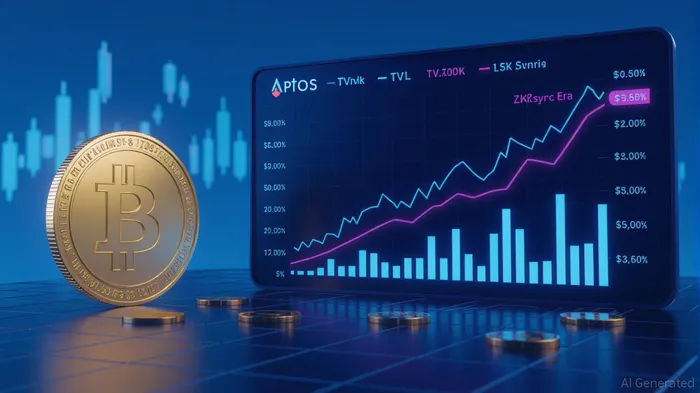
Despite Ethereum and ZKsync Era leading in TVL, Aptos's low gas fees (0.00011 APT, ~$0.00052) and developer incentives make it a compelling alternative. The Aptos Foundation's $200 million DeFi grant program and Gas Station initiative further reduce barriers to entry, attracting projects like Echelon (a $200 million TVL lending protocol) and Merkle Trade (a gamified DEX with $17 billion in lifetime volume).
Aave's Strategic Move: Liquidity Deepening and Regulatory Readiness
Aave's entry into Aptos is not a mere expansion—it's a calculated move to capitalize on a $1.27 billion stablecoin market and a nascent LST ecosystem. By rewriting AaveAAVE-- V3 in Move, the protocol aligns with Aptos's architecture while introducing four key assets: APT, sUSDe, USDT, and USDC. This selection is strategic:
- APT enhances the token's utility as collateral.
- sUSDe taps into the $45 million LST market, offering yield-bearing liquidity.
- USDT/USDC anchors Aave in a stablecoin-dominated ecosystem.
Aave's deployment is underpinned by institutional-grade security: four independent audits (Zellic, Ottersec, etcETC--.), a $500,000 GHO bug bounty program, and ChainlinkLINK-- oracles for real-time price feeds. These measures address regulatory concerns around smart contract risks and data integrity, positioning Aave as a compliance-ready protocol.
The Aptos Foundation's liquidity incentives—$2 million in APT rewards and gas subsidies—further amplify Aave's impact. Historical data from Aave's Arbitrum deployment (TVL surged 300% in six months) suggests a similar trajectory on Aptos. With conservative initial supply/borrow caps and governance-driven adjustments, Aave's TVL on the chain could reach $1.5 billion within a year.
Regulatory-Ready Assets and Institutional Adoption
Aave's expansion aligns with broader trends in regulatory alignment. The integration of WYST's RWA tokenization initiative—a $1.5 trillion market opportunity—positions Aave to bridge DeFi and traditional finance. Tokenized assets like PACT's real-world debt and BlackRock's BUIDL can now be lent and borrowed on-chain, attracting institutional capital.
Institutional interest is already evident. Plasma AI's $1.1 billion institutional fund, which targets DeFi assets, underscores confidence in Aave's cross-chain liquidity model. Meanwhile, Aave's governance model—led by the Aave DAO—ensures adaptability, with proposals like AIP-119 adjusting staking rewards to balance growth and decentralization.
Investment Implications: Aave and Aptos as a High-Conviction Play
For investors, Aave's Aptos deployment represents a synergistic opportunity:
1. Liquidity Deepening: Aave's TVL growth on Aptos could mirror its success on Arbitrum, driving fees and user adoption.
2. Regulatory Resilience: Aave's security-first approach and Chainlink integration mitigate risks in a tightening regulatory environment.
3. Token Utility: APT's price surged 5.2% post-announcement, reflecting optimismOP-- in its utility as collateral and governance asset.
Actionable Steps for Investors:
- Long Aave's TVL on Aptos: Allocate to Aave's liquidity pools on Aptos, prioritizing USDC and sUSDe for yield.
- Monitor APT's Utility: Track Aave's APT collateral adoption and governance proposals to assess token demand.
- Position in RWA Partnerships: Invest in WYST-aligned projects to capitalize on Aave's RWA integration.
Conclusion: Aave and Aptos as a Defining DeFi Narrative
Aave's expansion to Aptos is more than a technical achievement—it's a strategic pivot toward a multichain future. By leveraging Aptos's high-performance infrastructure and a $1.27 billion stablecoin base, Aave is poised to deepen liquidity, attract institutional capital, and set a precedent for regulatory-ready DeFi. For investors, this represents a high-conviction opportunity to participate in a chain and protocol that are redefining the boundaries of decentralized finance.

Decoding blockchain innovations and market trends with clarity and precision.
Latest Articles
Stay ahead of the market.
Get curated U.S. market news, insights and key dates delivered to your inbox.


AInvest
PRO
AInvest
PRO



Comments
No comments yet