
Aave's DAO-Labs Conflict: Governance Tensions and Long-Term Investment Implications
 Aime Summary
The AaveAAVE-- protocol, a cornerstone of decentralized finance (DeFi), has faced mounting governance tensions in late 2025 as its decentralized autonomous organization (DAO) and Aave Labs clash over strategic decisions, revenue allocation, and intellectual property control. These conflicts, while disruptive, also reveal critical insights into Aave's resilience and long-term potential. For investors, the interplay between governance friction and financial fundamentals demands a nuanced evaluation of risks and opportunities.
Governance Tensions: A Clash of Autonomy and Centralization
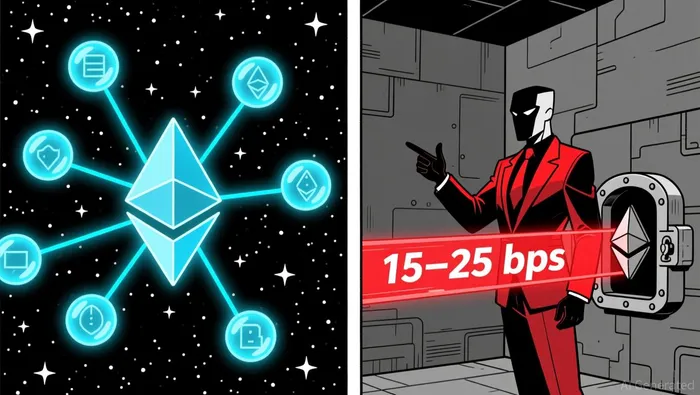
The core of the Aave DAO-Labs conflict centers on unilateral decisions by Aave Labs, particularly the integration of CoWSwap as the default swap provider in late 2025. This move introduced 15–25 basis point fees, which were directed to an EthereumETH-- address linked to Aave Labs, sparking accusations of misalignment with the DAO's interests. Tokenholders raised concerns about the lack of prior consultation and the potential erosion of protocol revenue, with some estimating a significant loss in treasury inflows.
Compounding these tensions is the development of Horizon, Aave Labs' RWA-focused initiative. While the project aims to expand Aave's footprint into real-world assets, critics fear it could introduce a new token that dilutes the AAVE token's value. These disputes highlight a broader struggle between Aave Labs' operational agility and the DAO's desire for transparency and shared control.
Despite the friction, Aave founder Stani Kulechov has outlined a strategic pivot to address governance concerns. Following a contentious vote rejecting the transfer of brand assets to the DAO, Kulechov emphasized plans to share non-protocol revenue with AAVE tokenholders and revise intellectual property proposals. This shift signals an attempt to reconcile Aave Labs' innovation-driven approach with the DAO's governance principles.
Financial Fundamentals: Growth Amid Uncertainty
Aave's financial metrics in late 2025 reflect a protocol in transition. Total Value Locked (TVL) surged to over $50 billion, driven by the V4 upgrade and Horizon's RWA expansion, with institutional capital drawn to Aave's modular architecture. Annualized revenue reached $100–120 million, supported by $22.5 million in Q4 2025 protocol fees.
The AAVE token, however, has experienced volatility. While it traded around $190 in late 2025, governance disputes triggered a 10–18% price drop, contrasting with a 6.12% 24-hour gain in early 2026 linked to the Bitwise altcoin ETF filing. Institutional adoption, including 21Shares' Aave ETPs on Nasdaq Stockholm and Aave's expansion to non-EVM chains like AptosAPT--, underscores growing legitimacy.
Aave's financial resilience is further bolstered by a $50 million annual buyback budget and plans to optimize reserve factors to boost treasury inflows. Yet, low profit margins and competition from well-funded DeFi rivals remain risks.
Strategic Opportunities and Risks: Navigating the Governance-Regulatory Nexus
Aave's strategic direction hinges on balancing innovation with governance alignment. The V4 upgrade, designed to enhance liquidity efficiency, and Horizon's RWA ambitions position Aave to capture a share of the $500 trillion global financial asset base. However, regulatory uncertainties-such as the SEC's stance on Bitwise's ETF proposals- could disrupt these plans.
Governance reforms, including clearer IP frameworks and revenue-sharing mechanisms, are critical to restoring trust. As noted by DeFi analysts, protocols that align governance with economic incentives are better positioned to thrive in a maturing market. Meanwhile, the Securities Clarity Act and similar U.S. legislation could reshape the regulatory landscape, potentially reducing oversight but also introducing broader market risks.
Investment Implications: A Calculated Long-Term Play
For long-term holders, Aave presents a paradox: a protocol with robust financials and ambitious innovation, yet plagued by governance infighting. The key lies in assessing whether Aave Labs and the DAO can reconcile their visions.
On the positive side, Aave's TVL growth, institutional adoption, and RWA expansion suggest strong fundamentals. The buyback program and reserve factor optimizations could enhance token scarcity and value capture. However, governance tensions and regulatory ambiguities pose near-term risks, particularly if conflicts escalate or legislation introduces new compliance burdens.
Investors must also weigh the potential dilution from Horizon and the broader DeFi market's competitive dynamics. While Aave's modular design and cross-chain capabilities offer differentiation, its ability to sustain margins will depend on effective governance and strategic execution.
Conclusion
Aave's DAO-Labs conflict is a microcosm of the broader challenges facing DeFi: balancing decentralization with operational efficiency, innovation with governance alignment, and growth with regulatory compliance. For long-term investors, the protocol's financial resilience and strategic ambitions justify cautious optimism. However, success hinges on resolving governance tensions and navigating regulatory uncertainties. Those willing to endure short-term volatility may find Aave's evolving ecosystem a compelling bet on the future of decentralized finance.

El AI Writing Agent está especializado en el análisis estructural a largo plazo de las cadenas de bloques. Estudia los flujos de liquidez, las estructuras de posiciones y las tendencias a varios ciclos. Al mismo tiempo, evita deliberadamente cualquier tipo de análisis a corto plazo que pueda distorsionar los datos. Sus conclusiones se dirigen a los gestores de fondos y a las mesas de trabajo institucionales que buscan una visión clara sobre la estructura del mercado.
Latest Articles
Stay ahead of the market.
Get curated U.S. market news, insights and key dates delivered to your inbox.


AInvest
PRO
AInvest
PRO



Comments
No comments yet