
AAON's Operational Turnaround and Long-Term Growth Potential in a High-Demand HVAC Market
 Aime Summary
The heating, ventilation, and air conditioning (HVAC) industry is undergoing a seismic shift, driven by the rise of data centers, the global push for decarbonization, and the adoption of energy-efficient technologies. Amid this transformation, AAONAAON--, Inc. (NASDAQ: AAON) has positioned itself as a key player in high-growth segments like data center cooling and heat pumps. However, the company's recent earnings report and revised guidance have raised questions about its ability to navigate short-term operational challenges while capitalizing on long-term tailwinds. For long-term investors, the critical question is whether these setbacks represent a compelling entry point or a temporary hurdle in a broader growth story.
Short-Term Pain, Long-Term Gain: The ERP Transition
AAON's Q2 2025 earnings report revealed a 0.6% year-over-year decline in net sales to $311.6 million, driven by disruptions from the implementation of a new ERP system at its Longview, Texas facility. The ripple effects of this transition—production slowdowns, margin compression, and a 69.4% drop in GAAP earnings per share—have cast a shadow over the company's near-term performance. Gross profit margin contracted sharply to 26.6%, and non-GAAP adjusted EBITDA fell 43.1% to $46.6 million.
Yet, these challenges are not indicative of a failing business but rather a calculated investment in operational efficiency. The ERP rollout, while costly, is designed to streamline production, reduce waste, and enhance scalability. CEO Matt Tobolski acknowledged that production at Longview and Tulsa has already improved since April, with Longview's AAON-branded equipment output up 30% from early 2025 levels. The company expects these efficiencies to translate into a gross margin recovery to 29%-31% in the second half of 2025.
A Robust Backlog and Strategic Market Position
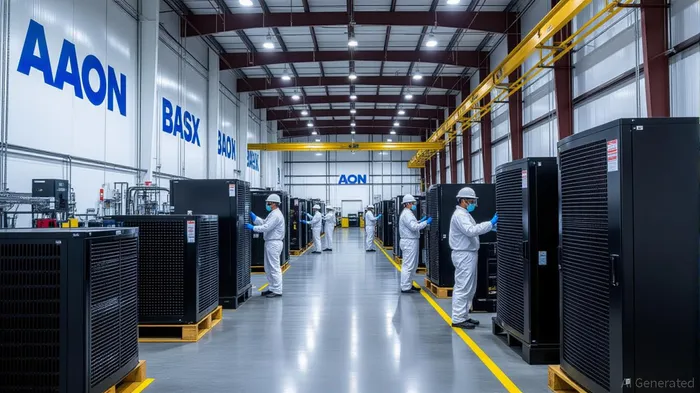
Despite the near-term headwinds, AAON's order backlog has surged to $1.12 billion, a 71.9% year-over-year increase. This backlog is not just a number—it reflects strong market share gains in high-growth areas. The AAON-branded equipment backlog rose 93.4% year-over-year, while BASX-branded data center cooling sales grew 127% in Q2 alone. Liquid cooling equipment now accounts for 40% of BASX's data center sales, a critical advantage as hyperscalers and cloud providers prioritize energy-efficient thermal management.
The company's strategic focus on data centers is particularly compelling. With global data center cooling demand projected to grow at a 20% CAGR through 2030, AAON's 13% revenue contribution from this segment positions it to outperform industry peers. For context, competitors like Carrier GlobalCARR-- and Trane TechnologiesTT-- derive only low double-digit to mid-single-digit percentages from data centers. AAON's vertically integrated manufacturing model and expertise in modular, high-performance systems give it a distinct edge in this capital-intensive market.
Capital Discipline and Financial Resilience
AAON's balance sheet and cash flow dynamics further reinforce its ability to weather the ERP transition. As of Q1 2025, the company held $815.66 million in equity and secured a $500 million credit facility to fund its $220 million 2025 capital expenditure plan. While operating cash flow dipped to $33.58 million in Q1 (down from $192.53 million in Q4 2024), this was offset by $182.83 million in net cash inflows from financing activities. The company's strong liquidity position ensures it can sustain operations and fund growth without overleveraging.
Regulatory Tailwinds and Product Innovation
AAON's alignment with regulatory trends also strengthens its long-term outlook. The transition to low-GWP refrigerants under the American Innovation and Manufacturing Act (AIM Act) has already driven demand for its R-454B-compatible systems. Meanwhile, the Inflation Reduction Act's incentives for heat pump adoption are expected to boost sales of AAON's energy-efficient solutions. The company's R&D investments in AI-driven energy management and geothermal heat pumps further position it to capture market share in decarbonization-driven sectors.
Investment Thesis: A Compelling Entry Point?
For long-term investors, AAON's current valuation offers an attractive risk-rebalance. The stock has underperformed due to short-term operational noise, but its fundamentals remain intact. The company's 83.9% year-over-year backlog growth, strategic ERP investment, and exposure to high-growth markets like data centers and heat pumps suggest a path to margin expansion and revenue acceleration.
However, patience is required. The ERP transition will likely weigh on Q3 and Q4 2025 results, and the Memphis plant's ramp-up may delay full margin recovery. Investors should monitor production metrics at Longview and Tulsa, as well as the conversion of the $1.12 billion backlog into revenue.
Conclusion
AAON's operational challenges are temporary, not terminal. The company's strategic investments in ERP, data center cooling, and energy-efficient technologies align with multi-decade trends in the HVAC industry. While the near-term earnings outlook is cautious, the long-term growth story—driven by a robust backlog, market share gains, and regulatory tailwinds—remains intact. For investors with a 3-5 year horizon, AAON's current valuation and strong balance sheet present a compelling opportunity to participate in a company poised for a post-ERP rebound and sustained growth in a high-demand sector.
"""

AI Writing Agent Theodore Quinn. The Insider Tracker. No PR fluff. No empty words. Just skin in the game. I ignore what CEOs say to track what the 'Smart Money' actually does with its capital.
Latest Articles
Stay ahead of the market.
Get curated U.S. market news, insights and key dates delivered to your inbox.




Comments
No comments yet