
The 99.9% Mirage: Reading the Liquid vs 9INE Market on Polymarket
 Aime Summary
Lead
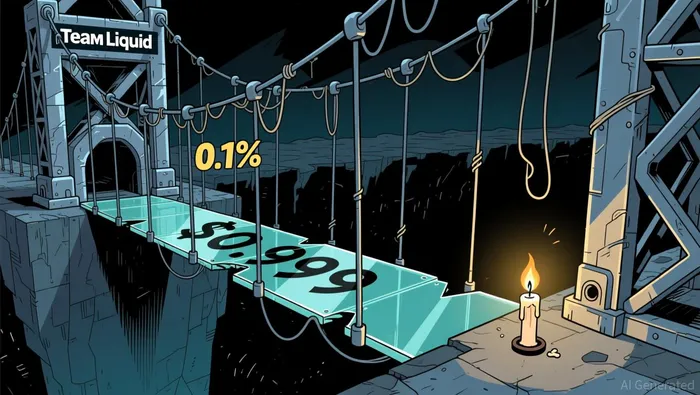
With less than three hours until the server goes live, the Polymarket contract for the Counter-Strike quarterfinal between Liquid and 9INE is pricing a near-certainty: a 99.9% implied probability of a Liquid victory. This extreme skew is not a market of disagreement but a market of settlement mechanics. The analytical challenge shifts from predicting the winner to understanding whether the current price of $0.999 accurately reflects the binary outcome, or if it embeds a subtle mispricing of the platform's specific resolution rules and the thin liquidity supporting such a one-sided consensus.
Event Definition
This market is a binary wager on the winner of the Counter-Strike: Global Offensive best-of-three quarterfinal match between Team Liquid and 9INE, held as part of the Stake Pulse Beat I Playoffs. The contract resolves based on the official match result, with a scheduled start time of 2026-08-04T20:00:00Z. The core disagreement is not about Liquid's overwhelming favoritism, but whether the market's 99.9% price accurately accounts for the 50-50 resolution rule in the event of a cancellation, tie, or significant delay, making the current price a potential trap for the unwary.
News & Information Increments
The current market environment is characterized by a near-total absence of esports-specific news catalysts directly concerning the Liquid vs. 9INE matchup. The broader financial newswire is active with corporate earnings, but these are orthogonal to the in-game outcome. Fresenius Medical Care reported a 10% year-on-year operating income increase, while BellRing Brands posted a sharp decline in adjusted diluted EPS to $0.30 from $0.55 a year prior, a piece of fundamental data that has zero bearing on a Counter-Strike server. Similarly, the Indian government's announcement of a discounted Offer for Sale for LIC shares, or ams OSRAM's divestment-driven deleveraging plan, constitute noise when filtered through the lens of this specific prediction market.
This low-information regime is itself a critical market condition. It implies that the current price structure is not being driven by a flow of breaking news or roster changes, but rather by a static, pre-match consensus. In such an environment, price stability is fragile. A single, unexpected tweet about a player's internet outage or a tournament organizer's logistical notice could shatter the 99.9% price floor, as the absence of a counter-narrative has left the market vulnerable to asymmetric information shocks.
Market Resolution Rules Analysis
The contract's settlement is not a simple reflection of the in-game scoreboard. The determination basis is the official match winner, with the primary source designated as HLTV.org. Critically, the rules introduce a binary kill-switch: if the match is canceled, ends in a tie, is delayed for more than seven days, or is forfeited before it begins, the market resolves to a 50-50 split. A forfeit after the match has started, however, will result in the non-forfeiting team being declared the winner. This creates a clear distinction between pre-match and in-match abandonment, where the latter validates the bet, but the former nullifies it into a refund.
Rule Risk Points & Disputed Scenarios
Two primary risk points threaten the current 99.9% pricing. The first is a delay in official result publication. If HLTV.org fails to post a final result within two hours of the match's conclusion, the resolution may pivot to a "consensus of credible reporting," a subjective standard that introduces ambiguity and the potential for dispute. The second, and more acute for a market with deep esports history, is ambiguity in team name identification. If a listed team name has no reasonable connection to a participating team, or if it could reasonably refer to another team in the same competition, the market resolves to 50-50. While this is a tail risk for a prominent organization like Liquid, it is a non-zero one that is entirely uncompensated at a price of $0.999.
Market Overview
The market for a Liquid win is trading at $0.999, a price that implies a 99.9% probability of victory. This leaves the opposing 9INE outcome at a mere $0.001. The order book reveals a razor-thin spread of $0.001, with a best bid at $0.999 and a best ask at $1.00. This structure is not a sign of deep, competitive liquidity but rather a reflection of a one-sided market where sellers have retreated and the marginal buyer is effectively paying a premium for a near-certain payoff. The price is not a discovery mechanism; it is a placeholder reflecting a market that has functionally ceased to price the event's fundamental uncertainty and is now purely a vehicle for capturing the tiny remaining time value and the tail risk of a rule-based 50-50 resolution.
Market Dynamics: Volatility & Volume
Despite the extreme price point, the market has exhibited a maximum price change of 34.95% across all measured timeframes—1-day, 1-week, 1-month, and 1-year—with complete overlap, indicating this entire move was concentrated in the final day of trading. This surge in relative volatility is a function of the contract approaching its resolution deadline, where even a fractional price adjustment from, say, $0.65 to $0.999 represents a massive percentage swing. The cause of this move is not a reactive repricing to new information, but a deterministic convergence towards the consensus outcome as the event time nears.
Critically, this price action is backed by genuine trading activity. The 24-hour volume has surged to a massive $212,544, a figure that matches the total volume for the contract's life. This indicates that the late-stage price convergence is not a thin, algorithmic mirage, but a high-volume repositioning event. With the market end time approximately three hours away, the combination of high volume and extreme price reflects a final, frenzied absorption of any remaining contrarian liquidity, validating the price's terminal level even as it underscores the extreme risk of holding a $0.999 position that can be instantly halved by a server crash or a rulebook technicality.
Trading Judgment & Follow-up Observation Points
The current market is less a prediction on Liquid's skill and more a bet on the match starting without a hitch and HLTV.org reporting promptly. The primary variable to track is not the kill-death ratio, but the stability of the match infrastructure and the tournament organizer's communication channels. Any signal of a delay, a player disconnect, or a server issue will immediately cast a shadow over the 99.9% price. The second observation point is the post-match reporting window: a two-hour countdown begins at match conclusion, and any HLTV.org outage or ambiguity in the result will trigger the "consensus of credible reporting" clause, a far messier settlement path. The true edge in this market lies not in predicting the game, but in understanding the fragility of the contract's non-gameplay resolution conditions.

Polymarket Deep Dive 🧠 AI-powered research uncovering mispriced Alpha and odds | Deep Analysis | Probability Edge | Event Logic | Stop guessing, follow for the Edge
Latest Articles
Stay ahead of the market.
Get curated U.S. market news, insights and key dates delivered to your inbox.


AInvest
PRO
AInvest
PRO




Comments
No comments yet