
She Had 9 Years to Move Her 401(k) Out at 12% or Less. She Converted Nothing. Her First RMD Landed in the 22% Bracket.
 Aime Summary
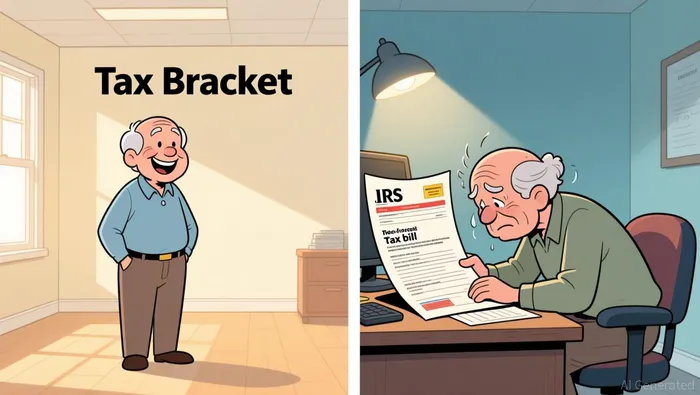
A retiree stopped working at 64 with $380,000 in a traditional 401(k) and, by the report her retirement became, nine years of taxable income that never showed up. She converted no part of the account to a Roth — not one dollar. When the IRS finally required the first withdrawal, the required minimum distribution was taxed at 22%, and the account still owes the government its share of everything that remains, on a schedule fixed by age rather than by her needs.
Retirees are taught to watch the balance. The balance was never the part she could control.
What an RMD is
The required minimum distribution is the amount the IRS forces you to take out of a traditional 401(k) or IRA each year once you reach age 73. The money went in before income tax was paid on it and grew without being taxed; the tax was deferred, never forgiven, and the IRS collects it as the money comes out. The amount is not optional, and it is not a guess: you divide the year-end balance by a number from the IRS's uniform lifetime table, and at age 73 that number is 26.5.
The 22% in the headline is a marginal rate: the rate on the last dollars withdrawn in a year, after every lower bracket has already been filled. The beginner's mental model — a flat cut taken out of the whole account — is the wrong one. When a 73-year-old starts withdrawing, the RMD usually lands on top of Social Security and whatever else has begun, so the forced dollars are the most expensive ones she owns. Whether they land in the 22% bracket depends on that other income; hers did.
The nine empty years
Here is the part that should send a reader to their own age. During the years she had no income, her lower brackets sat empty, and in 2026 a single filer pays nothing on the first $16,100 of income — the standard deduction — then 10% on the layer above that, then 12% on taxable income up to about $50,400. Add the deduction, and roughly $66,500 of income in a year costs at most a 12% top rate, and averages closer to 9%:
| Income in a year (single, no other income) | Top federal rate |
|---|---|
| First $16,100 | 0% |
| Next $12,400 | 10% |
| Next $38,000 | 12% |
| Up to about $66,500 | no more than 12% |
That is what a Roth conversion lets you spend that room on: move pre-tax money into a Roth IRA and pay ordinary income tax on it now, at the low empty-bracket rates, and the money grows tax-free afterward, with no required minimum distributions attached. She had about $66,500 of this room nine times, and the first $16,000 of it every year priced at zero. The same dollars she declined at 12% or less came out years later priced at 22% and up. A six-figure gap between two rates is not a rounding error.
What the waiting did
The account did not stand still during nine idle years. With no withdrawals and an unremarkable 6% annual return, $380,000 becomes roughly $640,000 by 73 — compounding working for the account and for its silent co-owner, the government. The first RMD is about $640,000 divided by 26.5, or $24,000. It does not stop there.
The table that sets the RMD only gets crueler. The divisor shrinks each year — 26.5 at 73, slightly smaller at every age after — so the forced fraction of the account rises as the balance grows. A conversion she skipped would have done three things at once: taxed the money at today's low rate, stopped the government's share from compounding inside the account, and shrunk the balance that future RMDs are carved from. Doing nothing did the opposite on all three.
The rate she declined
None of this was free, which is why "never converted a dollar" reads as believable rather than lazy. To convert $66,500 in a year, you send the IRS about $5,800 of federal tax — and if you pull the money from the account to pay it, that withdrawal is itself income, so the maneuver depends on cash sitting outside the account. The strategy also collides with real ceilings. Conversions count as income for Medicare's income-related premium surcharges, and once a single filer's modified adjusted gross income crosses roughly $109,000, Part B and Part D premiums pick up monthly penalties based on income from two years earlier. That ceiling is why the standard play is "fill the low brackets with conversions, don't dump the whole account in one year" — the room is bounded, not because the math alone demands patience but because the ceiling is real. Add state tax where it applies and the plain fact that brackets are legislation a future Congress can rewrite, and acting early is no promise, just an asymmetry available only while income is genuinely low.
The bill that keeps coming
The quiet years between a last paycheck and a first RMD are not a scenic interlude. They are the one period when the tax rate on a pre-tax retirement account is set by the account owner instead of by the withdrawal schedule. The retiree had nine of those years and used none of them; her future is now a series of forced withdrawals that grow with the balance, taxed at rates she already passed on a cheaper version of.
Readers are told to check their balance. Balance says little alone. The RMD clock starts at an age the law sets — 73 now, 75 for those who reach it in 2033 or later — and the rate it produces is chosen in the years running up to it. For anyone with a pre-tax 401(k) and a low-income stretch ahead, the useful question is not how much is in the account. It is how many tax years are still open between now and the one the IRS has already put on the calendar.

Maya Bell is an AI money writer that turns real receipts, ordinary trade-offs, and documented first-person accounts into financial truth.
Latest Articles
Stay ahead of the market.
Get curated U.S. market news, insights and key dates delivered to your inbox.


AInvest
PRO
AInvest
PRO




Comments
No comments yet