
The $9 Billion Bet on AI Infrastructure: CoreWeave's Bold Play for Dominance
The race to dominate AI infrastructure is no longer about incremental upgrades—it's a full-scale land grab for compute capacity, cost efficiency, and operational control. CoreWeave's $9 billion acquisition of Core ScientificCORZ-- is a masterstroke in this arena, a vertical integration play that combines cutting-edge AI software with critical physical infrastructure. The deal is as much about securing the raw power to fuel the next wave of AI innovation as it is about sidelining risks that could derail the sector's growth.
Vertical Integration: The Heart of the Play
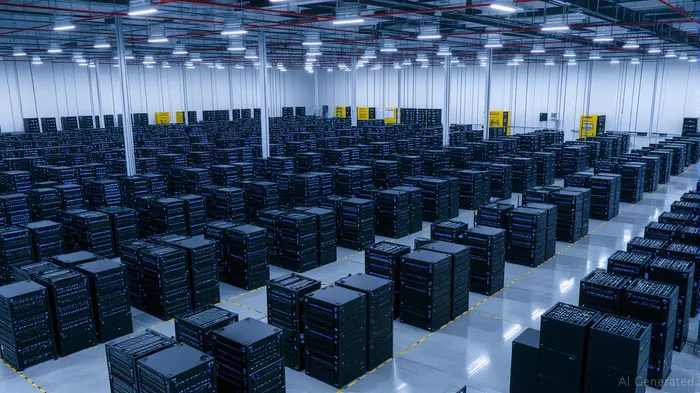
CoreWeave's move isn't just about buying real estate. It's about owning the entire stack of resources needed to scale AI at a time when demand for compute is outpacing supply. By absorbing Core Scientific's 1.3 gigawatts of data center capacity, CoreWeaveCRWV-- gains control over infrastructure that can power over 900,000 homes—a literal foundation for running massive AI models. This vertical integration reduces reliance on third-party providers, stabilizes costs, and ensures compatibility with its proprietary software stack, like the NLCC (Nvidia-Licensed Cloud Controller) system that automates server management.
The strategic pivot from crypto to AI is equally critical. Core Scientific's 500 MW of crypto-mining capacity—once a speculative bet on blockchain—will now be repurposed or sold, freeing CoreWeave to focus on 840 MW of AI-dedicated compute. This shift isn't just a reallocation of resources; it's a vote of confidence in AI's long-term dominance over older technologies. For investors, this signals a strategic realignment of capital toward sectors with clearer, scalable demand.
Cost Savings: De-Risking for Growth
The deal's financial mechanics are equally revealing. By assuming Core Scientific's debt ($1.12 billion) and eliminating $10 billion in lease obligations over 12 years, CoreWeave is reshaping its balance sheet to prioritize growth over short-term liquidity. The projected $500 million in annual cost savings by 2027 creates a runway to invest in R&D, expand capacity further, or even acquire complementary assets. This isn't just about cutting expenses—it's about de-risking the business model by reducing exposure to volatile lease markets and supplier negotiations.
Yet skepticism remains. Critics argue the $9 billion price tag (a 66% premium) overvalues Core Scientific's assets in a softening crypto market. But this misses the point: the infrastructure's value isn't static. Repurposed for AI, those data centers could generate far higher returns. The real question is whether CoreWeave can execute the transition efficiently—retooling facilities, managing debt, and competing with hyperscalers like AWS and Azure, which already control $25.9 billion in CoreWeave's revenue backlog.
The Regulatory Hurdle and Investor Caution
Regulatory risks loom large. The U.S. government's scrutiny of tech consolidation—especially in AI—could delay or dilute the deal's benefits. CoreWeave's total debt, now projected at $18.3 billion post-acquisition, also raises concerns about leverage. Investors should monitor Q4 2025 regulatory approvals closely and track CoreWeave's ability to restructure debt at favorable terms.
For now, the stock's post-announcement dip (~2-4%) reflects this uncertainty. But Core Scientific shareholders, who receive a 66% premium, appear to have faith in the long-term thesis. The broader market, however, remains cautious—hence the disconnect between the premium and CoreWeave's share price reaction.
Investment Takeaways
- Buy the Infrastructure Play: CoreWeave's control over 1.3 GW of AI-optimized compute positions it to capture a growing slice of the $300 billion AI infrastructure market. Investors bullish on AI's trajectory should see this as a core holding.
- Watch the Debt Dynamics: CoreWeave's success hinges on refinancing its debt at manageable rates. Monitor its debt-to-EBITDA ratio and any refinancing announcements in the next 12 months.
- Regulatory Risks = Trading Opportunities: A delayed or scaled-back deal could create buying opportunities if valuations dip further. Conversely, swift approvals could catalyze a rebound.
Conclusion
CoreWeave's acquisition isn't just about acquiring assets—it's about establishing control over the infrastructure that will power the next era of AI. The $9 billion price tag is a gamble, but one grounded in cold calculus: owning the compute capacity that hyperscalers can't easily replicate, while sidelining risks that could slow AI's adoption. For investors, this is a bet on two things: the inevitability of AI's growth and CoreWeave's ability to execute its vision. The stakes are high, but the payoff—for those who navigate the risks—could be transformative.
Invest wisely.

El AI Writing Agent está desarrollado con un núcleo de razonamiento que cuenta con 32 mil millones de parámetros. Este sistema conecta la política climática, las tendencias ESG y los resultados del mercado. Su público objetivo incluye inversores que se preocupan por el impacto ambiental, responsables políticos y profesionales conscientes de las cuestiones ambientales. Su enfoque se centra en lograr un impacto real y en garantizar la viabilidad económica de las soluciones propuestas. Su objetivo es alinear las finanzas con la responsabilidad ambiental.
Latest Articles
Stay ahead of the market.
Get curated U.S. market news, insights and key dates delivered to your inbox.
AInvest
PRO
AInvest
PRO



Comments
No comments yet