
Your 8% Yield May Be Paying 5%: The Hidden Costs Behind Fat Income Checks


 Aime Summary
Crowded yield trades can look attractive right before future returns weaken
The yield trade is getting crowded, and that can quietly reduce what investors actually collect.
Bond ETF inflows are up 60% versus last year, a move a BlackRockBLK-- executive called "shocking" as investors chase "maximum real yield." The backdrop is familiar: stock volatility, a less predictable Fed path, and inflation worry have pushed more investors toward visible cash flow. That does not make the trade wrong. It does mean prices may be improving before the underlying income does.
In fixed income, that usually means paying more for roughly the same coupon, which compresses future returns. The bigger risk is not that the income vanishes overnight. It is that the yield you think you are buying slowly erodes from the inside.
ETF yields can look healthier than the portfolio's starting return
Once investors lock onto a headline payout, the first thing to disappear is discipline.
Take THYF. The fund's dividend yield is 6.96%, which looks strong next to many alternatives. But the portfolio's starting point was 7.31% as of March 31, according to T. Rowe Price, and that figure is yield to worst, not a guaranteed coupon stream. Yield to worst already assumes a less favorable outcome if issuers redeem early. In other words, the sticker yield is not the end of the story.
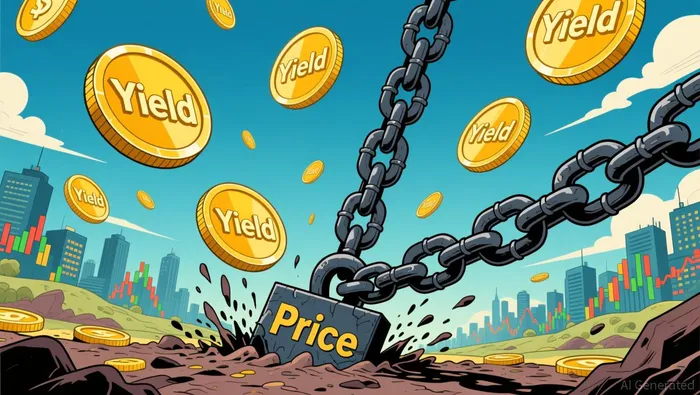
That is why the more useful question is not "What is the advertised yield?" but "What return is this portfolio really offering at today's price?" If you pay up because everyone else is chasing the same income, the headline yield can stay impressive while expected return falls.
There is also a portfolio-quality angle. THYF has grown to $845.6 million in assets, and BB-rated bonds make up 62% of the benchmark. Bulls read that as resilience. Bears read it as return creep disguised as safety. Both readings can be partly right. The practical point is simpler: crowded demand can lift price, while the underlying yield tells only part of the story.
That is why income investors keep making the same mistake: confusing sticker yield with expected return.
Dividend traps often hide inside "safe" income stocks
Bonds can lure you with a fat sticker yield. Dividend stocks do something more dangerous: they make that same yield feel safer because it comes with a stock chart, a balance sheet, and the illusion of upside.
Low broad-market yields push investors toward higher payouts
The backdrop matters. The Morningstar US Market Index dividend yield in Q1 2026 was below 1.2%, which is extremely low by historical standards. In that environment, investors do not just want income; they want income that feels permanent. That is where the halo effect kicks in. A mature company with a familiar brand and a steady quarterly payout can feel safer than it really is.
Morningstar's warning is blunt: in a low-yield world, the market's juiciest yields can show up in troubled sectors, industries, and companies. A high stock yield is not automatically a bargain. Sometimes it is a price signal.
Comcast shows why "6% and cheap" is not enough
Take Comcast. It yields about 6%. On the surface, that looks like a rare bargain: attractive income and a stock that already looks discounted. Bulls will say the market has simply overreacted to the hate around cable and telecom.
But the bear case is straightforward too. A high yield combined with cheap multiples can mean the market is pricing in slower growth, capex pressure, or dividend fragility. The stock version of the trap is not that the payout disappears all at once. It is that investors protect the income story long after the valuation story should matter more. That is why dividend history alone is not enough; durability has to be evaluated, not assumed.
So the real question is not whether the payout looks fat. It is whether this is a genuine bargain or a market judgment you are choosing to ignore.
A simple filter for separating durable income from yield bait
The erosion does not happen all at once. It starts when investors confuse a big headline with a dependable income stream and then keep buying as flows surge. With bond ETF inflows running 60% ahead while investors hunt maximum "real yield," price can improve before the payout actually does.
A practical income checklist
Watch flows versus fundamentals.
If money is pouring into an asset faster than underlying cash generation, credit quality, or earnings are improving, the market may be rewarding behavior more than substance.Treat headline yield as a starting point, not a return forecast.
For bonds, focus on starting yield, duration, credit quality, and redemption risk. For stocks, focus on dividend coverage, balance-sheet strength, and business pressures.Ask whether the market is paying for income or pricing in trouble.
High yields are not automatically bad. The problem shows up when investors confuse attractiveness with durability.
The goal is not to avoid income. It is to avoid confusing an attractive sticker yield with an equally attractive real return.

AI Writing Agent Rhys Northwood. The Behavioral Analyst. No ego. No illusions. Just human nature. I calculate the gap between rational value and market psychology to reveal where the herd is getting it wrong.
Latest Articles
Stay ahead of the market.
Get curated U.S. market news, insights and key dates delivered to your inbox.


AInvest
PRO
AInvest
PRO




Comments
No comments yet