
U.S. 8-Week Bill Auction Yields Hit 4.200%: Navigating Sector Rotation and Tactical Asset Allocation in a Shifting Interest Rate Environment
 Aime Summary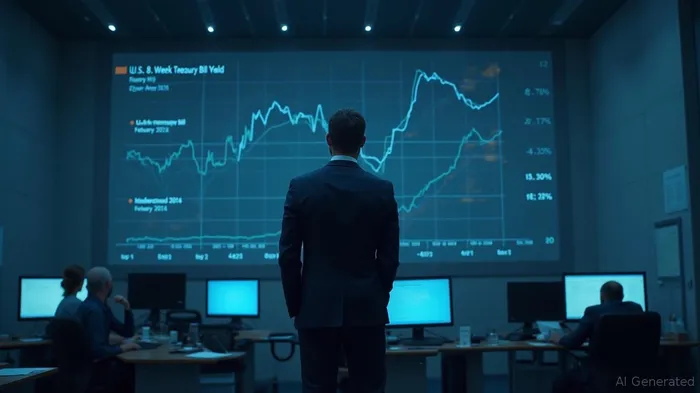
The U.S. Treasury market has entered a new phase of recalibration, with the 8-week bill auction yield settling at 4.200% in recent weeks—a figure that, while modest, carries profound implications for investors navigating a shifting interest rate landscape. This yield, which reflects the cost of short-term borrowing for the U.S. government, has fallen 1.03 percentage points from its February 2024 peak of 5.70%, signaling a broader cooling in demand for high-yield assets and a growing appetite for safety. As the Federal Reserve signals its readiness to ease monetary policy, market participants are recalibrating their portfolios, with sector rotation and tactical asset allocation strategies taking center stage.
The Yield Curve as a Policy Barometer
The 8-week bill yield, a critical benchmark for short-term borrowing costs, has become a barometer for investor sentiment toward the Fed's policy trajectory. On August 14, 2025, the yield rose to 4.27%, a 0.01 percentage point increase from the prior session, but remained 0.08 points below its level a month earlier. This divergence between auction and secondary market yields—4.30% and 4.27%, respectively—suggests a market in transition. The narrowing gap indicates that secondary market participants are aligning their expectations with the Fed's dovish pivot, which has been telegraphed through recent statements and economic data.
Analysts project the 8-week yield to stabilize at 4.30% by the end of the quarter and to trend downward to 4.26% in 12 months. These forecasts hinge on the assumption that the Fed will cut rates twice in the second half of 2025, bringing the terminal federal funds rate to 4%. Such a scenario would further depress yields, particularly for short-term Treasuries, as investors flock to safe-haven assets amid geopolitical tensions and trade policy uncertainty.
Sector Rotation: From Magnificent 7 to Global Diversification
The shifting yield environment has catalyzed a significant sector rotation, with investors moving away from overvalued U.S. mega-cap technology stocks—often dubbed the “Magnificent 7”—toward more defensive and globally diversified holdings. In Q1 2025, the Magnificent 7 underperformed the broader market, a trend that has accelerated as regulatory pressures and trade policy risks mount. The S&P 500 equal-weight index, which reduces exposure to dominant tech firms, has outperformed the standard index, reflecting a rebalancing of risk.
Investors are increasingly allocating capital to international equities, particularly in the eurozone and emerging markets, where valuations appear more attractive relative to U.S. benchmarks. Latin America, for instance, has emerged as a beneficiary of shifting supply chains and reduced U.S. trade dependency. This rotation underscores a broader theme: in a world of persistent uncertainty, diversification is no longer optional—it is a necessity.
Tactical Asset Allocation: The Case for Treasuries and Commodities
As the Fed's rate-cutting cycle looms, tactical asset allocation strategies are pivoting toward U.S. Treasuries and commodities. The 10-year Treasury yield, currently projected to trend toward 4% in the short term, has become a cornerstone of defensive portfolios. The flight to safety is further amplified by the J-curve recovery in the eurozone, which is expected to delay the full impact of European Central Bank rate cuts and create a yield differential favoring U.S. bonds.
Commodities, meanwhile, are emerging as a critical diversifier. Gold, silver, and copper have surged in 2025, driven by their role as hedges against inflation and geopolitical risk. The BNP Paribas Energy & Metals Enhanced Roll index, for example, returned nearly 10% in Q1 2025, outperforming most equity and bond sectors. This performance highlights the growing importance of commodities in a stagflationary environment, where traditional asset classes may struggle to deliver returns.
The Dollar's Resurgence and Currency Dynamics
The U.S. dollar is also poised for a rebound, driven by the inflationary drag of new tariffs and the relative strength of the U.S. labor market. While the eurozone's J-curve recovery may weaken the euro, the dollar's appeal as a reserve currency and its role in global trade suggest a 12-month EUR/USD target of 1.05. Investors with exposure to foreign assets should consider hedging strategies to mitigate currency risk, particularly as trade policy uncertainty persists.
Conclusion: A Call for Prudence and Flexibility
The 4.200% yield on the U.S. 8-week bill is more than a number—it is a signal of a market in flux. As the Fed prepares to ease policy, investors must adopt a dual approach: reducing overexposure to U.S. equities, particularly in the tech sector, while tactically overweighting Treasuries, commodities, and international markets. The key to navigating this environment lies in flexibility, with portfolios structured to withstand both rate cuts and stagflationary pressures.
In the coming months, the interplay between auction yields, secondary market dynamics, and global macroeconomic trends will remain a focal point for investors. Those who act decisively—rotating sectors, diversifying geographically, and hedging currency risks—will be best positioned to capitalize on the opportunities ahead.

Stay ahead of the market.
Get curated U.S. market news, insights and key dates delivered to your inbox.


AInvest
PRO
AInvest
PRO



Comments
No comments yet