
8-Sigma Crash: Did a Karaoke App Just Wreak Havoc on Logistics Stocks?
 Aime Summary
——The most crowded trade on Wall Street isn't Nvidia, it's fear—when a former karaoke company with a mere $6 million market cap clears its throat, a hundred-billion-dollar logistics giant is brought to its knees.
Wall Street witnessed a market anomaly on Thursday that defies traditional financial modeling. A micro-cap company, previously known for selling karaoke machines and holding a market value of just $6 million, triggered a massive selloff in the multi-billion dollar logistics sector. The catalyst was a press release from Algorhythm HoldingsRIME-- claiming its new AI platform could exponentially scale freight operations, sending industry titans like C.H. Robinson Worldwide Inc. and RXO Inc.RXO-- into a tailspin. While the fear of artificial intelligence disrupting legacy industries is valid, the mathematical magnitude of Thursday’s crash suggests the market has entered a phase of "Category 5" paranoia. Investors are no longer trading on earnings or fundamentals; they are trading on a visceral fear of obsolescence.
The Karaoke Pivot That Shook the Supply Chain
The epicenter of Thursday's volatility was Algorhythm Holdings, a company that rebranded in 2024 to pivot from karaoke machines to AI logistics after U.S. tariffs impacted its legacy business. On Thursday, the company announced that its "SemiCab" platform allowed customers to scale freight volumes by 300% to 400% without a corresponding increase in operational headcount.
The market reaction was immediate and violent, characterized by a distinct "David versus Goliath" dynamic.
- The Disrupter: AlgorhythmRIME-- shares soared 30%, having jumped as much as 82% earlier in the session.
- The Incumbents: C.H. Robinson tumbled 15% (down 24% at the lows), Landstar SystemLSTR-- fell 16%, and RXORXO-- dropped 20.5%.
- The Sector: The Russell 3000 Trucking Index slid 6.6%, marking the sector's worst drop since the trade-war meltdown of April.
The narrative driving the selloff is that open-source automation agents and AI platforms will disintermediate traditional truck brokers, who rely on human capital to match freight with carriers. However, the disparity in valuation—Algorhythm reported less than $2 million in sales last quarter—versus the billions in market cap wiped off established players suggests a disconnect. As Citigroup analyst Ariel Rosa noted, while the probability of industry disruption is high, skepticism remains that "this particular company is gonna be the one to disrupt the industry."
The "AI Scare Trade" Contagion
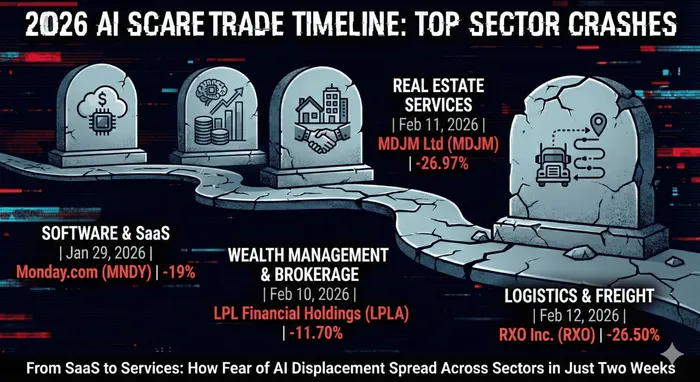
Thursday’s logistics rout is not an isolated event; it is the latest chapter in a rolling "AI Scare Trade" that has decimated specific service sectors over the last two weeks. Investors are systematically identifying industries with high headcount-to-revenue ratios and aggressive manual back-office functions, then liquidating positions at the first sign of AI competency.
As illustrated in the timeline above, the contagion has moved with clinical precision:
- Software & SaaS (Jan 29): Fears that AI can write code better than humans triggered a selloff in companies like Monday.com.
- Wealth Management (Feb 10): Brokerages and advisory firms fell as AI agents demonstrated capabilities in financial planning.
- Real Estate Services (Feb 11): Commercial real estate firms like CBRE faced their worst drops since 2020 amid fears that AI-driven headcount reductions would permanently slash demand for office space.
- Logistics (Feb 12): The freight brokerage model came under fire.
This rotation signals a sea change in market sentiment. The enthusiasm that drove the Nasdaq’s gains in previous years has been replaced by a "sell first, ask questions later" mentality. According to Morningstar strategist David Sekera, the primary question on Wall Street has become, "Who or what segment is going to be targeted by the market next?"
Visualizing the "Impossible": An 8-Sigma Event
To understand the severity of this panic, one must look at the mathematical absurdity of the price action. In financial statistics, standard deviation (σ) measures the amount of variation or dispersion of a set of values. A 3-sigma event is rare; an 8-sigma event is, theoretically, statistically impossible in a normal distribution.
According to traders at Goldman Sachs, the collapse in C.H. Robinson represented an 8-standard deviation (8σ) move.
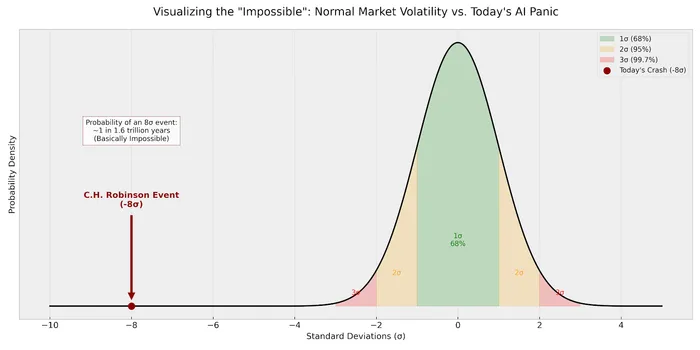
The chart above visualizes this anomaly. In a normal market environment, 99.7% of all price data points fall within three standard deviations (the pink zone). The crash experienced by logistics stocks on Thursday falls so far to the left of the curve—at negative 8σ—that it suggests a complete breakdown of efficient market pricing.
This extreme volatility was not limited to a single stock. Goldman Sachs reported that over 40 constituents of the S&P 500 experienced price moves exceeding 3 standard deviations on the same day, a level of volatility described by traders as "the highest in memory." This indicates that the market is currently "extremely fragile," with liquidity evaporating as buyers refuse to step in front of the AI steamroller.
The breadth of the selloff confirms that this is a macro-level liquidation rather than a company-specific adjustment. Even sectors loosely related to the "old economy," such as drug distributors McKesson and Cardinal Health, were dragged down, highlighting that the panic is indiscriminate.
The Bottom Line
The "AI Scare Trade" has evolved from a theoretical debate into a tangible capital rotation. While the threat AI poses to "middleman" industries is real, the market's reaction to Algorhythm—a company with a history of karaoke machines and net losses—suggests that fear has overtaken fundamentals.
For investors, the current environment requires a bifurcated strategy. The sheer velocity of these selloffs, evidenced by the 8-sigma moves, makes "catching a falling knife" dangerous in the short term. However, history suggests that knee-jerk reactions to technological shifts often create mispricing. As noted by Benchmark analyst Christopher Kuhn, it is unlikely that major corporations will switch their entire logistics infrastructure to a new software provider overnight without utilizing major brokers.
The prudent move is to remain wary of asset-heavy service sectors in the immediate term while recognizing that the "old economy" will not disappear in a week. If the fear of AI displacement keeps you up at night, the hedge is not to sell logistics stocks at the bottom, but to balance the portfolio with the "picks and shovels" of this revolution—semiconductors and energy—which remain the only clear beneficiaries of the AI boom.

Tianhao Xu is currently a financial content editor, focusing on fintech and market analysis. Previously, he worked as a full-time forex trader for several years, specializing in global currency trading and risk management. He holds a master’s degree in Financial Analysis.
Latest Articles
Stay ahead of the market.
Get curated U.S. market news, insights and key dates delivered to your inbox.
AInvest
PRO
AInvest
PRO



Comments
No comments yet