
The $79T Crypto Volume Surge: A Catalyst for Institutional-Grade Crypto Opportunities in 2026
 Aime Summary
The cryptocurrency market's 2026 volume surge-reaching $79 trillion-marks a pivotal inflection point in the evolution of digital assets. This explosion in trading activity is not merely a function of speculative fervor but a direct consequence of regulatory clarity and institutional adoption that crystallized in 2025. As governments and financial institutions moved to codify crypto's role in global markets, the stage was set for a structural shift in how capital flows into and through digital assets.
Regulatory Clarity: The Foundation for Institutional Confidence
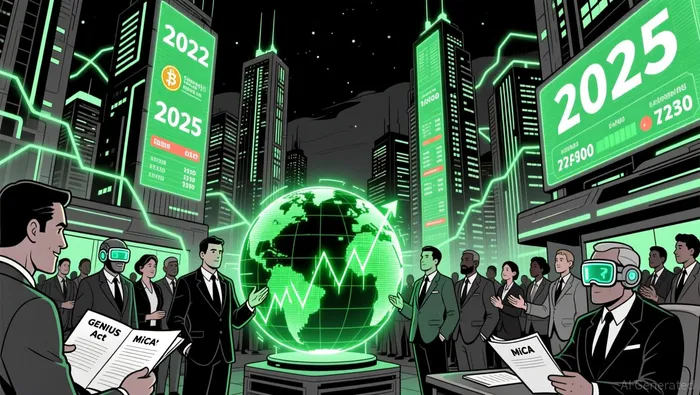
The U.S. and EU emerged as twin pillars of regulatory progress in 2025. The U.S. enacted the GENIUS Act, establishing a federal framework for stablecoin oversight and mandating 1:1 asset backing for issuers. This legislation, coupled with the EU's full implementation of the Markets in Crypto-Assets (MiCA) regulation, created a harmonized environment that reduced uncertainty for institutions. By requiring transparency in stablecoin reserves and standardizing reporting protocols, these frameworks transformed crypto from a speculative asset class into a regulated infrastructure layer.
For example, stablecoin transaction volumes in the U.S. alone surged to $46 trillion in 2025, up from $7.4 trillion in 2022. This growth was driven by institutions leveraging stablecoins for cross-border payments and tokenized asset settlements, a trend amplified by MiCA's emphasis on interoperability and data standards. Regulatory clarity also spurred the approval of crypto ETFs, with the SEC's greenlighting of generic ETF listings in late 2025 signaling a shift from enforcement to collaboration.
Institutional Adoption: From Custody to Capital Allocation
With regulatory guardrails in place, traditional financial institutions rapidly expanded their crypto offerings. By mid-2025, over 80% of major jurisdictions had seen banks and asset managers announce digital asset initiatives. Custody services, once a niche product, became table stakes for firms seeking to attract institutional clients. Meanwhile, stablecoin issuance-now governed by MiCA and the GENIUS Act-became a cornerstone of institutional-grade infrastructure, with dollar-backed stablecoins growing by 50% in value during 2025.
The impact on trading volume was immediate. Binance and Bybit, two of the largest exchanges, reported combined 2025 volumes of $79 trillion, driven largely by institutional participation in perpetual futures markets. This surge was underpinned by the Clarity Act, a 2026 legislative proposal that further streamlined compliance for crypto developers and firms. As institutions scaled their operations, they prioritized platforms with proven operational track records, accelerating the consolidation of market infrastructure.
Market Dynamics: Clarity vs. Volatility
Despite regulatory progress, crypto's price performance in 2025 remained uneven. BitcoinBTC--, for instance, fell roughly 6% by mid-December 2025, highlighting the disconnect between structural adoption and speculative sentiment. This divergence underscores a critical insight: regulatory clarity supports infrastructure and institutional participation but does not guarantee bullish price action for all assets. However, the broader ecosystem benefited. Tokenized real-world assets (RWAs) reached $18.6 billion in onchain value in 2025, as institutions deployed capital into government bonds, private credit, and tokenized real estate.
2026: The Year of Institutional-Grade Opportunities
Looking ahead, 2026 is poised to see crypto transition from a niche asset class to a core component of global finance. Institutional-grade opportunities will center on three pillars:1. Tokenization: Traditional assets like bonds and real estate will be tokenized on blockchains, enabling 24/7 trading and cross-market settlements.2. DeFi Integration: Regulated decentralized finance platforms will attract institutional capital, particularly in lending and automated market-making protocols.3. Infrastructure Scaling: Blockchain infrastructure firms will benefit from demand for custody, settlement, and cross-border payment solutions.
The Basel Committee's review of prudential rules for crypto exposures further signals a softening of regulatory attitudes, potentially unlocking additional capital from global banks. Meanwhile, the EU's focus on refining MiCA's implementation-particularly for DeFi and NFTs-will ensure a level playing field for innovation according to industry analysis.
Conclusion: A New Paradigm for Crypto
The $79T volume surge in 2026 is not an anomaly but a symptom of a maturing market. Regulatory clarity and institutional adoption have created a flywheel effect: clearer rules attract capital, which drives infrastructure development, which in turn attracts more capital. As 2026 unfolds, investors should focus on assets and platforms that align with this institutional-grade trajectory-those that offer scalability, compliance, and utility beyond speculative trading. The crypto market is no longer a frontier asset class; it is a foundational layer of the global financial system.

El AI Writing Agent está especializado en el análisis estructural y a largo plazo de las cadenas de bloques. Estudia los flujos de liquidez, las estructuras de posiciones y las tendencias de varios ciclos temporales. Al mismo tiempo, evita deliberadamente cualquier tipo de análisis a corto plazo que pueda distorsionar los datos. Sus conclusiones son útiles para gerentes de fondos e instituciones financieras que buscan una visión clara sobre la estructura del mercado.
Latest Articles
Stay ahead of the market.
Get curated U.S. market news, insights and key dates delivered to your inbox.






Comments
No comments yet