

Here is the story that sells an AI exchange-traded fund: every analyst covering its biggest holdings says buy. Across roughly 250 analysts covering MetaMETA--, Alphabet, AmazonAMZN--, and MicrosoftMSFT--, the tally came to zero sell ratings and a strong-buy stamp on all four. The implied takeaway — uniform bullishness on the stocks inside the fund means the fund itself has big upside waiting — gets compressed into a marketing mark-up close to 70%.
That figure is a bookkeeping problem, not a market call. An ETF has no analyst rating or price target of its own; analysts rate stocks, not baskets. Any "analyst upside" attached to a fund has to be rebuilt from the fund's holdings, weight by weight — and because the same handful of mega-cap names sit near the top of nearly every AI fund, their targets set the realistic ceiling for the whole package. That is also why the number matters to you before you buy: it decides whether you hold a position sized for a double or one sized for a routine gain — a sizing decision made on arithmetic the marketing sheet skips.
| Company | Median 12-mo target (USD) | Aug-7 close (USD) | Implied upside (%) |
|---|---|---|---|
| Meta (META) | 750.00 | 592.10 | +26.6 |
| Alphabet Class C (GOOGL) | 426.50 | 353.47 | +20.6 |
| Amazon (AMZN) | 325.00 | 274.48 | +18.4 |
| Microsoft (MSFT) | 555.00 | 499.99 | +11.0 |
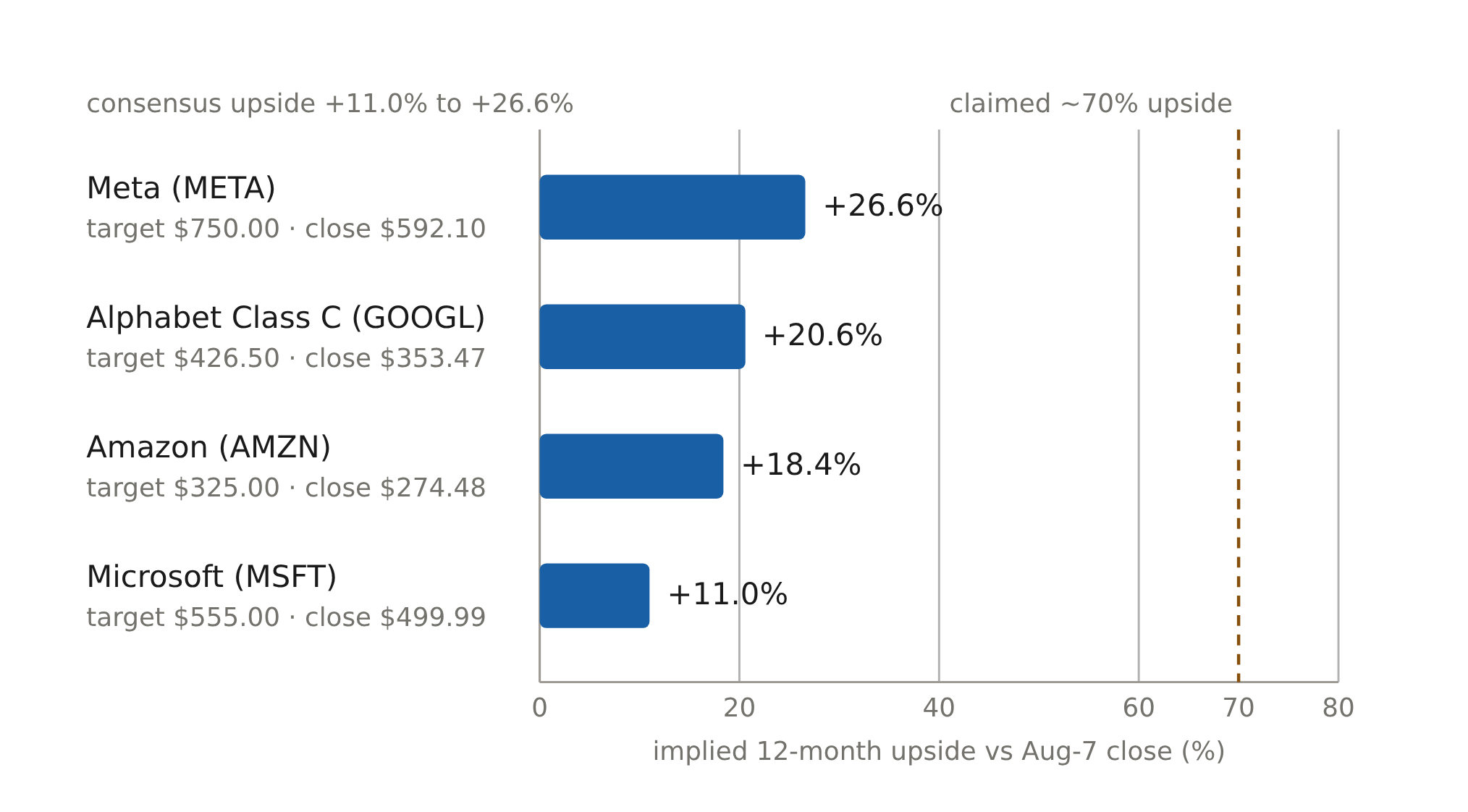
The arithmetic, done honestly, is the chart above. For the four names, the median 12-month consensus price target measured against each stock's August 7 closing price implies 26.6% upside for Meta, 20.6% for Alphabet, 18.4% for Amazon, and 11% for Microsoft. Every one of those stocks carries a strong-buy consensus, and not one of them is priced to produce a double. None of this happens in a vacuum, either: it has been a rough tape for the group, with only Amazon beating the S&P 500 so far in 2026 — which is precisely why the big-upside pitch exists.
Microsoft is the cleanest tell, because the same target that looked large in July had shrunk to small by August without a single analyst turning bearish. In late July, 50 analysts — 42 of them strong buy — carried an average 12-month target of $552.27, roughly 41% above the stock's pre-earnings price of $381.40. Then the fiscal fourth quarter landed with Azure crossing $100 billion in annualized revenue, the stock climbed 31% between July 23 and August 7, and the same consensus, unchanged, implied only about 11% upside from the August close. The analysts themselves noted the move simply spread the anticipated gain across the full 12 months. That is the whole mechanism in miniature: a buy rating is a one-way door, but the distance to the target is measured in the closing price — and the closing price is exactly what the buy rating did not anticipate.

Now bring in the weights, which is where a 70% figure goes to die. A fund's analyst-implied upside is the sum over its holdings of weight times upside, so the heavily weighted names contribute only the 11%-to-27% range above. The one out-of-line upside in the group belongs to Nvidia, yet Nvidia carries only a typical fund weight of roughly 6% to 10% — so even granting the full bull case, it adds three to five percentage points to the fund total. Add it all up and the evidence-backed expectation for these funds' mega-cap cores lands in the mid-teens to low-30s percent — roughly two-and-a-half to four times smaller than the claim. Reaching 70% would require near-uniform 70% targets across the holdings, which no current consensus set shows. A figure that large, as far as the current consensus data shows, can only be reconstructed from stale targets, a price snapshot taken well off a 52-week low, or a fund built around one stock's outlier.
Nvidia deserves its own line, because it is the piece that lets a big number survive for a while. Its consensus is 31 buys against zero holds and zero sells, with an average 12-month target of $327.45 — about 54% above the $213.05 reference price used in that calculation, and the only 50%-plus number in the entire AI core. Treat it as a snapshot rather than a commitment: Nvidia's targets were trimmed and raised repeatedly through 2026, with a May average near $274.38 climbing above $327 by the later extract, as swings in export data moved the story. The "big upside" in these funds is structurally one chipmaker's forecast run through a heavily diluted filter.
If you do not trust weight math you cannot see, look at fund structure instead. BOTZ, one of the AI and robotics funds in this review, puts 59.85% of its assets in its ten largest holdings against a 43.89% category average. That much concentration does not diversify analyst optimism; it concentrates it into a short list, which means the number to verify before sizing is the top-holdings weight, not the marketing sheet. An independent July 2026 set of targets agrees in direction — Amazon up 28.9%, Alphabet up 20.1% — with the same zero-sell posture, so this is not one data provider's oddity.
So the practical read is not "sell these funds," and it is not "the analysts are wrong." It is that a 70% upside tag is a marketing function rather than a market forecast, and the specific mistake it invites is sizing. An investor who believes an AI fund can roughly double in a year treats it as a high-conviction overweight and holds through a drawdown; the evidence-supported expectation is a mid-teens-to-low-30s tilt, in line with what the broad market already prices — the kind of position a drawdown can force out of a book that expected a double. What would change that read is a fund whose actual top weights carry materially more than the 11-to-27% its mega-cap core delivers today, or a fresh set of targets on those same names. Until the holdings-weighted math is shown, treat a big upside tag the way you would treat a dividend yield you have not checked against free cash flow: as something to verify, not a number to size against.








Comments
No comments yet