7 Ways Iran Can Stop Oil Shipments
If you're wondering why it's taking so long to vanquish Iran, this is why.
Where’s the US Navy?
It’s going on three weeks since President Trump said, “If necessary, the United States Navy will begin escorting tankers through the Strait of Hormuz, as soon as possible.”
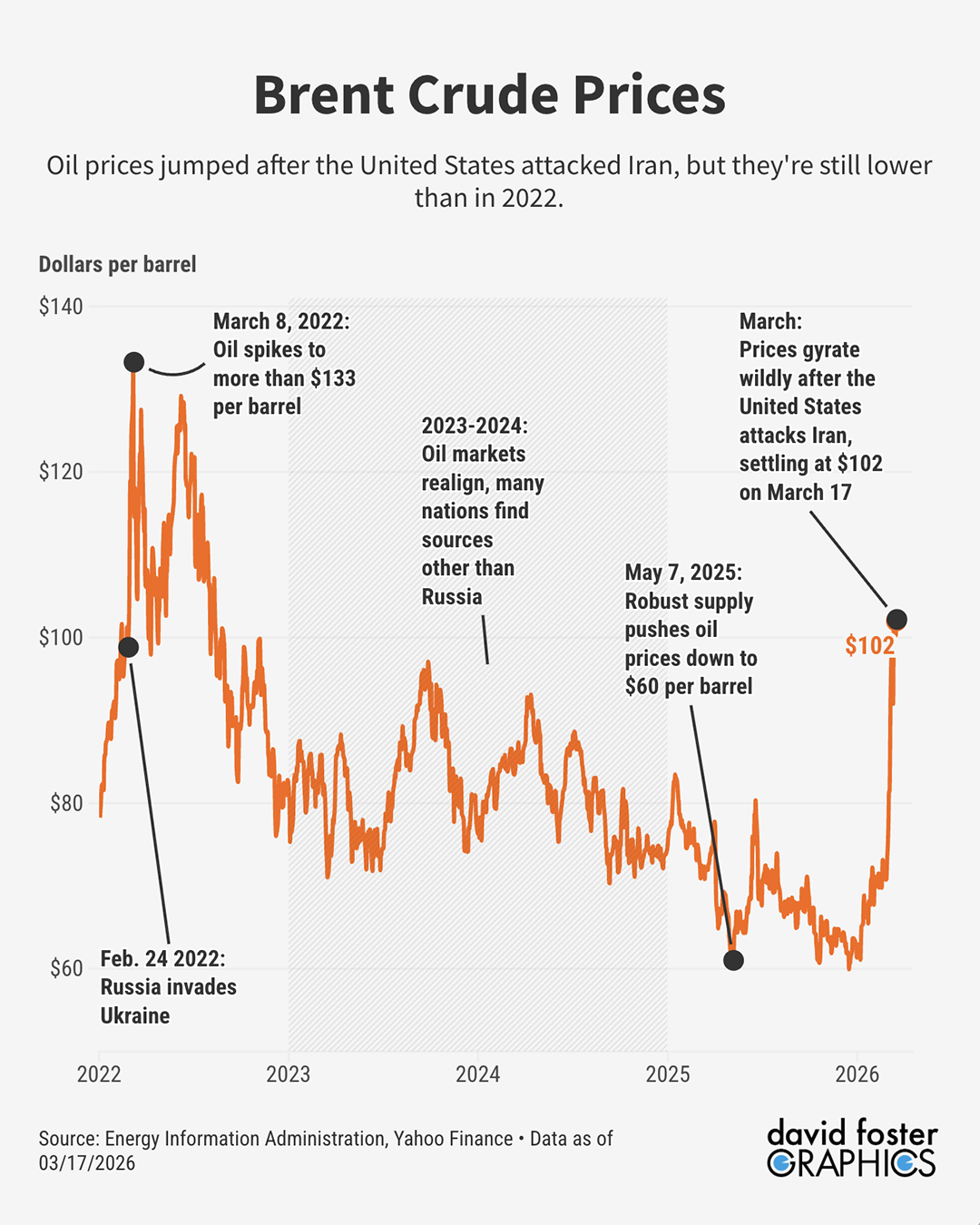
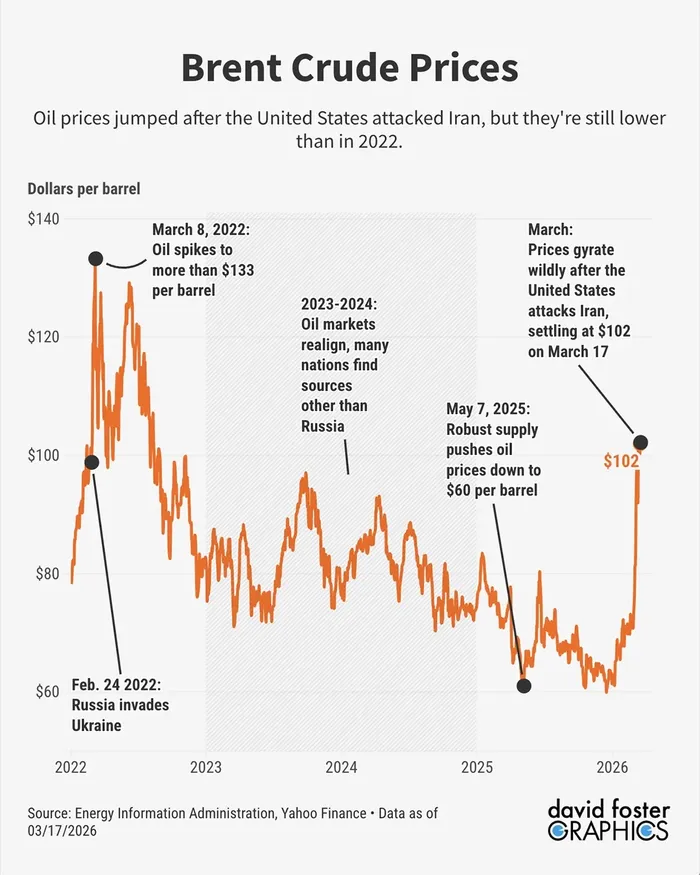
It seems necessary! Oil prices have jumped 60% since mid-February and are now firmly above $100 per barrel. US gasoline prices are quickly heading toward $4 per gallon. Stocks are sinking, as traders lose hope the war will end quickly. The pain is even worse in Europe and Asia.
The unhappy reality is that Iran, for all the damage it is sustaining, is fighting back—mainly by blocking cargo shipments through the Strait of Hormuz and snarling the markets for energy and other commodities. The wounded Iranian regime remains in charge, with Trump’s early call for a popular uprising among Iranian citizens looking especially naïve.
This standoff has surprised many investors, who expected a quick end to the war after the US-Israeli bombing campaign began on February 28. But strategists who study the Middle East expected exactly this type of painful impasse in the event of an American war with Iran. And it’s time for everybody else to take a crash course in how Iran can gum up energy markets, perhaps indefinitely.
The United States has an overwhelming military advantage against Iran, especially when allied with Israel, which may now have the world’s second-most-powerful air force. But Iran can lose militarily and still cause trouble. This is how “asymmetric” advantages in warfare can give the underdog a fighting chance.
Iran’s despotic regime has long understood that it has leverage by simply threatening to sink commercial or military ships transiting the Strait of Hormuz, the narrow passageway at the mouth of the Persian Gulf, abutting southern Iran. The US Navy understands this too. It will probably make a showing at some point, when it has massed enough ships and other capabilities to maximize defenses. But for now, Iran likely poses a severe threat to any vessel it decides to attack, including American warships.
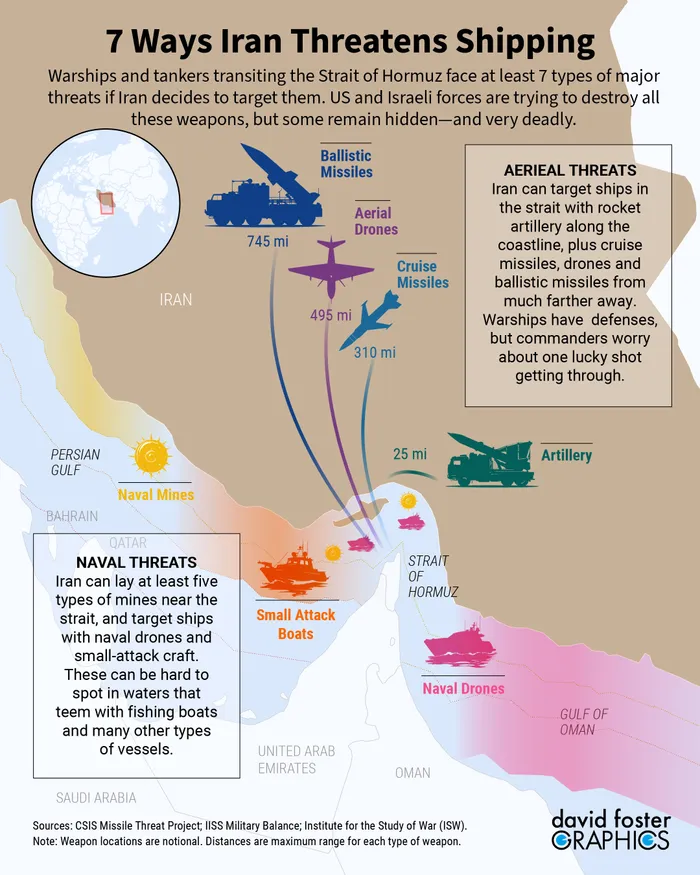
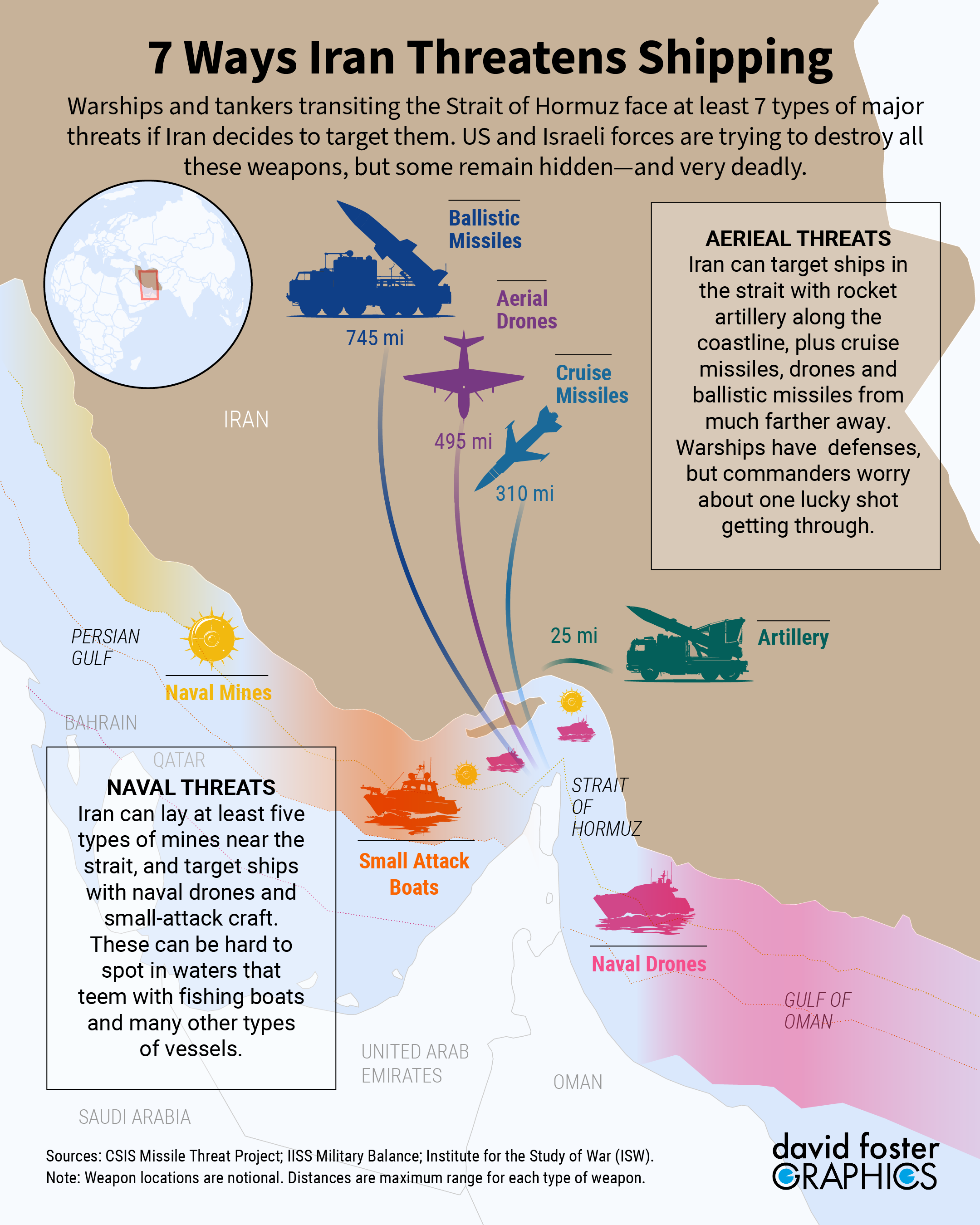
Iran has constructed overlapping layers of weaponry that can attack ships from many dimensions. It has several types of cruise missiles, ballistic missiles and drones it can launch from deep inside Iran. Coastal artillery can pepper ships with rockets and shells.
On the sea, naval drones and small attack boats laden with explosives can sneak through busy waters and attack ships close up. Iran also has at least five types of sea mines that can rip through the hull of a ship. Clearing them can be devilishly difficult.
More from Rick Newman: The Pinpoint Press
- The Better-Off Index rose—before the Iran war set it back
- 4 Ways Trump's Iran War is Costing You
- Pinpoint Insider: What news leaks tell you about Trump’s Iran war
US and Israeli forces are systematically trying to destroy all these weapons. But Iran has thousands and is almost certainly keeping some in reserve, to target ships. Many of these weapons are mobile, which means they can hide out of sight of overhead reconnaissance, then moved into firing position before enemy jets can find them.
Warships have defenses, but in the tight waters near Iran they might have to contend with several incoming threats all at once. At one point in the passage through the strait, ships must turn eastward into the Persian Gulf, which leaves them exposed to possible Iranian fire from a 270-degree arc. These are not sandy beaches like the Florida coastline. Jagged terrain includes countless outcroppings and hiding places.
Both sides know that a lucky shot could change the tenor of the war. Hitting a US Navy ship would elate the Iranian regime and be a huge black eye for the Pentagon. It would embolden Iran to mount more attacks and possibly trigger strong opposition to the war in the United States. That’s a huge part of Iran’s playbook, and the US Navy knows it.
The conspicuous absence of US Navy ships in the strait is evidence enough of how severe the Iranian threat is. And it might take American troops to root out drones, attack boats and mine-laying craft town by town along the Iranian coast, putting US troops into direct combat with Iranian forces defending their homeland.
“I’ve yet to hear a workable near-term (next 4-6 weeks) plan for how to open the strait that doesn’t involve US boots on the ground,” Ian Bremer of the Eurasia Group wrote on social media on March 18.
A contingent of 2,200 Marines is heading to the region, but that may not be enough to defeat all the threats Iran poses along its coastline. Trump is probably seeking other leverage.
He could use the marines to seize Kharg Island in the northwestern Persian Gulf, a crucial Iranian shipping facility that handles 90% of its oil exports. If Trump could get Kharg, that would give him control of most of the revenue that finances the Iranian regime. Maybe that would force Iran to concede and allow normal shipping to resume in the strait.
But anybody expecting that to happen soon should curb their enthusiasm. Trump’s war with Iran was never going to end quickly, and he should have never suggested it might.
Subscribe to The Pinpoint Press

_880f67651774016702168.jpg?format=webp&width=700)
Click Here: LINK TO PROMOTION PAGE


Rick Newman is an award-winning journalist who started The Pinpoint Press in 2025 after 12 years as a senior columnist for Yahoo Finance. Before joining Yahoo, Rick was chief business correspondent for US News & World Report, and before that, Pentagon correspondent for US News. He's the author of four books and a regular commentator on networks such as CNN and MSNBC.
Latest Articles
Stay ahead of the market.
Get curated U.S. market news, insights and key dates delivered to your inbox.


AInvest
PRO
AInvest
PRO