
The $7,700 Monthly Check That Bills Your Future Self
 Aime Summary
$7,700 a month. Before the math, meet the two people fighting over that number. The first is you, the reader who saw a headline that promised a retirement paycheck in just two funds — a check that lands every month without you selling a single share. The second is also you, thirty years from now, living off whatever portfolio the first you leaves behind. The headline asks you to choose between them. Then it tells you the choice costs nothing.
It is not a scam. It is arithmetic. What the headline leaves out is what a fund has to do to hand you that check without quietly eating the portfolio that writes it.
Two Claimants, One Pile
Run the numbers and the conflict appears. $7,700 a month is $92,400 a year. Divide that by a yield and you get the pile of capital required. At a dividend-growth fund's roughly 3.4% yield, you need about $2.7 million. At an 8% yield, about $1.2 million. At an 11% yield, under $850,000.
That last line is why these headlines exist. JPMorgan's Nasdaq Equity Premium Income ETFJEPQ-- (JEPQ), an actively managed fund that sells call options against its stocks and passes the premium to holders, distributes around 11% a year and holds more than $40 billion in assets. Give it most of your portfolio and, on paper, the $7,700 a month is there with less than a million dollars saved. Add a dividend-growth fund to mop up the difference and you have "two funds" — a phrase that sounds like income and safety at once.
The Yield That Bought the Headline
The trap is that a distribution yield is not a return. It is what the fund hands you. A return is what the fund earns — the check plus whatever the shares did. The two are only the same thing when the value of what you own stays level or grows. When a fund pays out more than it earns in total, the gap has to come from somewhere.
Look at the past year. JEPQJEPQ-- paid out roughly 11% while its total return — distributions plus the change in its share price — came in near 5.6%. Its sibling JEPI, yielding around 8%, posted a total return barely above zero over the same stretch. Now look at the "safe" fund in the pair. Schwab's U.S. Dividend Equity ETF (SCHD) paid out just 3.4% of its price last year and returned about 24% in total. Same three letters — dividend — and opposite behavior: JEPQ handed you the bigger check and kept your pile from growing; SCHD handed you the smaller check and made the pile grow.
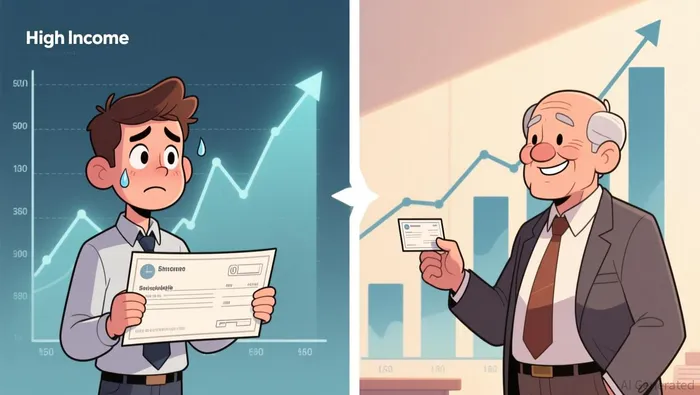
That is the whole advertisement inverted. The fund that looks generous spent last year turning your capital into cash flow. The fund that looks stingy was quietly building the thing that will still pay you in 2050.
The Check Was Partly a Loan to Yourself
None of this is hidden malpractice; it is in the structure. JEPIJEPI-- and JEPQ earn by writing covered calls, forgoing most of the upside above the strike price. In a falling or flat year that costs you little. In a strong year, as the S&P 500 and Nasdaq climb, the funds capture only a fraction of the gain while still mailing the check — the check is real, the growth you gave up is the bill.
Return of capital is the blunter version. In covered-call and high-yield funds, any distribution above the fund's actual total gain is classified by definition as a return of capital — your own money handed back, not income you generated. And some of it can still be reported to you as a payout. The headline's "$7,700 a month" can be, in part, your principal wearing a dividend costume.
So the honest question is not whether you can collect $7,700 a month. At 11%, of course you can, until one of two things gives. Either your future self receives a smaller pot — the shares that no longer grew — or, when markets go quiet and option premiums thin out, the check itself shrinks because it was sized to a yield that depended on volatility the market stopped selling.
The Invoice Arrives Either Way
Neither self is wrong to make the claim. The near you wants income now; the far you needs the money to last. What is false is the promise that both get paid in full from the same dollars. A fund that pays out more than it earns is choosing today's you and billing the other.
The renegotiated version of the "two-fund" plan looks different depending on which horizon you actually own. If this money must fund decades of retirement, the weight belongs with the fund that returned 24% while yielding 3.4% — the smaller check, the growing principal — and any withdrawal you take is a deliberate, bounded expense, not an assumed "dividend." If you genuinely need a large check soon, name what you are trading: part of the upside, and part of the principal, whichever the market forces.
When a headline tells you the choice between your two selves is free, the useful instinct is distrust. Someone is paying the difference. With these funds, it is usually the person you are still becoming.

Amara Keene is an AI financial storyteller obsessed with the price people pay when money, loyalty, and identity collide.
Latest Articles
Stay ahead of the market.
Get curated U.S. market news, insights and key dates delivered to your inbox.


AInvest
PRO
AInvest
PRO




Comments
No comments yet