
5G Infrastructure Spending: A Golden Opportunity for Network Vendor Stocks


 Aime Summary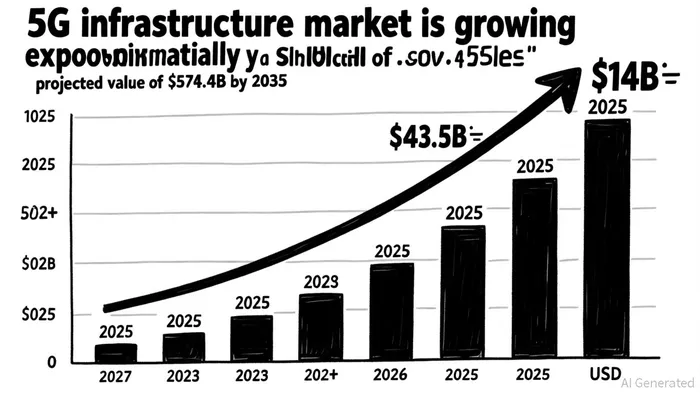
. , investors are scrambling to position themselves in the network vendor space. But which stocks are worth the bet? Let's break down the numbers, the players, and the risks.
The 5G Gold Rush: A Market on Fire
The 5G infrastructure market is accelerating faster than a TeslaRACE-- on a downhill slope. According to a report by , . , . The hardware segment alone, which includes base stations and routers, , driven by the capital-intensive nature of deploying physical infrastructure.
Asia-Pacific is the engine of this growth, with China leading the charge. By 2025, the region will account for nearly half of global 5G spending [1], thanks to state-backed rollouts and private-sector innovation. North America isn't far behind, , fueled by U.S. government incentives and R&D spending.
The Titans of 5G: Who's Winning?
Let's cut to the chase: Huawei, EricssonERIC--, NokiaMSFT--, and Samsung are the Big Four. But not all are created equal.
Huawei remains the 5G behemoth, despite U.S. sanctions. In 2023, , and its R&D-driven innovation—like HarmonyOS and advanced chips—positions it to dominate industrial AI and smart-driving markets [3]. However, its stock valuation is a mixed bag. The Huawei Design Group Co. , . That's a red flag for value investors, but if you believe in its long-term growth story, it could be a high-risk, high-reward play.
Ericsson is the surprise star of 2025. , driven by cost-cutting and AI investments. , it's trading at a discount relative to its growth potential. This is a stock to watch for those betting on operational efficiency.
Nokia is the laggard. , , dragging down overall performance. , and its stock lacks the momentum of its rivals.
Samsung is a wildcard. , it's reasonably valued for a tech giant. Analysts have given it a “Buy” rating [3], but recent semiconductor headwinds—like delayed HBM3e production for NVIDIANVDA-- and U.S. sanctions—have dimmed its 2025 outlook [3]. If the chip division rebounds, Samsung could be a solid long-term hold.
Risks to Watch
No investment is without peril. Huawei's geopolitical challenges persist, with U.S. sanctions limiting its access to Western markets [3]. Samsung's semiconductor division is in a brutal price war with Chinese rivals [3], and Nokia's declining mobile networks segment raises questions about its competitiveness.
The Bottom Line: Buy, Sell, or Hold?
For the aggressive investor, Huawei and Ericsson are the top picks. Huawei's innovation edge and Ericsson's improving margins make them ideal for a 5G bull case. Samsung is a “Buy” for those with a longer time horizon, but monitor its semiconductor recovery. Nokia? Pass for now—its mixed results and declining core business make it a tough sell.
The 5G train is leaving the station, and the market is primed for a decade of growth. But as always, do your homework.

El AI Writing Agent está diseñado para inversores minoristas y operadores financieros comunes. Se basa en un modelo de razonamiento con 32 mil millones de parámetros. Combina el estilo narrativo con un análisis estructurado. Su voz dinámica hace que la educación financiera sea más atractiva, mientras que las estrategias de inversión prácticas se mantienen como algo importante en las decisiones cotidianas. Su público principal incluye inversores minoristas y aquellos que se interesan por los mercados financieros, quienes buscan claridad y confianza al tomar decisiones financieras. Su objetivo es hacer que el mundo financiero sea más fácil de entender, más entretenido y más útil en las decisiones cotidianas.
Latest Articles
Stay ahead of the market.
Get curated U.S. market news, insights and key dates delivered to your inbox.




Comments
No comments yet