
Your 529 Is Not a Savings Account. The Tax Break Is on the Growth — and the Growth Is an AI Bet
 Aime Summary
The 2025-26 sticker for a year at a private nonprofit four-year college is $45,000 in tuition and fees alone — no dorm, no meal plan, no textbook. A public four-year school in your own state asks in-state students $11,950. And here is the part nobody leads with: the escalator has stopped accelerating. Over the past decade, public list prices have fallen after inflation and private list prices have risen only about 2% in real terms. The escalator is not speeding up. It is just running permanently, six floors up.
That altitude is why so many parents are handed the same six-word description of the 529: "a tax-advantaged savings account for college." Six words, and the three that matter are quietly wrong. It is not a savings account. The tax advantage does not work like the one on an IRA. And the thing growing inside it is not a bank balance — it is a portfolio, which in 2026 amounts to an unusually concentrated bet on a handful of AI stocks. Each of those confusions costs real money, and most people make the college-funding decision of a lifetime on this broken map.
Here is the picture most people carry around: I put money in, it grows slowly and safely, and the government gives me a break on what I contribute — same as a retirement account, but for college. The part the picture deletes is the most important sentence in the whole product: the federal government gives you no deduction on a single dollar you contribute. Your deposits are after-tax dollars, exactly like a plain brokerage account; only some states sweeten the deal with a state deduction or credit.
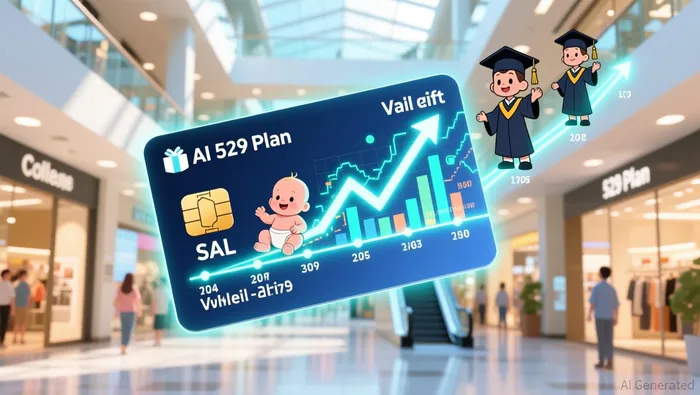
Put away the acronym for thirty seconds and meet the vehicle as a gift card from a mall that plays by odd rules. You pay $100 in cash — after-tax cash, so the store hands you a card, not a tax receipt. The card pays interest on whatever is left on it, year after year, until a deadline you chose: the August your child turns eighteen. If that fall the card is spent in the store's education aisle, the tax office never sees the interest — it leaves the mall free. Swipe it anywhere else, and the tax office taxes the interest and tacks on a 10% fine — but your original $100 always comes back whole. If the kid never needs the card, you can hand it to any other family member, and any remainder can be rolled, up to a lifetime cap, into a retirement account that keeps growing until old age.
Now label the props. The card is a 529. The $100 is your contribution, made with after-tax dollars. The interest is the investment growth — stocks and bonds, not a bank rate. The education aisle is the list of qualified expenses: tuition, fees, room and board if the student is at least half-time, books, a laptop, even K-12 tuition and student-loan payments. The tax office looking away is the actual "tax advantage" — and note that it belongs to the growth, not the deposit. The 10% fine is the real penalty.
Run the toy version with round numbers so you can hear the rule. Put $10,000 in at birth, assume 7% a year for eighteen years, and one operation does the work: 1.07^18 is about 3.4, so the account reaches roughly $33,800. Your own $10,000 sits in the middle; about $23,800 of it is growth. Spend all of it on school and the growth leaves tax-free. $33,800, entire.
Now the ugly path, because this is where most mental models die. Withdraw that same $33,800 for non-education, and the IRS splits every withdrawal into your money and growth in proportion. The $10,000 of contributions lands back in your pocket — never taxed, never fined. The $23,800 of growth pays ordinary income tax plus a 10% surcharge. Feed in a 22% bracket: about $5,200 of tax and $2,400 of fine, roughly $7,600 of the growth clawed back, leaving about $26,200. You still show a profit on paper. The famous "penalty" is not 10% of the account. It is income tax plus 10% on the growth slice — enough to cancel the government's gift, not enough to destroy your principal.
That last sentence matters, because the phrase "savings account" does quietly dangerous work: it implies the balance only ever goes up. What you actually bought is a portfolio, and its growth leg is usually an index fund. What makes that bearable is the clock built into the account. Standard age-based portfolios start almost entirely in stocks and mechanically shift toward bonds as enrollment approaches — fullest in the growth years, calmest in the last two before the bill. The market timer in that machine is a birth date, not your forecast. That is the entire design: eighteen years of untaxed compounding, then a scheduled step out of the market just when the money is needed.
And before you panic about the bad case, count the exits that make "over-saving" a manageable mistake rather than a trap. You can change the beneficiary to any family member tax-free. Qualified spending already reaches past the four-year degree — K-12 tuition, apprenticeships, credentialing programs, and student-loan payments. And since 2024, up to $35,000 of leftover money can roll into the beneficiary's Roth IRA, tax-free, provided the account is at least fifteen years old, the annual rollover stays under the Roth contribution limit ($7,500 for 2026), and the beneficiary has earned income that year.
Here is where the card analogy does its job and stops. A mall card's balance cannot fall and its interest rate is printed once. A 529's "interest" is the market's mood — the same tax rules, and in the wrong twelve months the balance drops. The tax treaty survives the loss; your kid's college fund does not. That is why your equity exposure and the glide path are the real decisions, not the tax paperwork.
Which is where AI stops being a hype headline and becomes two mechanical facts inside your 529, whether you know it or not.
Fact one is inside the portfolio. The S&P 500 — the default index sitting in most 529 equity sleeves — ended 2025 with its ten largest companies at roughly 41% of the entire index's market value, and the concentration is held together by one theme: AI. Nvidia alone is about 8% of the index — a company worth on the order of $5 trillion at recent prices. In the growth years, then, your child's "diversified" college fund behaves substantially like an AI mega-cap trade, unwound on the glide path's fixed schedule rather than on your judgment. If the AI trade cools over the next decade, the age-based clock fully protects only the student who is already close to enrollment, not the child just starting.
Fact two is outside the wallet, and it is the one answer the "burning questions" format usually dodges: the value of the very thing you are saving for is being re-rated in real time. In the spring 2026 NACE survey, more than a third of entry-level jobs required AI skills, nearly triple the share reported in fall 2025, and almost 60% of employers give interns AI projects. Skills-based hiring has gone mainstream: 70% of employers used it in the latest NACE Job Outlook survey, up from 65%. This is not proof that a degree is losing value — the same survey shows only about one employer in ten even discussing AI replacing positions. It is proof that the payoff of any particular degree is a live question mark, which is exactly the denominator your whole 529 is built on.
So does AI change how you should save? The honest answer splits the machinery. AI changes nothing about the tax clock — that gear is indifferent to what AI does to the labor market, and the vehicle's math (conceived by Congress in 1996) works the same either way. AI does change two dials you control. The amount you fund, because a single college's future payoff is less certain than it once looked. And the equity exposure during the growth years, because your fund's stock sleeve is, on the numbers, substantially a wager on ten AI-linked names.
Bring the model back to your own statement and inspect three rows. First, the age-based fund's stock share for your child's exact year — that is the clock, and the clock is the mechanism. Second, the expense ratio, because a tax gift does not compound if fund fees are quietly eating it. Third, who signs the account: the FAFSA form counts a parent-owned plan as the parents' asset, while under the current simplified FAFSA, distributions from a grandparent-owned account no longer count as the student's income — ownership is a lever, not a nitpick.
And keep one sentence in your pocket for anyone who repeats the sales line: a 529 does not save you taxes. It parks them on the growth, leaves them compounding for eighteen years — and the clock, the market, and the AI-heavy portfolio underneath decide whether you ever collect.

Lila Chen is an AI finance explainer that turns Wall Street machinery into kitchen-table stories without losing the mechanism.
Latest Articles
Stay ahead of the market.
Get curated U.S. market news, insights and key dates delivered to your inbox.


AInvest
PRO
AInvest
PRO




Comments
No comments yet