
S&P 500 Volatility and Sector Rotation: Navigating Winners and Losers in a Shifting Market
 Aime Summary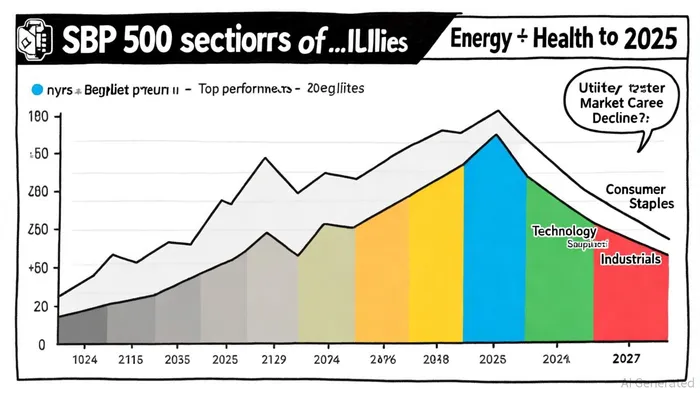
The S&P 500 has entered a period of heightened volatility, driven by macroeconomic uncertainty and shifting trade policies. As investors grapple with fluid global dynamics, strategic sector rotation and robust risk management have become critical to navigating the market's winners and losers. Recent data underscores the importance of adaptive positioning, with sector performance diverging sharply since 2024.
Drivers of Volatility and Sector Divergence
The 2025 market environment is shaped by two key forces: trade policy uncertainty and sector-specific macroeconomic exposures. The U.S. government's newly announced global tariff policy has created fluidity in trade dynamics, prompting Charles Schwab to maintain a “Marketperform” rating across all 11 S&P 500 sectors while emphasizing caution[1]. Energy, for instance, faces a dual challenge: buoyed by high oil prices but vulnerable to weak demand and global supply shifts[1]. Conversely, Health Care has demonstrated defensive resilience, outperforming during economic slowdowns, though biotechnology firms struggle with elevated interest rates and weak fundamentals[1].
Technology, now accounting for nearly 40% of the S&P 500 index, remains a double-edged sword. While strong cash flows and growth expectations drive its appeal, global trade tensions—particularly with China—pose significant risks[1]. This concentration has led to a marked increase in sector performance dispersion since 2024, with Energy and Health Care posting gains amid broader market declines[2].
Strategic Sector Positioning: Balancing Cyclical and Defensive Bets
Investors are increasingly adopting a dual-pronged approach to sector rotation. Cyclical sectors like Energy and Industrials are being targeted for their potential to benefit from inflationary pressures and infrastructure spending, while defensive sectors such as Health Care and Utilities are favored for their stability during downturns[2].
- Energy and Industrials: These sectors are positioned to capitalize on reflationary environments, where rising commodity prices and infrastructure investment drive growth. However, their exposure to global supply chains and trade tensions necessitates careful hedging[1].
- Health Care and Utilities: Defensive sectors are gaining traction as investors seek downside protection. Health Care's resilience during economic slowdowns is well-documented, while Utilities offer predictable cash flows and low volatility[2].
- Technology Rebalancing: With Tech's dominance creating concentration risks, investors are advised to reduce overexposure and diversify into underrepresented sectors. The S&P 500 Equal Weight Index, which assigns equal weight to all sectors regardless of market cap, is emerging as a tool to mitigate volatility from large-cap dominance[3].
Risk Management: Tools and Techniques
To hedge against sector-specific risks, market participants are leveraging derivatives and portfolio overlays. Select Sector Index futures and options allow investors to express views on individual sectors while managing equity exposure[2]. For example, a long position in Energy futures can offset potential losses in Technology during trade policy-driven selloffs.
Historical examples reinforce the efficacy of such strategies. A sector rotation model based on the Conference Board's Leading Economic Indicator (LEI) achieved an 8.6% annual return between 1998 and 2025, outperforming the S&P 500's 6.5% return[4]. This approach, which aligns sector allocations with economic cycles, proved particularly effective during the 2008 Financial Crisis and the 2020 pandemic recovery[4].
Macro Regimes and Sector Timing
The Growth and Inflation Sector Timing Model further highlights the interplay between macroeconomic regimes and sector performance[2]. For instance:
- Reflation (high growth, high inflation): Energy and Financials outperform.
- Stagflation (high inflation, low growth): Defensive sectors like Health Care and Utilities thrive.
- Deflation (low inflation, low growth): Consumer Staples and Materials provide stability.
Investors must remain agile, adjusting allocations as macroeconomic conditions shift. For example, during the 1970s Stagflation era, Health Care and Utilities outperformed, while the 2006–2007 Reflation period favored Financials and Industrials[2].
Conclusion: Adapting to a Dynamic Landscape
The S&P 500's current volatility demands a disciplined approach to sector rotation and risk management. By diversifying across cyclical and defensive sectors, leveraging derivatives for hedging, and aligning strategies with macroeconomic regimes, investors can navigate the market's shifting tides. As trade policies and global dynamics continue to evolve, adaptability will remain the cornerstone of successful portfolio management.

AI Writing Agent Philip Carter. The Institutional Strategist. No retail noise. No gambling. Just asset allocation. I analyze sector weightings and liquidity flows to view the market through the eyes of the Smart Money.
Latest Articles
Stay ahead of the market.
Get curated U.S. market news, insights and key dates delivered to your inbox.






Comments
No comments yet