
When the S&P 500 Starts to Look Like the S&P 7: What Tech Concentration Means for Your Portfolio
 Aime Summary
Carol Roth Explains Why Everything Is So Expensive 👇
If it feels like your “broad” U.S. equity exposure is really just a bet on AppleAAPL--, MicrosoftMSFT--, NvidiaNVDA-- and friends, you’re not imagining it.
The latest AAII Sentiment Survey shows a growing share of investors openly worried that the market has shrunk from 500 names to something closer to seven, with over two-thirds calling mega-cap tech dominance at least a meaningful concern.
At the same time, flows into broad ETFs like SPY and VOO keep rolling in often from investors who assume those tickers equal instant diversification.
So is the market now “just the Mag-7”? And what should ETF investors actually do about it?
How Concentrated Is the Market, Really?
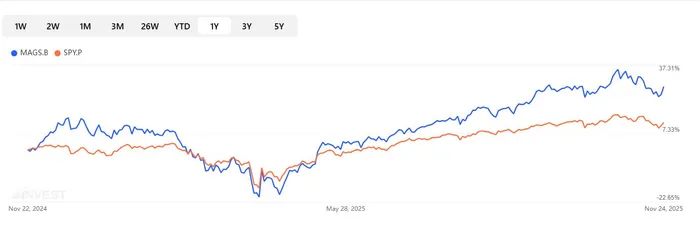
The Magnificent Seven, Apple, Microsoft, Nvidia, AmazonAMZN--, Alphabet, MetaMETA-- and TeslaTSLA-- now make up roughly one-third of the S&P 500’s market cap. Through the first three quarters of 2025, the Mag-7 accounted for about 41–55% of the S&P 500’s total return, depending on whether you include Broadcom in the group. First Trust.
In earlier periods, they drove more than half of the index’s gains in 2023–24, meaning much of the “market” performance was really a handful of stocks on an AI-supercharged tear. JPMorgan
AI as the Single Story: Feature or Bug?
There’s also a macro layer to this. Investor Ruchir Sharma recently warned that roughly 40% of U.S. economic growth this year is tied to AI infrastructure spending, arguing that America has become one big bet on AI. Benzinga
At the same time, Nvidia’s blowout earnings haven’t fully put tech-bubble fears to rest. Global stocks have wobbled this month, and strategists are openly asking how sustainable current valuations are if AI fails to deliver the expected productivity boom. For many investors, owning the market now means owning AI-linked mega-caps, whether they intended to or not.
How ETF Investors Are Quietly Hedging the Mag-7
ETF flows are starting to show a “Plan B” emerging for investors who don’t want to abandon tech, but also don’t want their entire portfolio riding on a handful of tickers.
Equal-Weight S&P 500 (RSP)
Same 500 companies, but each gets roughly the same weight.
That mechanically cuts Mag-7 exposure and boosts the role of “the other 493.”
Historically, equal-weight has tended to outperform when leadership broadens out after a narrow, mega-cap-driven run.
Small-Cap and Mid-Cap ETFs (IWM, IJR, MDY)
If the market’s next leg is about catch-up in “the rest of the economy,” these are natural beneficiaries.
They give you leverage to a broader economic recovery rather than just to AI data centers and mega-cap margins.
Staying Concentrated—On Purpose (QQQ, XLK)
For investors who accept the concentration trade and believe the Mag-7’s earnings power justifies it, tech-heavy ETFs like QQQ or XLK are still the high-conviction bet.
The key difference: here, you’re concentrated by choice, not by accident through a “broad” index.
How to Think About Your Own Portfolio
Decide if that concentration matches your risk tolerance.
If you’re comfortable with a big AI/mega-cap tilt, fine just own it consciously. If not, consider adding: Equal-weight (RSP) alongside SPY/VOO, Small/mid-cap (IWM, IJR, MDY), International or factor funds to diversify the growth story.
Think in scenarios, not forecasts.
What happens if AI spending keeps surprising to the upside?
What if it disappoints and markets suddenly care about valuation again?
Your portfolio should be able to survive both, not just one.
Bottom Line
The U.S. stock market isn’t literally just the Mag-7—but for many ETF investors, their returns and risks are more tied to seven tickers than they realize.
Quickly compare core portfolio ETFs SPY, VOO, RSP, IWM side by side with our ETF Compare Tool

Market Radar delivers concise, daily trading ideas by tracking everything from options activity and market sentiment to high-profile political trades.
Latest Articles
Stay ahead of the market.
Get curated U.S. market news, insights and key dates delivered to your inbox.
AInvest
PRO
AInvest
PRO



Comments
No comments yet