
The S&P 500's Record-Setting Ascent and the Forces Behind It
 Aime Summary
Federal Reserve Policy: A Shift Toward Accommodation
The Federal Reserve's pivot toward easing monetary policy has been the most significant catalyst for the S&P 500's recent ascent. By December 2025, the CME FedWatch index priced in an 87% probability of a 25-basis-point rate cut at the December FOMC meeting . This expectation was reinforced by the Fed's decision to end its quantitative tightening (QT) program on December 1, 2025, a move aimed at stabilizing liquidity conditions amid rising repo rates and depleted overnight reverse repo (ON RRP) facilities.
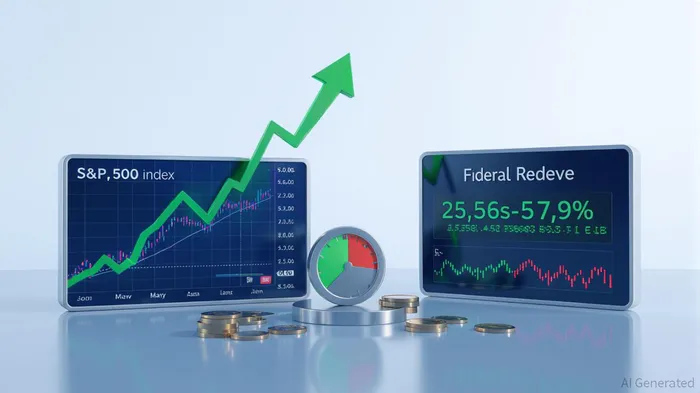 Reserve management purchases (RMPs), a tool designed to inject short-term liquidity without altering long-term borrowing costs, have further signaled the Fed's commitment to maintaining ample reserves. These operations, which involve buying short-term Treasury bills, are part of a broader strategy to avoid a repeat of the 2019 repo market turmoil according to market analysis. The shift in tone from the Fed has also been amplified by speculation about Kevin Hassett, a dovish figure, potentially succeeding Jerome Powell as chair-a development that has heightened market expectations for continued rate cuts in 2026 .
Liquidity Dynamics and Market Sentiment
The Fed's liquidity interventions have directly influenced investor sentiment. The termination of QT and the deployment of RMPs have alleviated concerns about funding market instability, as reserves have transitioned from "abundant" to "ample" levels according to market reports. This has been reflected in the sharp decline of the VIX "fear" index, which fell to multi-year lows in late November 2025, signaling a risk-on environment .
Moreover, the anticipated implementation of the One Big Beautiful Bill Act-a sweeping policy initiative projected to boost GDP and corporate spending in 2026-has added to the bullish narrative . Analysts argue that the combination of fiscal and monetary easing is creating a self-reinforcing cycle: lower borrowing costs stimulate economic activity, which in turn supports corporate earnings and equity valuations.
The S&P 500's resilience has also been bolstered by robust global demand for U.S. equities. Foreign private sector inflows into U.S. stocks reached $647 billion in the 12 months through September 2025, driven by the AI boom and post-election optimism according to market analysis. This capital influx has disproportionately benefited cyclical sectors such as transportation and regional banks, which have outperformed in anticipation of a rate-cut-driven economic reacceleration .
However, the market's focus on AI-driven growth has raised concerns about stretched valuations. While the S&P 500 quietly rebounded to near-record levels in late November 2025, with a two-week rally of 5.5% , skepticism persists about the sustainability of capital expenditures in the tech sector. A report by Flagstar notes that speculative bubbles in AI-related firms could pose risks if profit margins fail to meet lofty expectations .
A Pivotal Moment for Investors
As 2026 approaches, investors face a critical juncture. The S&P 500's projected 14% earnings growth and the Fed's dovish trajectory suggest continued momentum, but the risks of overvaluation and policy missteps cannot be ignored . The One Big Beautiful Bill Act's implementation, if successful, could provide a tailwind for equities, but its effectiveness will depend on execution and broader economic conditions.
For now, the market's resilience-bolstered by liquidity injections, rate-cut expectations, and global capital flows-underscores the importance of a strategic reassessment of equity exposure. While the S&P 500's record-setting ascent reflects optimism about the near-term outlook, investors must balance this with caution, particularly in sectors where fundamentals may lag behind price action.

Delivering real-time insights and analysis on emerging financial trends and market movements.
Latest Articles
Stay ahead of the market.
Get curated U.S. market news, insights and key dates delivered to your inbox.






Comments
No comments yet