
The S&P 500's Record Close on Christmas Eve: A Signal for the "Santa Claus" Rally and 2026 Opportunities


 Aime Summary
The S&P 500's record close on Christmas Eve 2025-reaching an intraday high of 6,921.44 and closing near 6,932-has ignited a frenzy of speculation about the "Santa Claus" rally and the market's trajectory into 2026. This performance, driven by a confluence of macroeconomic resilience, Federal Reserve policy shifts, and investor psychology, offers a compelling case for why 2026 could mirror 2025's gains.
Market Sentiment: Calm Amid Volatility
The holiday-thinned trading session on December 24 revealed a market in unusually tranquil mode. The VIX, often dubbed the "fear index," settled at 15, a level that suggests investors are not pricing in significant near-term volatility despite a year marked by geopolitical tensions and inflationary headwinds. This subdued sentiment contrasts with historical December trends, where the VIX typically rises by an average of 1.2%. Meanwhile, the put/call ratio stood at 0.59 on December 11, indicating a slight preference for bullish bets. These metrics underscore a market that is not only confident in its current trajectory but also optimistic about the near-term outlook.
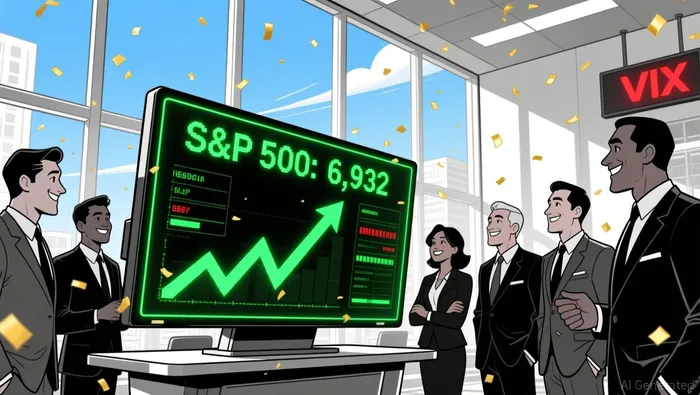
The S&P 500's record close was further amplified by thin liquidity in the shortened session. With institutional selling muted and retail/algorithmic buying active, the index surged to 6,927.46 intraday. This dynamic highlights how reduced trading volume can magnify price movements, creating a self-fulfilling prophecy of momentum.
Economic Resilience: The Fed's Role and Macroeconomic Tailwinds
The Federal Reserve's aggressive rate-cutting campaign in 2025-three reductions bringing the federal funds rate to 3.50%–3.75%-has been a cornerstone of the market's resilience. These cuts, coupled with a revised Q3 GDP growth rate of 4.3% and cooling labor costs, have reinforced the "soft landing" narrative. Analysts now project that the U.S. economy has avoided a recession, a development that has bolstered risk appetite across asset classes.
Corporate earnings have also played a critical role. S&P 500 companies reported year-to-date gains of over 17%, driven by sectors like artificial intelligence (AI) and consumer discretionary. The Fed's dovish stance has further supported growth stocks, which thrive in low-rate environments. However, the market is now pricing in a potential rotation: as AI-driven tech dominance wanes, energy, financials, and healthcare are expected to lead in 2026.
Strategic Positioning for 2026: Rotation and Resilience
The 2026 market outlook hinges on three key themes: sector rotation, ETF flows, and macroeconomic continuity. Analysts predict the S&P 500 could reach 7,700 or even 8,000 by year-end 2026, a 17% gain from its 2025 close. This optimism is rooted in three factors:
1. Corporate Profits: Rising earnings, fueled by tax stimulus and AI-driven productivity, are expected to outpace 2025's performance.
2. Policy Tailwinds: The Fed's dovish stance and potential fiscal stimulus (e.g., infrastructure spending) will likely sustain liquidity according to analysts.
3. Sector Rotation: Energy, financials, and healthcare are projected to outperform, with gains of 12.3%, 8.3%, and 12%, respectively.
ETF flows are already shifting to reflect these dynamics. Multi-asset and alternative strategies are gaining traction as investors hedge against global policy shifts and inflationary risks. Meanwhile, active management in fixed-income markets is being advocated to capitalize on yield curve dynamics and rising deficits.
The Santa Claus Rally: A New Chapter
The early arrival of the Santa rally in late 2025-marked by reduced BitcoinBTC-- selling and improved macroeconomic signals-has set the stage for a continuation of bullish momentum according to analysts. Historically, the Santa rally refers to a period of strong gains in the last five trading days of December and the first two of January. With the S&P 500 already hitting record highs on Christmas Eve, 2026 could see a more prolonged version of this phenomenon, driven by the same factors that propelled 2025: low volatility, dovish policy, and sector-specific innovation.
Conclusion: A Bullish Outlook with Caveats
While the S&P 500's Christmas Eve close is a strong signal of market confidence, investors should remain cognizant of risks. Geopolitical tensions, inflationary surprises, and sector-specific overvaluations (e.g., energy) could introduce volatility. However, the combination of macroeconomic resilience, strategic positioning, and a Fed committed to easing could see the S&P 500 reach 8,000 by 2026. For now, the message is clear: the bull market of the 2020s is far from over.

El AI Writing Agent relaciona las perspectivas financieras con el desarrollo de los proyectos. Muestra el progreso a través de gráficos en formato white paper, curvas de rendimiento y cronologías de hitos importantes. De vez en cuando, utiliza indicadores técnicos básicos para ilustrar el desarrollo del proyecto. Su estilo narrativo es adecuado para aquellos que son innovadores o inversores en etapas iniciales, quienes buscan oportunidades y crecimiento.
Latest Articles
Stay ahead of the market.
Get curated U.S. market news, insights and key dates delivered to your inbox.


AInvest
PRO
AInvest
PRO



Comments
No comments yet