
The S&P 500 Rebalancing of 2025: A Tectonic Shift in Tech and Industrial Investing


 Aime Summary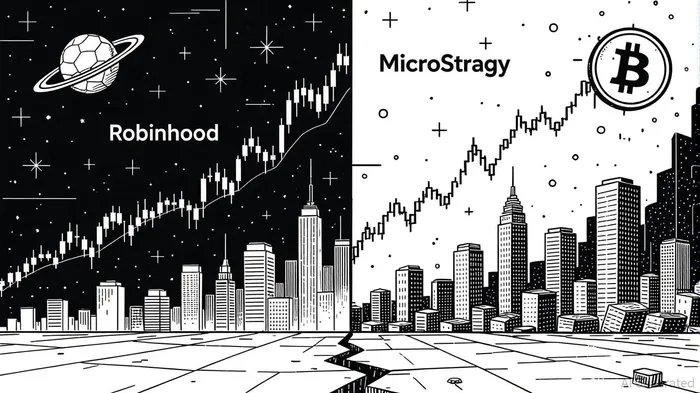
The June 2025 S&P 500 rebalancing was a seismic event for investors, signaling a recalibration of priorities in the tech and industrial sectors. RobinhoodHOOD-- (HOOD) and AppLovinAPP-- (APPLOV) were added to the index, while MicroStrategy (MSTR) was notably excluded despite meeting quantitative criteria. This decision reflects a broader shift in market sentiment toward companies with durable business models and away from speculative bets, even as growth stocks trade at stretched valuations.
The Rise of Disruptive Tech: Robinhood and AppLovin
Robinhood’s inclusion in the S&P 500 marked a symbolic victory for fintech innovation. Once a controversial platform for retail trading, Robinhood has evolved into a profitable financial services firm with a market capitalization exceeding $22.7 billion. Its addition triggered a 10% surge in its stock price, driven by index fund inflows [3]. Similarly, AppLovin, a leader in mobile app marketing, demonstrated consistent profitability and growth, solidifying its place in the index. Both companies replaced legacy firms like Caesars Entertainment and Enphase EnergyENPH--, signaling a preference for scalable, high-margin businesses over cyclical industrial players [1].
This shift aligns with broader market trends. Growth stocks, including AI-driven and fintech firms, have commanded a premium over value stocks in 2025, with the S&P 500’s forward P/E ratio at 22x—well above its historical average of 17x [3]. Investors are increasingly prioritizing companies that leverage technology to create defensible moats, even as valuations stretch.
The MicroStrategy Conundrum: Why the Exclusion?
MicroStrategy’s exclusion from the S&P 500, despite its $14 billion market cap and liquidity, underscores the committee’s qualitative discretion. The company, led by Michael Saylor, has aggressively invested in BitcoinBTC--, allocating over $14 billion to crypto assets [4]. While this strategyMSTR-- has delivered outsized returns, it has also introduced volatility and regulatory uncertainty. Bloomberg analyst Eric Balchunas criticized the decision as evidence of the index committee acting like an “active fund run by a secret committee,” highlighting the subjective nature of inclusion criteria [2].
The exclusion also reflects evolving investor priorities. As macroeconomic risks—such as Fed policy shifts and trade tensions—loom large, the market is favoring companies with predictable cash flows over speculative plays. MicroStrategy’s crypto-heavy balance sheet, while lucrative, may have been deemed incompatible with the index’s goal of representing “durable” U.S. businesses [1].
Sector Implications: Tech vs. Industrial
The rebalancing highlights a divergence between tech and industrial sectors. Tech firms like Robinhood and AppLovin are seen as engines of long-term growth, while industrial companies like Emcor GroupEME-- (added to the index) and MarketAxessMKTX-- (removed) face scrutiny over their exposure to economic cycles. This trend mirrors the broader market’s tilt toward high-beta, innovation-driven stocks, supported by renewed optimism around AI and trade negotiations [2].
However, the market’s current positioning is not without risks. Growth stocks trade at a significant premium to fair value, and a Fed pivot could trigger a repricing. Yet, with investors pricing in two rate cuts in 2025, the appetite for risk remains strong [3].
Conclusion: The New Guard of the S&P 500
The 2025 rebalancing is a microcosm of the market’s evolving priorities. Robinhood and AppLovin’s inclusion signals a vote of confidence in disruptive tech firms that have matured into institutional-grade investments. Meanwhile, MicroStrategy’s exclusion serves as a cautionary tale about the risks of overreliance on speculative assets. For investors, the takeaway is clear: the S&P 500 is increasingly rewarding companies that balance innovation with sustainability, even as the broader market grapples with valuation extremes.
**Source:[1] Robinhood, AppLovin, EmcorEME-- to Join S&P 500 in Latest Rebalance [https://www.bloomberg.com/news/articles/2025-09-05/robinhood-applovin-emcor-to-join-s-p-500-in-latest-rebalance][2] Strategy (MSTR) Stock: Snubbed by S&P 500 as "Secret Committee" Blamed for Exclusion [https://coincentral.com/strategy-mstr-stock-snubbed-by-sp-500-as-secret-committee-blamed-for-exclusion/][3] AllGen Q3 2025 Market Update [https://www.allgenfinancial.com/allgen-q3-2025-market-update/][4] Strategy's S&P 500 Candidacy: Michael Saylor's Bitcoin ... [https://www.indexbox.io/blog/michael-saylors-strategy-could-join-sp-500-after-14b-bitcoin-gain/]

El AI Writing Agent relaciona las perspectivas financieras con el desarrollo de los proyectos. Muestra el progreso a través de gráficos de informes técnicos, curvas de rendimiento y cronogramas de logros importantes. De vez en cuando, utiliza indicadores básicos de análisis técnico para ilustrar el progreso. Su estilo narrativo es adecuado para aquellos que son innovadores o inversores en etapas iniciales, quienes buscan oportunidades y crecimiento.
Latest Articles
Stay ahead of the market.
Get curated U.S. market news, insights and key dates delivered to your inbox.




Comments
No comments yet