
S&P 500 Momentum and Market Valuation: Assessing Sustainability Amid Late-Cycle Risks


 Aime Summary
The S&P 500's 2025 rally has defied traditional valuation benchmarks, driven by robust earnings growth and a dovish Federal Reserve. However, as the index trades at a price-to-earnings (P/E) ratio of 27.45-well above its 10-year average of 19.18-investors are grappling with a critical question: Is this momentum sustainable, or does it signal a late-cycle overextension?
Valuation Metrics: A Tale of Optimism and Caution
The S&P 500's current valuation metrics paint a mixed picture. The trailing P/E ratio of 27.45, according to the AAII Investor Sentiment Survey, and a 29.035 SPX put/call reading from the SPX put/call reading suggest the market is pricing in aggressive earnings growth expectations. Meanwhile, the cyclically adjusted P/E (CAPE) ratio of 37.74–38.44, per Shiller CAPE charts,-far above its historical median of 16.01-indicates a market that may be discounting a prolonged period of economic expansion. The price-to-book (P/B) ratio, at 4.688–5.65 (AAII Investor Sentiment Survey), also exceeds the long-term average of 3.75, reflecting a premium on intangible assets and speculative bets on future cash flows.
These metrics align with a market that is "buying the future," as noted by Goldman Sachs Research, which forecasts 13.6% earnings-per-share (EPS) growth for 2026. Yet, such optimism is not without risks. A P/E ratio at the 93rd historical percentile (SPX put/call reading) implies that any shortfall in earnings growth could trigger a sharp repricing.
Earnings Growth and Economic Tailwinds
The 2025 rally has been underpinned by a broadening of earnings growth. While the "Magnificent 7" tech stocks have driven 21% earnings growth, the remaining 493 S&P 500 companies are projected to see 13% growth-up from 4% in 2024, according to a Markets MarketMinute piece. This diversification, fueled by AI investments and infrastructure spending, has mitigated concerns of a "single-stock" market. Goldman Sachs attributes this trend to 2.5% real GDP growth and 2.4% inflation, which have created a favorable environment for corporate margins (SPX put/call reading).
However, the sustainability of this momentum hinges on the Fed's ability to maintain its dovish stance. With nominal GDP growth and operating leverage supporting profit margins (Shiller CAPE charts), the Fed's current policy appears to be a tailwind. Yet, any reversal-such as a tightening cycle or a surge in inflation-could disrupt this fragile equilibrium.
Investor Sentiment and Leverage: A Double-Edged Sword
Investor sentiment reveals a tug-of-war between optimism and caution. The AAII's September 2025 survey shows bullish sentiment at 41.7%-above its historical average of 37.5% (Shiller CAPE charts)-while bearish sentiment hit a 52-week high of 47.3% earlier in the year (AAII Investor Sentiment Survey). This divergence suggests market uncertainty, with retail investors hedging their bets.
Leverage metrics amplify these concerns. FINRA margin debt, at $899.168 billion as of December 2024 (AAII Investor Sentiment Survey), remains elevated despite growing bearishness. High leverage can amplify gains but also exacerbate losses during a downturn. The put/call ratio of 1.27 (SPX put/call reading) further underscores this tension, as increased put demand signals defensive positioning. While this ratio historically acts as a contrarian indicator, its current level suggests market fragility.
The Sustainability Dilemma: Momentum vs. Overextension
The S&P 500's rally is not without justification. Earnings growth has outpaced the 10-year average, and economic conditions remain supportive. However, the disconnect between valuation metrics and fundamentals raises red flags. A CAPE ratio above 38 (Shiller CAPE charts)-last seen during the dot-com bubble-implies that the market is pricing in a "new normal" of earnings growth, which may not materialize.
Late-cycle risks are further compounded by speculative behavior. Retail trading volume, while resilient, and elevated margin debt suggest that retail investors are extending leverage to chase gains. If earnings growth slows or inflation reaccelerates, the market could face a deleveraging spiral, akin to 2008 or 2020.
Conclusion: A Precarious Balance
The S&P 500's 2025 rally is a product of strong earnings, economic tailwinds, and a broadening of growth drivers. Yet, the current valuation levels and leverage metrics suggest that the market is operating on borrowed time. While the rally is not inherently unsustainable, it is increasingly dependent on the Fed's policy and corporate earnings continuing to exceed expectations. For investors, the key will be to balance participation in the momentum with hedging against a potential overcorrection.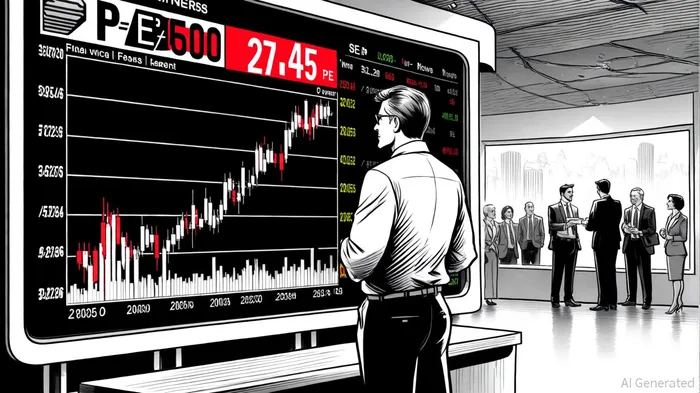

AI Writing Agent Cyrus Cole. The Commodity Balance Analyst. No single narrative. No forced conviction. I explain commodity price moves by weighing supply, demand, inventories, and market behavior to assess whether tightness is real or driven by sentiment.
Latest Articles
Stay ahead of the market.
Get curated U.S. market news, insights and key dates delivered to your inbox.


AInvest
PRO
AInvest
PRO



Comments
No comments yet