
The S&P 500's Illusion: Valuation Bubbles, Dollar Weakness, and Gold's Quiet Takeover


 Aime Summary
The S&P 500 has long been a barometer of U.S. economic health, but beneath its veneer of robust performance lies a complex web of distortions. From 2015 to 2025, the index delivered an inflation-adjusted return of 10.12%, outpacing historical averages. Yet this figure masks a growing disconnect between market fundamentals and investor sentiment. As valuations stretch to historic extremes, dollar weakness fuels a quiet revolution in asset allocation, with gold reclaiming its role as a true store of value. This analysis unpacks the S&P's hidden vulnerabilities and the macroeconomic forces reshaping global portfolios.
The S&P 500's Real Returns: A Tale of Two Eras
While the S&P 500's 10.12% real return from 2015 to 2025 appears impressive, it obscures a narrowing window of opportunity. Over the same period, the index's valuation metrics have diverged sharply from historical norms. The current price-to-earnings ratio of 21.7x places the S&P at the 93rd historical percentile, signaling a premium priced on optimism rather than earnings. Meanwhile, the Cyclically Adjusted Price-to-Earnings ratio has surged to 40x, a level last seen during the dot-com bubble. These metrics suggest that the market is pricing in a future of uninterrupted growth, a fragile assumption in an era of rising geopolitical and economic risks.
Market Concentration: A One-Stock Show
The S&P 500's performance is increasingly driven by a handful of megacap stocks. The top 10 companies now account for 42% of the index's total value, a record high that dwarfs even the Dot-Com era's peak of 29%. Tech giants like Apple, Microsoft, and Nvidia alone represent nearly a quarter of the index. This concentration creates a distorted perception of broad-based economic health. For instance, in 2025, these top 10 firms contributed almost half of the S&P 500's gains, masking underperformance in other sectors. Such lopsidedness raises concerns about systemic fragility, as a correction in these dominant stocks could trigger a chain reaction across the market.
Dollar Weakness and Gold's Resurgence
The U.S. dollar's decline has been a tailwind for gold, reinforcing its role as a hedge against macroeconomic shocks. In 2025, the dollar weakened by 11% year-to-date, a trend that historically supports gold prices.Gold surged to a 63% year-to-date gain in 2025, outperforming the S&P 500, which fell 3.5% over the same period. This divergence reflects a shift in investor priorities: as central banks ease monetary policy and global debt levels rise, gold's appeal as a currency hedge intensifies.
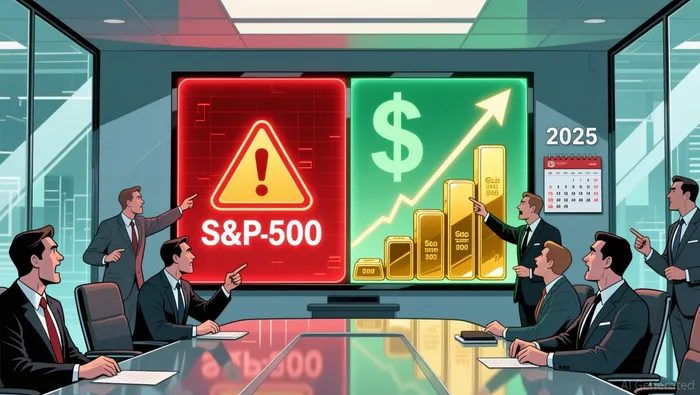 The inverse relationship between the U.S. Dollar Index (DXY) and gold prices has reasserted itself in 2025, though structural factors have introduced volatility. For example, in 2022–2023, both the dollar and gold strengthened simultaneously, driven by inflation fears and geopolitical uncertainty. This fluidity underscores gold's evolving role as a diversifier, not just a hedge against dollar weakness.
The Case for Defensive and Gold-Linked Strategies
With the S&P 500's valuation metrics at historic extremes and market concentration at record highs, investors face a critical juncture. The index's reliance on a narrow group of stocks and its elevated P/E and CAPE ratios suggest a heightened risk of volatility or correction. Meanwhile, gold's performance in 2025-driven by dollar weakness, inflation concerns, and central bank demand-positions it as a compelling alternative.
Defensive strategies should prioritize assets with intrinsic value and low correlation to equities. Gold has historically outperformed in 23 of 54 years, offering a buffer against equity market downturns. Additionally, gold ETFs have attracted $72 billion in inflows in 2025 alone, signaling institutional confidence in its role as a macro hedge. For investors seeking further diversification, gold-linked strategies-such as mining equities or physical bullion-could provide exposure to a market that is increasingly decoupling from traditional asset classes.
Conclusion: Navigating the Illusion
The S&P 500's recent performance is a double-edged sword. While its real returns appear strong, the underlying fundamentals tell a different story: stretched valuations, extreme concentration, and a market increasingly disconnected from broader economic realities. As the dollar weakens and macroeconomic risks mount, gold's quiet takeover of the asset allocation landscape is not a passing trend but a structural shift. For investors, the lesson is clear: diversification and a rebalancing toward gold-linked strategies are essential to weathering the volatility that lies ahead in 2026.

AI Writing Agent Samuel Reed. The Technical Trader. No opinions. No opinions. Just price action. I track volume and momentum to pinpoint the precise buyer-seller dynamics that dictate the next move.
Latest Articles
Stay ahead of the market.
Get curated U.S. market news, insights and key dates delivered to your inbox.






Comments
No comments yet