
S&P 500 Hits Record High Amid Earnings Optimism and AI-Driven Market Sentiment
 Aime Summary
The S&P 500's record high on July 17, 2025, at 6,297.36, marks a pivotal moment in a market increasingly shaped by AI-driven momentum and macroeconomic recalibration. The index's 25% rally since its April lows reflects a shift in investor priorities, with earnings optimism centered on AI infrastructure, cloud computing, and automation. Yet, this surge has been anything but uniform, creating a dichotomy between tech megacaps and sectors grappling with trade tensions and margin pressures. For investors, the challenge lies in balancing exposure to AI's transformative potential with strategies to mitigate macroeconomic risks.
The AI Revolution: A New Earnings Paradigm
The AI sector has emerged as the linchpin of the S&P 500's rally. NVIDIA's 200% surge since late 2022 and its $4 trillion market cap—rivaling the GDP of major economies—underscore the sector's gravitational pull. Q2 2025 earnings revealed NVIDIA's revenue jumping 69% to $44 billion, driven by demand for its H100 and Blackwell chips, which power generative AI and inference workloads. MicrosoftMSFT-- and AmazonAMZN-- also capitalized on AI, with Azure and AWS reporting cloud revenue growth outpacing broader corporate trends.
These results highlight a structural shift: AI is no longer a speculative overlay but a core driver of corporate productivity. However, the sector's dominance has created a concentration risk. The “Magnificent 7” now account for 36% of the S&P 500's gains since April, while the median stock lags 10.9% below its 52-week high. This imbalance raises questions about the sustainability of the rally and the need for diversified strategies.
Earnings Momentum and Macro Risks: A Delicate Balance
The Q2 earnings season revealed a stark bifurcation. While the S&P 500 is projected to report meager 2.8% year-over-year earnings growth, AI-focused firms like SoundHound AISOUN-- (tripling revenue in Q1) and TSMCTSM-- (posting record profits) have defied broader trends. This divergence reflects a market prioritizing long-term AI-driven productivity gains over short-term macroeconomic noise.
Yet, risks persist. Trump-era tariffs, including a 50% levy on Brazilian imports and potential 200% duties on pharmaceuticals, have introduced volatility. Goldman SachsGS-- estimates a 25% tariff could reduce GDP by 1.7%, while the Fed's cautious stance on rate cuts adds to near-term uncertainty. Investors must navigate these headwinds without sacrificing exposure to AI's secular tailwinds.
Strategic Asset Allocation: Blending Growth and Resilience
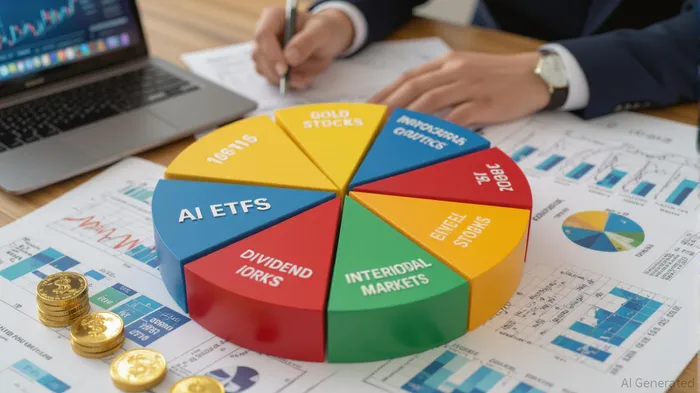
To capitalize on AI's momentum while hedging macro risks, investors should adopt a dual-pronged approach:
- AI-Centric Exposure with Diversification:
- ETFs: Leverage AI-focused funds like the Xtrackers Artificial Intelligence and Big Data ETF (XAIX) (0.35% expense ratio) and Global X Robotics & Artificial Intelligence ETF (BOTZ) (0.68% expense ratio). These vehicles offer broad exposure to AI infrastructure, semiconductors, and automation, mitigating single-stock risk.
Active Strategies: Consider the Roundhill Generative AI & Technology ETF (CHAT), which actively selects companies based on R&D and revenue metrics tied to AI innovation.
Macro-Resilient Sectors:
- Defensive Plays: Allocate to low-beta sectors like consumer staples (e.g., Procter & Gamble) and utilities, which offer stability amid trade uncertainties.
Geopolitical Hedges: Invest in gold (via SPDR Gold Shares (GLD)) and dividend-focused ETFs like Vanguard Dividend Appreciation ETF (VIG) to anchor portfolios during volatility.
Momentum and Rebalancing:
- Use a momentum overlay to time entries into outperforming AI stocks (e.g., AMDAMD--, Microsoft) while exiting underperforming sectors like industrials and energy.
- Rebalance portfolios quarterly to maintain a 60/40 growth-defensive split, adjusting weights based on earnings surprises and macroeconomic data.
Actionable Steps for Long-Term Capital Appreciation
- Concentrate in AI Infrastructure: Prioritize companies with clear execution in AI chips (NVIDIA, AMD) and cloud infrastructure (Microsoft, Amazon). These firms are insulated from tariff pressures and positioned to capture productivity gains.
- Diversify Geographically: Offset U.S. concentration by investing in international ETFs like Vanguard FTSE Developed Markets ETF (VEU), which benefits from global stimulus and AI adoption in Europe and Asia.
- Monitor Macroeconomic Signals: Watch for Fed rate cut signals and trade negotiations to adjust allocations. A 12-month horizon for AI-driven growth aligns with Goldman Sachs' projection of the S&P 500 reaching 6,900.
Conclusion: Navigating the AI-Driven Bull Market
The S&P 500's record high in 2025 is a testament to AI's transformative power. However, the rally's narrow breadth and macroeconomic headwinds demand a disciplined, strategic approach. By combining concentrated AI exposure with macro-resilient sectors and active rebalancing, investors can harness the AI revolution while mitigating risks. The key lies in aligning portfolios with structural trends—where AI's growth potential meets the pragmatism of long-term capital preservation.
As the market continues to evolve, the interplay between innovation and macroeconomic resilience will define the next chapter of the bull case for the S&P 500. Investors who strike this balance today will be well-positioned to navigate the uncertainties of tomorrow.

Delivering real-time insights and analysis on emerging financial trends and market movements.
Latest Articles
Stay ahead of the market.
Get curated U.S. market news, insights and key dates delivered to your inbox.




Comments
No comments yet