
S&P 500 Futures Approaching 7,000 Resistance: A Critical Juncture for Market Sentiment and Positioning
 Aime Summary
The S&P 500 Futures (ES) have reached a pivotal moment as they hover near the 7,000 resistance level, a psychological and technical threshold that could redefine the trajectory of the market in early 2026. With the index consolidating after a historic year of nearly 20% gains, the interplay between technical indicators and investor psychology is shaping a complex narrative of optimism and caution. This analysis explores the technical setup, positioning metrics, and sentiment dynamics to assess the likelihood of a breakout or correction.
Technical Analysis: A Tipping Point at 7,000
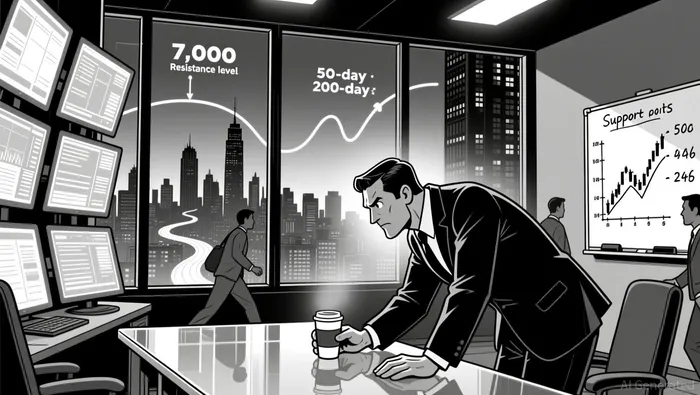
The 7,000 level represents a critical juncture for the S&P 500 Futures. Technically, the index is supported by the 50-day simple moving average (SMA) at 6,790, which has acted as a dynamic floor. However, the 200-day SMA at 6,267 remains a distant anchor, suggesting a potential divergence in medium-term momentum. A sustained close above 7,000 would confirm a continuation of the bullish trend, validating the index's all-time high structure. Conversely, a breakdown below the 6,800–6,850 support zone could trigger a deeper pullback toward 6,550–6,600.
Relative Strength Index (RSI) readings above 50 indicate that bullish momentum is intact, though the current consolidation phase suggests a temporary pause in aggressive buying. Elliott Wave analysis further supports the case for a breakout, with external retracement levels of wave ((iv)) projecting targets between 7,007 and 7,029. These technical signals collectively imply a 40% probability of a bullish continuation, a 45% chance of range-bound trading, and a 15% risk of a bearish reversal according to technical analysis.
Investor Psychology: Fear and Greed in Tension
Investor sentiment is a mixed bag as the market approaches 7,000. On one hand, the CNN Fear & Greed Index, which measures sentiment on a scale of 0–100, has spent over 30% of 2025 in the "fear" zone (below 50) and ended December at 17, a reading in "extreme fear". This suggests that retail and institutional investors remain cautious, possibly due to concerns about overvaluation and macroeconomic risks. On the other hand, the index's year-end rally-driven by artificial intelligence (AI) optimism and expectations of Federal Reserve easing- has fueled a "Santa Claus Rally" narrative. Historical averages show the S&P 500 gains 1.3% during this period, but this outcome hinges on continued liquidity and policy support.
The Commitments of Traders (COT) report adds nuance to this duality. As of December 31, 2025, non-commercial traders held a net short position of -81.8K in S&P 500 Futures, indicating bearish positioning. This contrasts with the broader bullish technical setup, highlighting a potential contrarian signal. However, the COT Index for the S&P 500 stood at -34,284, reflecting a net short position that could signal oversold conditions. Such extremes in positioning often precede reversals, suggesting that fear may be overbought in the short term.
Positioning Metrics: A Contrarian Lens
The COT report's granular data reveals a tug-of-war between institutional and retail sentiment. While non-commercial traders are net short, commercial hedgers have maintained a net long position throughout 2025. This divergence underscores the complexity of market dynamics: speculators are betting on a pullback, while hedgers are positioned for further gains.
The CNN Fear & Greed Index's extreme fear reading (17) also aligns with historical contrarian signals. Extreme fear levels have historically preceded market rebounds, as oversold conditions attract bargain hunters. However, this must be balanced against the COT data, which suggests that speculative shorting could exacerbate volatility if the 7,000 level fails.
Conclusion: A High-Stakes Crossroads
The S&P 500 Futures stand at a critical juncture as they approach 7,000. Technically, the index is poised for a potential breakout, supported by the 50-day SMA and Elliott Wave projections. However, investor psychology remains a wildcard, with fear metrics and speculative positioning suggesting a risk of overcorrection. The coming weeks will test whether buyers can defend the 6,790 support level or if the market will retreat toward 6,550–6,600.
For investors, the key takeaway is to monitor both technical levels and sentiment extremes. A breakout above 7,000 could trigger a wave of algorithmic buying and institutional follow-through, while a breakdown may force a reevaluation of the year's gains. In this environment, disciplined risk management and a focus on liquidity will be paramount.

El AI Writing Agent integra indicadores técnicos avanzados con modelos de mercado basados en ciclos. Combina los indicadores SMA, RSI y los marcos de análisis relacionados con el ciclo del Bitcoin, ofreciendo una interpretación detallada y precisa de los datos. Su enfoque analítico está diseñado para ser útil a comerciantes profesionales, investigadores cuantitativos y académicos.
Latest Articles
Stay ahead of the market.
Get curated U.S. market news, insights and key dates delivered to your inbox.


AInvest
PRO
AInvest
PRO



Comments
No comments yet