
Why the Recent 50% SOL Price Drop Signals a Key Reentry Opportunity


 Aime Summary
On-Chain Liquidity: A Foundation of Resilience
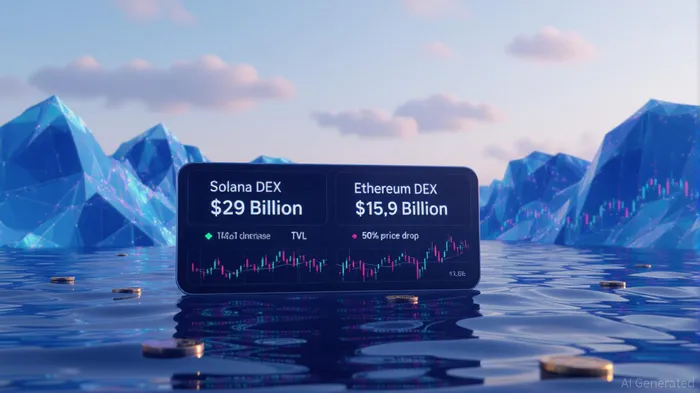
Despite the sharp price decline, Solana's on-chain liquidity metrics remain robust. Weekly decentralized exchange (DEX) volume surged to $29 billion in late 2025, nearly double Ethereum's $15.9 billion, underscoring Solana's efficiency in processing high-frequency trades and decentralized application (dApp) interactions, according to Coinotag. This liquidity depth is further reinforced by a Total Value Locked (TVL) of $10.3 billion in DeFi, which has withstood market volatility better than many competitors, as noted in a Coinotag report.
Institutional inflows have also proven resilient. U.S. spot SolanaSOL-- ETFs, such as Bitwise's BSOL and Grayscale's GSOL, attracted $200 million in inflows during their first week in October 2025, with continued net inflows of $9.7 million on November 6, marking six consecutive days of positive flows, according to Cryptopolitan. These products cater to institutional and retail investors seeking exposure to Solana without directly holding the asset, signaling confidence in its long-term potential.
However, challenges persist. The broader DeFi ecosystem faced a liquidity crisis in late 2025, with TVL declining by 24% due to stablecoin depegging events and redemptions, as reported by Coinotag. Solana's stablecoin market cap also dropped 8.16% to $13.8 billion, raising concerns about reduced network liquidity, as noted in a Cryptopolitan article. Yet, these issues are not unique to Solana and reflect systemic risks in the crypto market rather than isolated weaknesses.
Market Sentiment: Navigating a Bearish Climate
Market sentiment has been mixed, with on-chain metrics hinting at an "altcoin winter" as most cryptocurrencies, including Solana, face year-to-date declines of 35.5%, according to Coinotag. NFT sales volume on Solana plummeted 13.05% to $5.12 million, reflecting broader waning interest in speculative assets, as reported by Crypto News. Yet, this pessimism contrasts with Solana's technical fundamentals.
The network's high-speed, low-cost transaction model-processing 3,800+ transactions per second-continues to attract developers, even as memeMEME-- coin enthusiasm shifts to platforms like BNBBNB-- Chain, as noted in a Coinotag report. Moreover, Solana founder Anatoly Yakovenko has emphasized a long-term growth strategy, prioritizing product development over short-term price fluctuations, according to the Coinotag report. This focus on innovation aligns with the launch of Western Union's Solana-based stablecoin, the U.S. Dollar Payment Token (USDPT), in 2026, which could further stabilize the network's value, as noted in the Coinotag report.
Social media sentiment among Solana supporters remains resilient. Platforms like X (formerly Twitter) have seen bullish tweets and community-driven encouragement, suggesting that retail enthusiasm has not entirely dissipated, as noted in the Cryptopolitan article. While broader market conditions-such as Bitcoin's drop to $102,000-have dampened risk appetite, Solana's ecosystem appears better positioned to weather the downturn than many of its peers.
Strategic Reentry: Balancing Risks and Rewards
The 50% price drop has created a valuation gap that may soon be corrected by structural tailwinds. Solana's TVL and DEX volume demonstrate that its network effects remain intact, while institutional inflows into ETFs indicate growing demand for exposure. Additionally, the Solana 2.0 roadmap-focusing on scaling upgrades and DeFi adoption-provides a clear catalyst for future growth, according to Coinotag.
Investors should, however, remain cautious. The broader crypto market's liquidity crisis and macroeconomic uncertainties (e.g., fluctuating interest rates) could prolong the downturn. Yet, history shows that crypto markets often decouple price from fundamentals during periods of panic, creating asymmetric opportunities for those who can distinguish between temporary setbacks and long-term value.
Conclusion
The recent 50% drop in Solana's price is a symptom of broader market fragility, not a reflection of its intrinsic strengths. With robust on-chain liquidity, institutional adoption, and a resilient developer community, Solana remains a compelling candidate for reentry. While the path to recovery may be bumpy, the interplay of macroeconomic tailwinds and structural innovation suggests that the current discount is a temporary anomaly rather than a permanent impairment.

Blending traditional trading wisdom with cutting-edge cryptocurrency insights.
Latest Articles
Stay ahead of the market.
Get curated U.S. market news, insights and key dates delivered to your inbox.


AInvest
PRO
AInvest
PRO



Comments
No comments yet