
The $5 Trillion Crown: Decoding the Market’s 80% Nvidia Bet
 Aime Summary
Lead
With 28 days until the August 31 settlement, Polymarket’s contract on the world’s largest company has crystallized into a lopsided bet: 80% implied probability that Nvidia holds the crown, versus just 11.4% for Alphabet. This article dissects the gap between market pricing and underlying reality, examining how a wave of hyperscaler capex data and a sharp rotation in mega-cap tech have driven the contract, while exposing the resolution rule ambiguities and volume dynamics that could make the final settlement more contested than the current odds suggest.
Event Definition
The market resolves to the company with the largest market capitalization at the close of trading on August 31, 2026, as determined by a consensus of credible financial reporting. The core disagreement is not simply about which firm is biggest today, but whether the current trajectory of earnings beats, AI infrastructure spending, and supply-chain headwinds can sustain or invert the pecking order over the next four weeks.
Latest News & Information Increments
The dominant catalyst repricing this market is the sheer scale of confirmed AI capital expenditure. Amazon’s H1 2026 capex hit $98.4 billion, with Q2 spending up 68% year-over-year, pushing Polymarket traders to assign 62.5% probability full-year exceeds $220 billion. This is not isolated: Morgan Stanley analysts now track consensus 2027 cloud capex estimates at roughly $1.2 trillion, a 30% year-over-year jump, and believe their own $1.4 trillion aggregate estimate may be more realistic as all four major U.S. hyperscalers remain supply-constrained. Alphabet itself raised its 2026 capital spending guidance to a $195–$205 billion range.
This spending bonanza has translated directly into equity performance. AmazonAMZN-- shares surged to an all-time high above $287, pushing its market cap past $3 trillion, after a Q2 earnings beat powered by a 36.7% rise in AWS revenue. NvidiaNVDA--, meanwhile, maintains an 86% share of the AI data center GPU market and saw Q1 fiscal 2027 net income soar 140% to $1.87 per share, fueling its fluctuating battle with Apple for the title of world’s most valuable company at around $5 trillion. The news flow has overwhelmingly favored the AI infrastructure providers, creating a powerful narrative that market-cap leadership belongs to the firms enabling the buildout, not just those selling consumer devices.
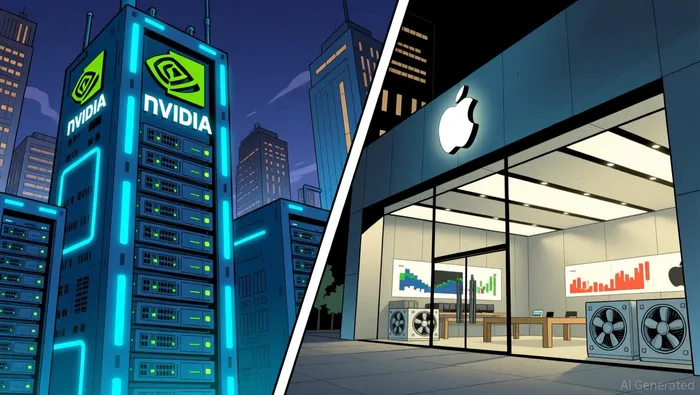
In contrast, Apple’s recent news flow has introduced a note of caution. A four-day selloff erased $503 billion from its market value, causing it to slip below Alphabet to become the third-largest U.S. company by market cap. The drop followed weaker-than-anticipated revenue guidance tied to persistent supply issues, even as its shares remain up 23% for the year. This divergence—punishing AI spenders less for their capex and punishing Apple more for supply-chain hiccups—has reinforced the market’s conviction that the crown will not return to Cupertino by month-end.
Market Resolution Rules Analysis
The contract settles based on which company holds the largest market capitalization “as of market close” on August 31, 2026, using a “consensus of credible reporting.” This means the outcome is not a real-time snapshot but a single point-in-time determination drawn from financial media and data providers. The trigger is unambiguous: one company must be larger than all others at that specific moment. The primary source of truth is not a single exchange feed but a journalistic consensus, introducing a layer of editorial judgment into what appears to be a quantitative metric.
Rule Risk Points & Disputed Scenarios
Two structural risks lurk beneath the surface. First, the phrase “as of market close” is time-zone ambiguous. A company’s primary listing closes at a specific local time, and a sharp after-hours move in one stock could create a divergence between the last official composite price and the economic reality at 23:59 UTC. Second, the reliance on a “consensus of credible reporting” creates a potential dispute channel. If two major financial data terminals or news organizations publish slightly different market-cap figures due to share-count updates or currency conversion timing, the resolution could hinge on which source Polymarket’s oracle deems part of the consensus, a risk that is elevated in a tightly clustered race.
Market Overview
The current pricing structure reflects a market that has largely made up its mind. The Alphabet “Yes” contract trades at approximately 0.1045, with a narrow 0.005 bid-ask spread, signaling efficient price discovery around a low-probability outcome. The Nvidia contract, priced at 0.80, implies an 80% probability of victory and has seen its price rise by 0.30 over the past month. This is not a market wrestling with 50-50 uncertainty; it is a market expressing strong directional conviction, with the remaining probability mass distributed among Apple, Microsoft, and Amazon. The tight spread on the Alphabet contract and robust liquidity in Nvidia’s market suggest that the current prices are not merely aspirational quotes but reflect genuine two-sided trading, even if the absolute level of conviction is high.
Market Dynamics (Volatility & Volume)
The volatility signature is one of steady, conviction-driven repricing rather than chaotic swings. Nvidia’s contract has gained 0.30 over the past week, month, and year, a consistent upward drift that mirrors the accumulation of bullish AI-infrastructure news. The Alphabet contract, despite its low absolute price of 0.114, has experienced amplified relative volatility, with a 0.032 one-day jump and a 0.062 one-week rise. This suggests that while the market’s base case is firmly negative for Alphabet, a minority of traders are actively testing the possibility of a late-stage upset, likely driven by the recent news that Apple briefly ceded its position to Alphabet.
Critically, these price moves are backed by genuine capital. The total event volume exceeds $1.02 million, and 24-hour volume stands at a robust $133,946, placing it in a strong engagement tier. The Nvidia market alone commands liquidity of over 79,000, with a 0.03 bid-ask spread that is reasonable for a high-priced contract. The absence of a volume-price divergence—where large price moves occur on thin trading—lends credibility to the 80% probability. Traders are not merely marking up a thinly traded book; they are transacting at size, absorbing the spread, and shifting the market’s consensus price point.
Trading Judgment & Follow-up Observation Points
The 80% probability assigned to Nvidia is a robust reflection of the current earnings and capex cycle, but it is not a risk-free conclusion. The primary variable to track is the daily market-cap gap between Nvidia and Apple, which has been fluctuating around the $5 trillion mark. Any further supply-chain warnings from Apple, or a sudden risk-off rotation out of high-multiple AI stocks, could compress the gap and inject volatility into the final days. The secondary variable is the resolution mechanism itself: if the race is close at the close, the market’s final settlement will depend on which reporting sources form the consensus, a nuance that current prices do not appear to be discounting. For now, the market is pricing a high probability of an Nvidia victory, but the remaining 20% is not merely noise—it is the premium for rule risk and a late-August surprise.

Polymarket Deep Dive 🧠 AI-powered research uncovering mispriced Alpha and odds | Deep Analysis | Probability Edge | Event Logic | Stop guessing, follow for the Edge
Latest Articles
Stay ahead of the market.
Get curated U.S. market news, insights and key dates delivered to your inbox.


AInvest
PRO
AInvest
PRO




Comments
No comments yet