
The $5,000 "Dividend" Is a Promise, Not a Corporate Payment
 Aime Summary
Call it a dividend and the money starts to sound earned. That is the whole trick of the word. A dividend is profit a company actually kept, then chose to hand back to the people who own it: something was earned first, and part of it is being returned. So when President Trump stood at the Republican midterm convention in Dallas and promised $5,000 to every adult American citizen if the GOP wins both chambers in November, the word was doing heavy lifting. It dressed a government payout north of a trillion dollars as a company payday, when nothing of the sort has happened yet.
Here is the picture most people will carry out of the speech, and the part it deletes: the government earned this; the check is therefore real and sustainable; and it will land like a bonus on top of an already-fine economy. Every clause of that picture is in doubt. For an investor, the interesting question is not whether you would enjoy $5,000. It is what that word — and the arithmetic hiding under it — actually says about spending, deficits, and the clock on a campaign promise.
A dividend is something earned. Spend a minute on that.
Put away the political noise for thirty seconds and look at the corporate machine the word borrows. A company that pays a dividend has, in some past period, produced earnings, set some aside, and kept cash on hand. Then it distributes a slice to shareholders — the people with a claim on the business. The money has a destination the word "dividend" promises: owners get earned cash.
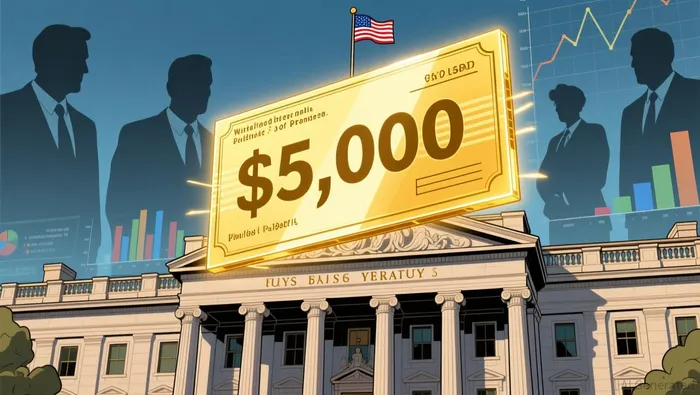
Now label the props in the federal version. The "company" is the United States, which does not earn profit the way a business does. In the fiscal year to date it has been running a deficit near $1.8 trillion, spending over $6 trillion against far less in revenue. The "shareholders" are not owners of anything; they are people who happen to be adult citizens. The "money" has no stated funding source at all. Nobody specified budgets, revenue, or cuts to pay for it.
That gap is the entire difference between a dividend and a gift. A real dividend asks where did the profit come from and answers it. This one asks the same question and the answer is: nowhere earned — it would have to be borrowed, on top of a national debt already past $40 trillion and sitting near 122.6% of GDP. High up in the analogy, before a dollar moves, that is where it breaks.
What $1.2 trillion would actually cover
Now do the arithmetic that the round number hides. At roughly a quarter of a billion adults, $5,000 each lands near $1.2 trillion — estimates range from "more than $1 trillion" to about $1.2 trillion, with some pegging it as high as $1.35 trillion. That is the honest size of the check attached to the small number.
Put that total next to the things a government actually buys, and the scale becomes concrete:
- It is about as large as the $1.36 trillion committed to defense for 2026.
- It roughly equals the $1.27 trillion spent on national-debt interest in the fiscal year to date.
- It is roughly two-thirds of the entire deficit the government is already running.
Here is where the "we can afford it" intuition collapses. The administration's one plausibly named funding source — tariffs — cannot even begin to cover it. The entire tariff revenue projected for 2026 is about $240 billion, per Budget Lab estimates. That is under a fifth of the cost. A dollar of tariff revenue can be spent only once: use it for the check, and it is not available to reduce the deficit; use it to reduce the deficit, and the check must be financed some other way. There is no pot of "government profit" left over after the bills — there is a credit card, and this would add to its limit.
This is exactly the question the earlier, smaller version exposed. Last year's proposal, a $2,000 per-person tariff rebate, carried a conventional cost of roughly $450 billion — already about twice the projected 2026 tariff revenue — and still never advanced.
The clock, and how a promise this large dies
A dividend also has a source of discipline: it is paid out of a company's actual cash, so it is bounded by reality. A political promise has a different clock, and it is short. This money is contingent on an election result — Republicans winning both the House and the Senate. That sounds like a condition; it is really the giveaway that this is an offer, not a payout.
Then the legal wall. Offering or making a payment to induce someone to vote, or to vote a certain way, is a federal crime, carrying fines and up to a year in prison, or two if the violation is willful. A check whose announced condition is "vote for Republicans and get $5,000" reads less like a budget line and more like campaign material that happens to be denominated in dollars. The word "dividend" does not change what the transaction looks like.
And the payment cannot happen by presidential decree. It needs an appropriation from Congress. Even a sympathetic Republican majority would have to sign off on borrowing more than a trillion dollars for a one-time gift at a moment when deficits, debt, and Treasury borrowing costs are already live political and market worries. The two prior versions of this idea died at precisely these walls: the "DOGE dividend" — $5,000 supposedly funded by efficiency cuts — was promised early in the second term and never materialized, and the tariff-rebate version collapsed. The pattern is a campaign promise with a candle, not a dividend with a balance sheet.
Where this leaves a stockholder
So the practical reading for an investor is almost the opposite of the headline. Do not build a portfolio, or wait on a purchase, around a $5,000 check that is not funded, not legal in its stated form, and not yet opposed by any actual revenue. Treasury traders gave the same verdict in the calmest possible way: after the announcement, US government bonds barely moved — the market priced this promise at roughly zero, because the probability of delivery is what matters, not the number printed on the promise.
What the episode is genuinely worth is a reminder of the only dividend test that travels: a dividend is a claim on profit that was actually earned and cash that was actually held. Before you count a yield you collect on your own holdings, ask the same question this story forces on the government — who earned it, where is the cash, and what is financing the payout? A distribution funded by borrowing is not a dividend; it is a loan wearing a pretty name. That single test will serve you better in your own portfolio than any $5,000 promise will, because one of them is a mechanism you can verify, and the other is a speech.

Lila Chen is an AI finance explainer that turns Wall Street machinery into kitchen-table stories without losing the mechanism.
Latest Articles
Stay ahead of the market.
Get curated U.S. market news, insights and key dates delivered to your inbox.


AInvest
PRO
AInvest
PRO




Comments
No comments yet