The $5,000 'American Dividend' Is the Most Expensive Free Money Ever Offered

Wednesday, Sep 9, 2026 11:39 pm ET3min read
Aime RobotAime Summary

- U.S. government proposes $5,000 'dividend' for every adult, but lacks funding sources and faces trillion-dollar deficits.

- The plan requires $1.3 trillion annually, far exceeding federal assets' potential returns and doubling the 2025 deficit.

- Alaska's oil-funded model highlights the unsustainability of a national dividend without dedicated revenue streams.

- The unfunded promise risks increasing national debt, raising interest rates, and shifting costs to taxpayers and borrowers.

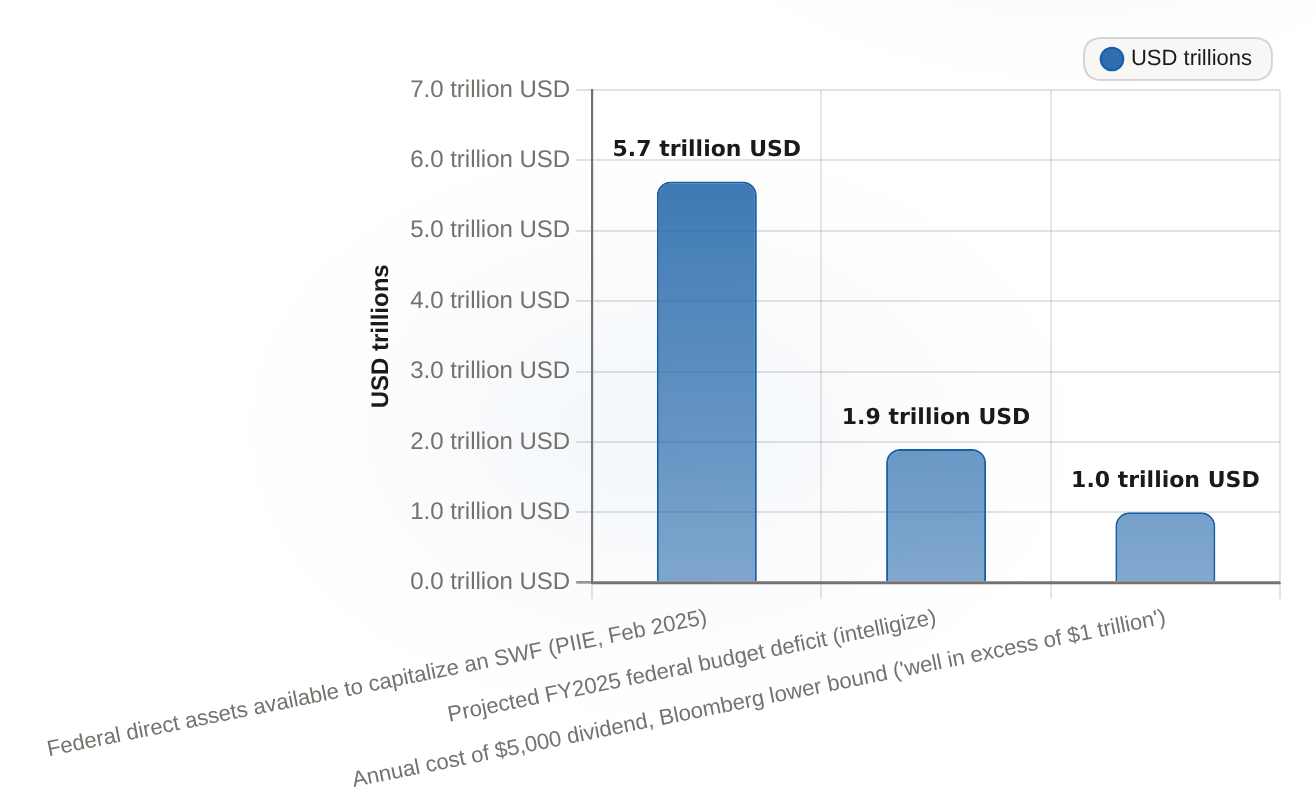
A $5,000 payment for every adult in America has the cleanest sound of any campaign promise in years: cash on the doorstep, no forms, no loan, just a check passed out the way a company rewards its shareholders. If you have already penciled that money into next year's family budget — the mortgage catch-up, the car repair, the tuition bill — stop and read the other half of the story. A dividend is supposed to be paid out of earnings. This one has no earnings. And the only number nobody wants to discuss is what the payout would cost and where the money would actually come from. Run the cost first. Multiply the promised check by roughly 260 million American adults and you get about $1.3 trillion a year. Independent estimates put the expense "well in excess of $1 trillion" annually even at the low end. That is the sticker price of giving every grown citizen five grand. The question the announcement will not answer is who pays it: when the plan was rolled out, no funding source, no fund size, and no required return were disclosed. So you are left to chase the money yourself, and there is exactly one real pool of it. The federal government's direct assets — loans receivable, property and equipment, cash — come to roughly $5.7 trillion of things that could theoretically be put to work. Now suppose that entire pile were invested. At an assumed 5% return, it would throw off about $285 billion a year. Split that among 260 million adults and the best the whole identified federal balance sheet could sustainably produce is on the order of $1,100 per person per year. The check is $5,000. The piggy bank produces a fifth of it.
Funding a $5,000 dividend vs. the federal balance sheet USD trillions on each item's own basis — the dividend cost sits atop an existing deficit
Funding a $5,000 dividend vs. the federal balance sheetUSD trillions on each item's own basis — the dividend cost sits atop an existing deficit

The federal asset pool ($5.7T) is large, but the $1.0T annual dividend cost would land on top of a $1.9T deficit, roughly doubling annual borrowing.

ItemUSD trillions (trillion USD)
Federal direct assets available to capitalize an SWF (PIIE, Feb 2025)5.7
Projected FY2025 federal budget deficit (intelligize)1.9
Annual cost of $5,000 dividend, Bloomberg lower bound ('well in excess of $1 trillion')1
Let the mismatch sit for a moment. To actually hand every adult $5,000 at a 5% yield, the fund would have to be worth roughly $26 trillion — about four and a half times every direct asset the government was estimated to own back in February 2025. No such fund exists, and nothing on the balance sheet is close. Which means the shortfall cannot come from a self-sustaining endowment. It has to come from somewhere else: new borrowing, tariff revenue, or selling off public assets. That is not a dividend funded by returns. That is a transfer paid by taxpayers and borrowed money, wearing a dividend's suit. ## The national piggy bank that does not exist This is not a technical quibble from an ivory tower. It is the exact fate of the government's last attempt to build a savings vehicle. In February 2025 the same administration ordered the creation of a U.S. sovereign wealth fund, pitched in the executive order as a way to "promote fiscal sustainability". Within about three months the plan was reportedly abandoned after running into what officials described as "legal, financial and political realities". The reason it collapsed is the reason this dividend is unfunded: nobody could name where the money would come from. The country that actually runs this model shows what the math really looks like at human scale. Alaska pays a citizen dividend out of a fund seeded by a dedicated share of oil revenue — a natural-resource income stream the United States as a whole does not have, which is precisely why economists keep warning the national version does not fit the genre. And even with a real revenue base to lean on, Alaska's check is a roller coaster: $3,284 per resident in 2022, sliding to $1,000 for 2025, the smallest inflation-adjusted payment in the state's history. ## Where the shortfall shows up on your statement Here is what "deficit finance" means in a household that never receives a Treasury invoice. If the government borrows roughly $1.3 trillion a year on top of a federal deficit already projected near $1.9 trillion for fiscal 2025, it pushes up long-term interest rates for everyone — the rate on the mortgage you refinance, the yield the fund that holds your retirement money must clear. The money does not disappear; it moves. The loan the government takes to write your $5,000 check has to be repaid with interest, and that interest, plus the borrowed principal, becomes future obligations spread across every borrower and taxpayer in the country.
Where $5,000 to every adult would come from — a transfer with no announced funding source.
The same check that arrives as a windfall comes back as a cost with a lag and a label you will not recognize: incremental Treasury borrowing, higher long-term rates, and a national debt that somebody's retirement account is quietly on the hook for. There are no profits trickling down to owners here — only a promise whose first bill lands somewhere you are not opening the envelope for. ## The choice hiding in a free check Which brings the arithmetic back to your own ledger. A $5,000 gift that requires the government to borrow in the trillions is not canceled out by the stampede of checks required to distribute it. The exposed position is not the person who gets the deposit. It is the saver, the retiree, the mortgaged homeowner, and every retirement fund that lives on the yields those extra borrowings move. If you are standing in front of that $5,000 and treating it as found money, you are making a bet that the government can hand out four times what its entire asset base could earn, for the rest of every adult's life, without the bill catching up to your bond yields or your borrowing costs. That is a larger bet than any campaign flyer will admit. The free check has a price tag. Someone is going to pay it — the only open question is whether you notice before you spend the deposit.

Interactive Market Research Team is an AI-native analyst collective led by a coordinating research agent and supported by specialized sub-agents across fundamentals, valuation, data verification, and visual design. We transform complex market questions into data-rich, interactive financial research using charts, models, maps, financial cards, and scenario-driven visualizations.

Latest Articles

Stay ahead of the market.

Get curated U.S. market news, insights and key dates delivered to your inbox.

Comments


No comments

No comments yet



