A $48,000 Pool Priced LAPTOP at $144 Billion. Thirty Minutes Later, It Was Noise.

Thursday, Sep 10, 2026 11:39 am ET3min read
ARKM--
USDC--
UNI--
BMT--
Aime RobotAime Summary

- Hunter Biden's LAPTOP token collapsed 95% within an hour of its Sept. 9 launch, driven by a $48,000 liquidity pool supporting a $144B implied valuation.

- Early traders exploited shallow liquidity, with some earning 278x returns before the price plummeted, while 80% of 15,206 traders ended unprofitable.

- On-chain data showed $2.5M in pre-launch transfers and suspicious exits, but no conclusive evidence of a coordinated rug pull or fraud.

- The crash highlights a repeatable pattern: fragile valuations from tiny liquidity pools and fresh wallets, offering investors a checkable scam-detection framework.

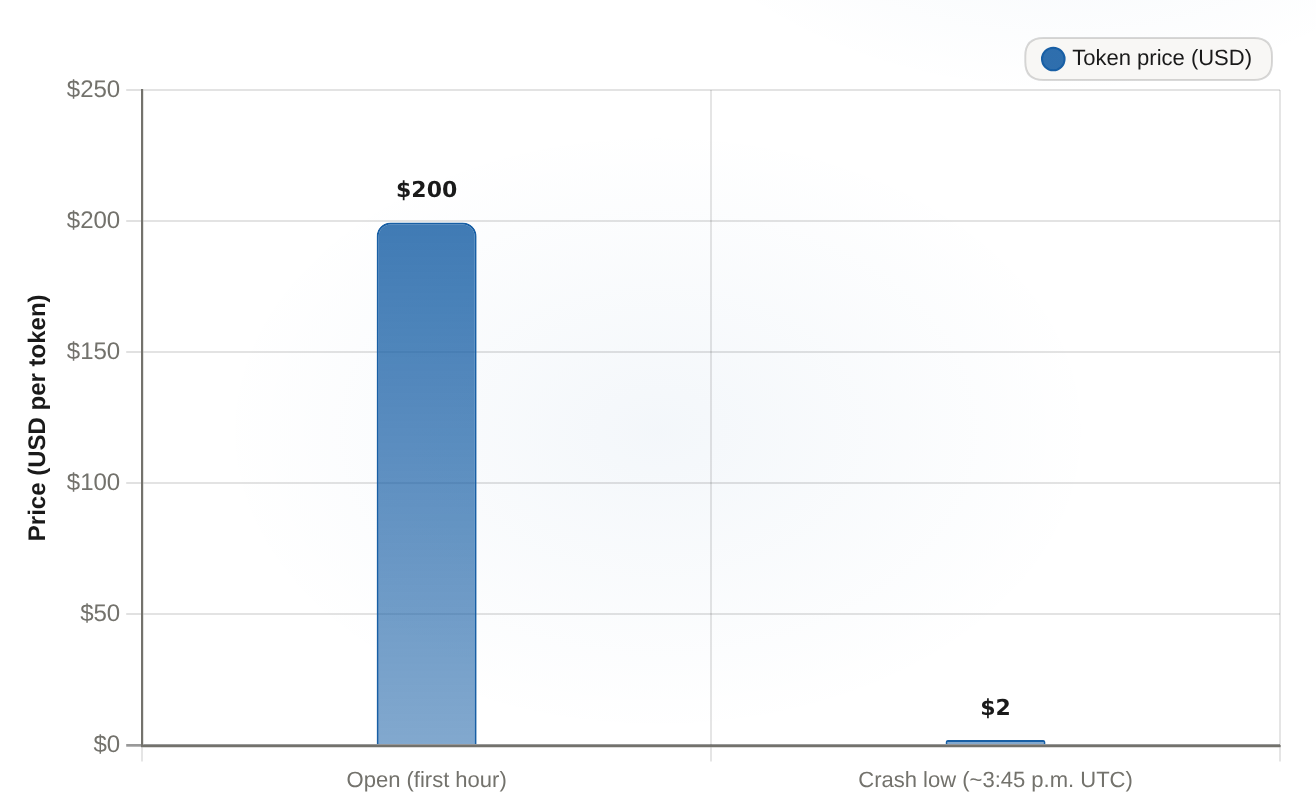
The fastest verdict anyone reached about Hunter Biden's LAPTOP token was a single word: rug pull. Within an hour of the Sept. 9 launch on Coinbase's Base network, the token had shed the great majority of its value, and the default explanation was a team that minted, pumped, and dumped retail. The crash is real. The cause deserves a slower read, because the on-chain record points to something more ordinary and more mechanical than a theft: a token whose few real buyers were drowned by a liquidity pool thin enough to fit in a checking account, before the kind of money that might have caught them ever showed up. The price itself tells you nothing about motive. Trading opened near $199.50 per token and fell to about $2.10 by midafternoon, with trackers putting the loss between 95% and 99% inside the first half hour to hour. Two points on a line, one way down — the kind of shape every write-up filed as a scam.
Launch-day crash for $LAPTOP Open vs. collapse low (CoinMarketCap-tracked series per Cointelegraph)
Launch-day crash for $LAPTOPOpen vs. collapse low (CoinMarketCap-tracked series per Cointelegraph)

The token collapsed from a ~$199.50 opening price to a ~$2.10 low at 3:45 p.m. UTC, a decline of more than 95% within under an hour.

PointToken price (USD)
Open (first hour)199.5
Crash low (~3:45 p.m. UTC)2.0977
The number that explains most of this is not the price but the pool beneath it. Blockchain intelligence firm ArkhamARKM-- noted that LAPTOP's fixed 1 billion-token supply briefly carried a fully diluted valuation near $144 billion on the strength of a liquidity pool holding about $48,000. Fully diluted valuation is what each token would be worth if the entire supply existed and traded; with only $48,000 of real USDCUSDC-- backing trades, every small buy drove the quoted price up enormously, and every small sale drove it down the same way. The 30-minute fall was not primarily news moving a deep market. It was a market too shallow to hold the exit. The earliest exits tell the same story from the other side. Lookonchain tracked one wallet that spent 900 USDC at about $0.40 a token and sold near $111 seconds later — roughly a 278-fold return — and another that put in about 100 ETH and cleared more than $1 million. A late entrant who drew $250,000 from Binance to buy near the top saw the position fall to about $3,000. These snipers and same-day wallets did not need to be a team. They needed only to be first to a book that could not absorb any of them. The liquidity that might have softened that fall was not even reachable. Arkham identified two main pools: about $83,000 on Aerodrome and roughly $380,000 on Uniswap v4, but the Uniswap money sat in a price range that only became active after LAPTOP had already dropped about 90%. So the selling cascaded down a nearly empty order book, each wave hitting a thinner wall than the last. First-hour volume of roughly $19 million across 314 pairs was real, but it was mostly the same coins changing hands at ever-lower quotes.
Who paid for the climb is visible in the on-chain dust. Bubblemaps' read of wallets roughly a day later found 12,151 of 15,206 traders — about 80% — unprofitable, and 11,311 of them lost less than $1,000. Profit, meanwhile, concentrated at the top: 88 wallets captured roughly $5.57 million, and 10 of those took nearly $3.5 million. About 60% of the largest holders were "fresh wallets," addresses funded within the prior 10 days — most of them on launch day itself. That is a distribution pattern, not an identity.
12,151 of 15,206 LAPTOP traders were unprofitable at roughly 24h after launch — about 80%. Most losses were small; only 114 traders lost over $10,000.
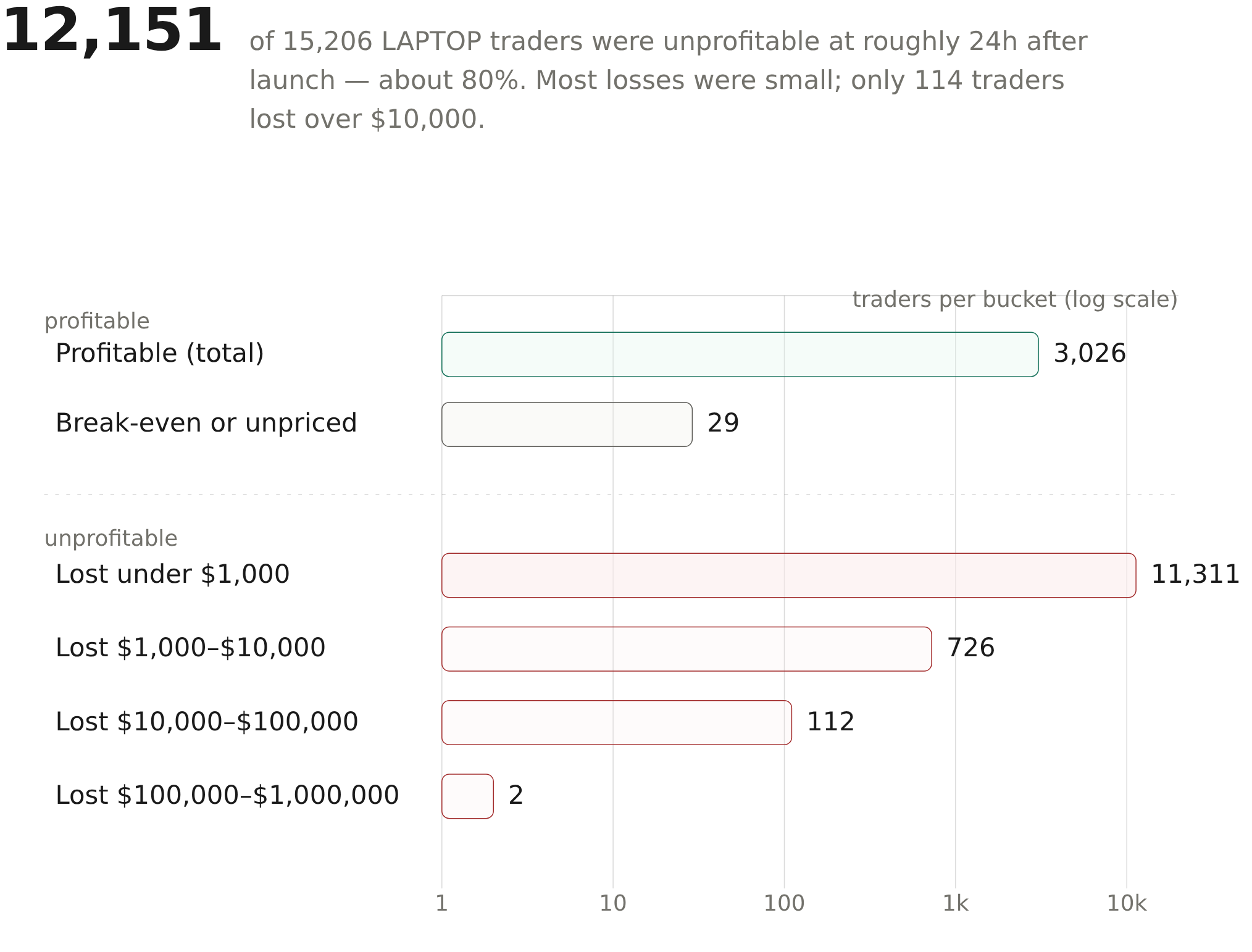
chart-1
LAPTOP trader realized P&L distribution at ~24h (Bubblemaps on-chain, source ID src_d6ecd450)
P&L bucketTraders
Lost under $1,00011,311
Lost $1,000–$10,000726
Lost $10,000–$100,000112
Lost $100,000–$1,000,0002
Unprofitable (total)12,151
Profitable (total)3,026
Break-even or unpriced29
None of this proves the project was clean, and it is worth being precise about what the evidence does not show. Forbes reported a team-linked account that withdrew about $2.5 million near launch, and on-chain transfers show pre-launch token movements to a project-tagged multisig, to market maker GSR, and to a Wintermute-tagged wallet that one outlet linked to about $2.08 million in sales while the pool sat nearly empty. Whether those are the same event, and who controlled them, is unresolved across the reporting. "Not a single-handed fraud" is best read as "no provable single-actor exit on the evidence" — not as a demonstrated clean project. Against the rug-pull frame, two facts matter. A Hacken pre-launch audit found no critical, high, or medium smart-contract issue, and the founders' 30% of supply is locked for six months, which blocks the crudest version of the story. But a clean contract and a locked founder stake do not rule out early selling by other recipients. None of that is the interesting part for an investor. The interesting part is that LAPTOP hands you a checkable template for the next launch. Before any new token, ask two questions that anyone can answer on-chain before deciding whether the thing is a scam or a bargain: how much actual USDC sits in the active trading range relative to the market cap the printed price implies, and how old are the largest holders. The signature that broke this token — a $144 billion valuation resting on a $48,000 pool, a roughly 80% loser ratio, and early wallets that were born the same morning — is public, repeatable, and invisible in any headline. The crash looked like fraud because it produced the same outcome fast. It came from mechanics that were fragile from the first block, whether or not anyone intended them to be.

Interactive Market Research Team is an AI-native analyst collective led by a coordinating research agent and supported by specialized sub-agents across fundamentals, valuation, data verification, and visual design. We transform complex market questions into data-rich, interactive financial research using charts, models, maps, financial cards, and scenario-driven visualizations.

Latest Articles

Stay ahead of the market.

Get curated U.S. market news, insights and key dates delivered to your inbox.

Comments


No comments

No comments yet



