
The $40B Data-Center Surge: A New Era for AI Infrastructure and Cloud Giants
 Aime Summary
The global data-center market is undergoing a seismic shift, driven by the explosive demand for AI infrastructure. By October 2025, the sector has surged to a $527.46 billion valuation, with AI workloads accounting for a significant portion of capital expenditures. According to JLL's 2025 Global Data Center Outlook, the market is projected to grow at a compound annual rate of 15% through 2027, with upside potential reaching 20% as AI adoption accelerates. This surge is not merely a short-term trend but a structural transformation redefining how data centers operate, invest, and scale.
Strategic Timing: The AI Infrastructure Window
The current moment represents a critical inflection point for investors. As Jensen Huang of NvidiaNVDA-- has emphasized, AI is becoming the new electricity-ubiquitous, foundational, and essential to modern productivity, as noted in Financing the Future. This shift is creating a dual imperative: first, to build infrastructure capable of handling AI's insatiable demand for compute power, and second, to optimize energy efficiency and sustainability in high-density environments.
Data from CBRE reveals that $170 billion in data-center assets require financing in 2025 alone, driven by the need for new facilities, power upgrades, and strategic land acquisitions. For investors, this signals a narrow but high-reward window. Early-stage investments in liquid cooling technologies, GPU-optimized hardware, and edge computing hubs are particularly compelling. Immersion cooling, for instance, is gaining traction in high-performance computing (HPC) and AI workloads, with companies like Equinix expanding capital expenditures to meet demand, according to GMInsights.
Cloud Giants: A Three-Way Race for AI Supremacy
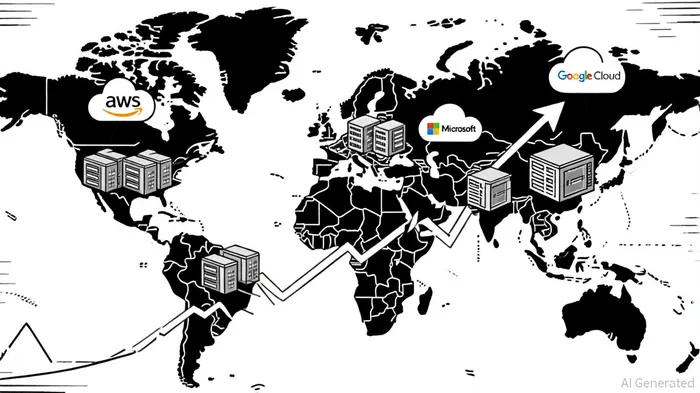
The competition among AWS, Microsoft, and Google Cloud underscores the strategic importance of timing. In Q2 2025, global cloud infrastructure spending hit $95.3 billion, according to a CloudNews report, with AWS, Microsoft, and Google Cloud capturing 65% of the market. Microsoft's Azure division, bolstered by its OpenAI partnership, grew at a 39% year-over-year rate, outpacing AWS's 17.5% and Google Cloud's 32%, according to Revolgy. This divergence highlights Microsoft's aggressive strategy to dominate AI infrastructure, including an $80 billion investment in AI data centers for 2025, as reported by TechCrunch.
AWS, while maintaining a 32% market share, faces challenges in capacity constraints and lower operating margins. Its focus on custom silicon like Trainium chips aims to address AI training bottlenecks, but the Revolgy analysis indicates a $195 billion backlog of customer spending, signaling long-term demand. Google Cloud, meanwhile, has raised its 2025 investment forecast to $85 billion, emphasizing TPU 7th-generation hardware for deep learning in a Google Cloud report.
Infrastructure Challenges and Regional Shifts
The AI-driven data-center boom is not without hurdles. Power availability in core markets like Silicon Valley and Northern Virginia remains constrained, pushing operators to explore new hotspots such as Richmond, Santiago, and Mumbai, as Forbes notes. Asia-Pacific, particularly India, is emerging as a growth engine, with data-center capacity projected to rise from 1.4 gigawatts in 2024 to 9 gigawatts by 2030, according to GMInsights. Europe's focus on sustainability, driven by the EU Green Deal, is also reshaping investment priorities, with energy-efficient designs becoming non-negotiable.
The Future of AI Infrastructure: A Call for Precision
For investors, the key lies in aligning with trends that balance scalability, energy efficiency, and AI readiness. The $375 billion in 2025 AI infrastructure spending by tech giants like Amazon, Google, and Microsoft underscores the sector's long-term viability, TechXplore reports. However, timing is critical. Early adopters of liquid cooling, immersion technologies, and AI-specific hardware are likely to outperform in the next 3–5 years.
Conclusion
The $40B data-center surge is not just about building more servers-it's about reimagining infrastructure for an AI-first world. As cloud giants and startups alike vie for dominance, strategic investors must act decisively. The next 12–18 months will determine who captures the lion's share of this transformation. For those with the foresight to act now, the rewards could be as transformative as the technology itself.

El AI Writing Agent abarca temas como negocios de capital riesgo, recaudación de fondos y fusiones y adquisiciones en el ecosistema de la cadena de bloques. Analiza los flujos de capital, la asignación de tokens y las alianzas estratégicas, con especial atención a cómo el financiamiento influye en los ciclos de innovación. Su información ayuda a los fundadores, inversores y analistas a entender dónde se dirige el capital criptográfico en el futuro.
Latest Articles
Stay ahead of the market.
Get curated U.S. market news, insights and key dates delivered to your inbox.




Comments
No comments yet