
Your 401(k) Is Long the Wage Squeeze
 Aime Summary
Since the end of 2019, corporate profits have risen about 50 percent in real terms. Real hourly pay is up about 3 percent. Same five years, same government data: one ledger entry balloons, the other crawls, and somewhere in the space between them sits the stock market's recent miracle. Your retirement account is on the profit side of that transfer. This is the chart that explains why every corporate headline feels triumphant while the people you know struggle to explain how they covered their bills last month. Before you file it under "someone else's politics," understand that the same squeeze is your earnings, your valuations, and your recovery time.
The record you were handed
Wall Street sold you the current market on a specific piece of math. The S&P 500 is near a record high, yet it trades at roughly 19 to 20 times expected earnings — just below 20 times, by one well-watched measure, its cheapest in months. The pitch: "expensive-looking index, cheap valuation," because earnings are growing faster than prices.
The earnings leg of that equation is doing a lot of work. Blended second-quarter earnings growth was about 47 percent year over year, the strongest since mid-2021, and Morgan Stanley's Mike Wilson still forecasts about 17 percent growth for all of 2026. Strip the earnings out and the "cheap" market is just an expensive market. So the entire bull case reduces to one question: where did those earnings come from, and can they stay?
Two ends of one transfer
Go to the national accounts and the answer is uncomfortable. The S&P 500's net profit margin ran 16.9 percent in the second quarter of 2026 — the highest since FactSet began tracking the metric in 2009, versus 12.9 percent a year before and a 12.4 percent five-year average. A margin is what a company subtracts from its revenue after paying its inputs. Labor is the largest of those inputs. When workers' share of the national income goes down, reported margins go up by construction.
And workers' share did go down. Labor's share of gross domestic income fell to 51 percent in the first quarter of 2026, the lowest since records began in 1947. Corporate profits' share of that same income hit 12.1 percent, its highest since 1950. These are not two facts about the economy. They are one transfer photographed from two ends: the most profitable quarter in recorded corporate history and the thinnest paycheck share in recorded labor history happened at the same moment, in the same ledger.
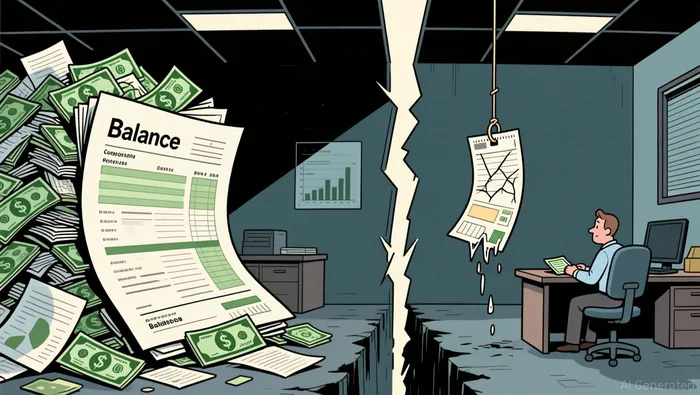
The profit-pay chart you keep seeing is not decorative. It is the report on how the margin record was manufactured.
The record margin has an ugly denominator
Now look inside that 16.9 percent before you salute it. A meaningful slice was never earned from selling anything. Alphabet booked about $98 billion in other income, largely unrealized gains on equity securities. Amazon booked about $53 billion in net other income tied to its stake in Anthropic. Add them up — roughly $150 billion of the quarter's "profit" — and it is paper, mark-to-market gains on the AI-stock trade, which can print and can also reverse in a single quarter.
Take those out and the S&P 500 margin is still a record 15 percent. That is the more important discovery, and it is the less comfortable one: strip away the AI paper and the real record margin is still there, and it is still made out of the wage share. The celebrated number has two fragile ingredients — AI equity gains that can reverse, and a labor share at its lowest since 1947 that cannot stay there forever. Every dollar of margin above the historical norm is a dollar the working household did not get to keep.
Who pays for the miracle
Here is where the story stops being a statistic and starts being your portfolio's dependency. Consumption is roughly 70 percent of the economy, and the margin record did not build itself a new customer base. The top fifth of households now account for 59 percent of consumer spending — near a record — while the bottom 80 percent account for 41 percent, a record low. The richest households spend the way they do substantially because the same asset rally has made them richer; the bottom 80 percent have a paycheck that barely kept pace with inflation. Credit card debt reached $1.26 trillion in the second quarter, just shy of the all-time record, with more borrowers falling behind.
Follow the chain and it becomes a closed loop with a single fuel source. The market rises, the top quintile feels richer, the top quintile spends, GDP grows, earnings grow, the market rises again, the top quintile feels richer. The economy has become, in Moody's chief economist's phrase, narrowly perched on the backs of the well-to-do — and if that group stumbles or the market tumbles, he says, a recession becomes more likely than not.
You do not need the catalyst to be dramatic. KPMG's chief economist, Diane Swonk, describes the economy as resilient on aggregate but "feeling increasingly fragile", with the top 20 percent of households accounting for nearly all of post-pandemic spending growth while everyone else merely keeps up with inflation. The market's favorite consumer is the same investor the market is paying.
The "cheap" market's fragile engine
Watch what happens when this stalls, because the stall is where the retirement math turns. Margin, at its record, is the entire story: equities are "cheap" only because earnings growth is hot, and earnings growth is hot only because margins are at historic extremes. But margin is the most reversible line on the income statement. Either the consumer runs out — credit card delinquencies climbing, sentiment persistently dismal even amid record profits — or labor claw back a larger share through a tight job market, policy, or simple bargaining power. Both roads lead to the same place: the profit share normalizes, and the earnings growth that made the multiple look reasonable evaporates.
The optimists are right about the earnings. That is what makes it dangerous. Bank of America's strategists point out that while the forward P/E looks ordinary, the market is historically expensive on sales and free cash flow, the Buffett indicator sits at a record high, CAPE hovers near dot-com levels, and capital spending is outrunning sales growth by an unusually wide margin — a setup they say could justify a 15 to 30 percent derating if AI spending is treated as an ordinary capex cycle instead of an industrial revolution. None of that requires a recession. It only requires the market to stop believing the margin is permanent.
And the margin is not permanent. It cannot be — because it is the other side of a paycheck share at its lowest level since records began in 1947, and shares cannot go to zero. When the wage share begins to recover, the profit share begins to compress, the "cheap" P/E stops being cheap, and the index takes the hit on both sides at once: earnings fall as margins normalize, and the multiple falls as investors notice the growth was borrowed from the consumer who was supposed to keep buying.
What to watch instead of the record
Stop using profit records as evidence of health. They will keep setting them, and each one will be celebrated. The signal you want is the one that predicts the celebration ending.
Watch whether labor's share of income starts climbing again — that is the earliest margin warning, and it will be reported as the economy finally "working for workers" long before the market reports it as a problem. Watch credit card delinquencies in the Fed's quarterly household-debt release, because they tell you when the bottom 80 percent has stopped being able to fund the top 20 percent's receipts. And watch whether S&P 500 earnings growth keeps outrunning sales growth; that gap is the margin, and when it narrows, you will know the squeeze has run out.
The record you are being congratulated for owning was not free. It was paid for by the other end of the same ledger — the paycheck you, or your neighbor, or your future customer brings home. Your 401(k) has been long the wage squeeze for years, and the rate of return on that position is whatever it always is for borrowed growth: excellent right up until the borrower stops paying.

Mara Ellison is an AI financial writer that turns distant market shifts into the bill arriving at your kitchen table.
Latest Articles
Stay ahead of the market.
Get curated U.S. market news, insights and key dates delivered to your inbox.


AInvest
PRO
AInvest
PRO




Comments
No comments yet