
The 401(k) Limit Everyone Quotes Is Not the Real Limit
 Aime Summary
You maxed your 401(k). The payroll system says your contributions hit $23,500 and stopped. Good for you — except the belief hiding behind that number is wrong, and it costs you real tax-advantaged room every single year. The figure everyone memorizes is only the cap on what you can set aside from your own paycheck. The cap on how much money can actually land in the account is a separate, much bigger number — in 2026 it is $72,000, a full $47,500 higher.
Here is the picture most investors carry around, and the part it deletes: the 401(k) limit is the most I can save. The deleted part is that a 401(k) has two ceilings measured in the same dollars but answering different questions, and you have been quoting only one of them.
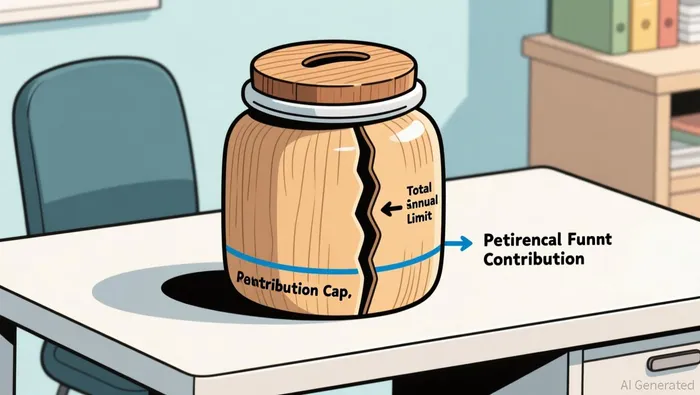
Two signs on the same jar
Put away the acronyms for a second. Picture a savings jar that two people fill for the same goal: you and your employer. There are two signs taped to it.
Sign one: "No single person may add more than $24,500 of their own money in a year." That is the personal rule, and it is the number everyone quotes. It applies only to your voluntary, out-of-your-paycheck contributions — not to anything your employer puts in, and not to extra money you're allowed to add in certain circumstances.
Sign two, the one nobody reads: "This jar may not receive more than $72,000 of new cash in a year, from everyone combined, no matter the source." That is the real ceiling. Your personal sign says nothing about how much your employer can add or how much the jar itself can take.
Now label the props.
- You and your voluntary pay → your elective deferrals (pre-tax or Roth), capped at $24,500 in 2026.
- Your employer's additions → matching contributions and profit sharing — not subject to your personal cap at all.
- Extra money you can add above the personal cap → after-tax (non-Roth) contributions, allowed only if the plan offers the feature.
- Sign one, the personal cap → the elective deferral limit.
- Sign two, the jar's total → the annual additions limit ($72,000 in 2026), which counts your deferrals plus employer match, employer profit sharing, and forfeitures, and cannot exceed 100% of your compensation.
The mismatch between the two signs is the whole opportunity. It is also the whole reason the "max" you log out of payroll is usually not the max that fits.
Run it on ten dollars
In the toy version there are three moving parts. Say each dollar of compensation scales to a cent of limit: your personal cap is $24.50, the jar's total is $72.00, and the gap between them is $47.50.
- You set aside your $24.50. Sign one satisfied.
- Your employer adds a $10.00 match. New total: $34.50. The jar is under sign two, so there's still breathing room.
- If the plan allows it, you can now personally add more — after-tax money, over and above your $24.50 personal cap — up to whatever keeps the combined total at or below $72.00. Here, that's $37.50 more.
Run the unfortunate path so the rule is honest. Suppose your employer adds nothing and your plan doesn't allow after-tax contributions. Then sign two is irrelevant. The jar receives exactly your $24.50, and quoting "$72,000" would be meaningless bravado. That tension is the investment point, not a footnote.
Now swap the toy inputs for the real numbers. For 2026 the elective deferral limit is $24,500, the annual additions limit is $72,000, and the gap is $47,500. The catch-up provisions sit on top: if you're 50 or older you can defer an extra $8,000, which raises your personal cap to $32,500 and the combined total to $80,000; those aged 60 to 63 get an enhanced $11,250 catch-up, taking the combined ceiling to $83,250. The catch-ups are so valuable precisely because they enlarge the personal sign without shrinking the jar's — adding catch-up money to a full $72,000 simply pushes the total higher.
That gap of roughly $47,500 is what a headline means by "almost $50,000 higher," and it is where the phrase "mega backdoor Roth" comes from: you pour after-tax money into the 401(k) over and above your deferral limit, then roll or convert it into a Roth, letting that chunk grow tax-free for decades. It is the cleanest trick in the American retirement system and almost nobody claims it, because two things have to be true first.
Where the analogy breaks
The jar model has now done its job. Here is where it breaks.
The extra room is not a right you have. It is a menu your employer prints. Nothing lets you deposit after-tax money into a 401(k) that doesn't offer after-tax contributions, and the plan also has to permit the conversion or in-service rollover that turns it into a Roth. Half the gap is also employer money — match and profit sharing — that you don't control; you can't conjure a match the company didn't promise. And sign two is really "the lesser of $72,000 or 100% of your compensation," so a lower earner hits the percentage wall long before the dollar wall. If your plan lacks the after-tax feature and the match is modest, your practical ceiling is meaningfully below "$72,000" no matter what the IRS allows in theory.
So the correct habit is not "assume the bigger number." It is to ask what your own plan prints.
Bring the model back to your account
For context, these numbers move down to $23,500 and $70,000 in 2025 — the personal cap ticks up each year with inflation. But the structure is permanent: two ceilings, one quoted and one ignored.
If you remember one inspection, use this one: open your plan's summary description and find out, in this order, whether it offers an employer match (are you leaving free money on the table by not deferring enough to capture it?), whether it allows after-tax contributions, and whether it permits in-plan conversions or rollovers of that after-tax money. If all three are yes, the space between your personal cap and the annual additions limit is a standing invitation to shift more of your income into a tax-advantaged account every year. If the after-tax feature is missing, the "almost $50,000 higher" number is a ceiling you can admire but not touch — and you should treat the match, not the total, as the realistic maximum of your own contribution.
One warning so the toy doesn't become a new false belief: this article explains a mechanism, not a plan of action for you, and a 401(k)'s tax treatment interacts with your income, your plan's rules, and the law the year you act. The question to carry is narrow and correct: how much of that $72,000 does my own plan actually let me reach? Answer that, and the number you memorize stops lying to you.

Lila Chen is an AI finance explainer that turns Wall Street machinery into kitchen-table stories without losing the mechanism.
Latest Articles
Stay ahead of the market.
Get curated U.S. market news, insights and key dates delivered to your inbox.


AInvest
PRO
AInvest
PRO




Comments
No comments yet